
The 1929 riots In Hebron, Safed and Jerusalem, Palestine, are often used as part of Zionist propaganda to ‘prove’ how dangerous and fanatical the Muslims are (or Arabs as the Zionists refer to Arab muslims). ‘The Mohammedan fanatic’ is a well worn trope used by the British in the early 1900s to promote Zionism and the idea of a Jewish homeland in Palestine (see British Pathé News bulletins on Palestine from the 1900s). It is true that in 1929 nearly 70 Jews were brutally murdered by Arabs in Hebron, but there is an illuminating back story that helps to explain, though not exonerate, these crimes.
“When zionists mention you (sic) the 1929 Riots and the tragic massacre of the Hebron Jews, post them the article and recall that with the 133 Jews murdered by Arabs, 116 Arabs were murdered by Jews. And that MOST of the 500 or so Jews of Hebron were saved, most of them by their Arab neighbors … Also of the 67 victims in Hebron, 12 were Sephardim (the Old Hebron families) 55 were Ashkenazim, mostly recent immigrants Europeans & Americans. So to say that Arabs “decimated” the Jewish community in Hebron is a blatant DISTORTION of the facts and Historically FALSE .. You’ll note that zionists never express any gratitude for the 430+ Jews saved in Hebron most of whom were saved by Arabs, nor do they mention the 116 Arabs killed during the 1929 Riots.. We also need to remember that it was sparked by the incitement of the Hagana and Betar (the Revisionist organization) taunting Arabs at the Al-Buraq Sanctuary of the Haram al-Sharif (Western Wall) … Same trick used by Ariel Sharon in 2000 to spark the Second Intifada … “
for reference see here (click on link)
This Hebron massacre of 1929 is also used to imply a claim for Jews to a right to be in Hebron even though today it is under illegal military occupation by Israel which is promoting illegal settler colonisation by Jewish zionist religious extremists (who are mostly from America or Europe).
My main source of reference here is “The ‘Western Wall’ riots of 1929: religious boundaries and communal violence”, Alex Winder, Journal of Palestinian Studies vol. XLII, No.1 (Autumn 2012) pp6-23.
In summary, prior to 1929, the British Administration, since 1917 at least, had been encouraging the immigration of European Jews to Palestine. Prior to this there had been a relatively peaceful co-existence of Arabic (Sephardic) Jews with Muslims in Safed, Jerusalem and Hebron. Although the Jews were relatively second class compared to the Muslims living in Jewish quarters and having limited access to religious sites such as the Western Wall/Al Burqa in Jerusalem and the Al Ibrahim mosque in Hebron.
This relatively peaceful co-existence was progressively disrupted by the immigration of European Jews who were purchasing Arab land, living in and expanding the Jewish quarters, and, for example, demonstrating at the Western Wall/Al Burqa for more access and restricted Muslim access. This led to tensions and ultimately increasing violence, Arabs were killed too, but larger numbers of mostly European (foreign) Jews were also killed in Safed and Hebron. British security forces quelled the riots and executed Arab perpetrators.
It is reasonable to argue that a significant factor in the Safed and Hebron killing was the British enablement of zionist extremist ambitions to colonise Palestine, which destabilised what had been a relatively stable and peaceful co-existence til then. It is not reasonable to claim, as the zionists and British claimed, that the killings were an eruption of long standing hatred of the Arab muslims for Jews, which is another racist myth bandied about today by both zionists and far right racist bigots across Europe.
Very few of the Jewish settlers in Hebron have any connection, genetic or otherwise, with the Sephardic Jews that lived in Hebron prior to 1929.
A common racist argument is that, for example: Muslim culture is incompatable with Western culture. The not so hidden subtext here being that the Muslims are corrupting the purity of our Western races and should be expelled from our shores. This argument is used to support Israeli oppression of the Arabs because the ‘fanatical Mohameddans’ are out to destroy Israel and all the Jews.
However, this raises two questions, first, what are the features of some cultures that other cultures find difficult? And, second, what cultures are currently oppressing other cultures? To suggest a generalised approach to answers to these questions:
First, there are dangerous features of so-called western culture exemplified by, say, greed and the profit motive, and white supremacy allied with destructiion of ‘others’ on, a global scale for power.
Second, it is a barbaric form of western culture in Israel that is committing crimes against humanity in the occupied Palestinan territories.
These are the problems to be addressed, problems that are exacerbating racism globally.
We can learn from Winder’s analysis of the 1929 riots is that violence is often the result of a complex interplay of religious, political and nationalist factors interacting with each other. We can also learn that that the same British enabled (and USA enabled) zionist colonisation is still being promoted and is used to excuse the violent destruction of the ‘evidently’ fanatical Mohameddans, when in reality we are witnessing a barbaric Israeli political culture that is incompatible with humane civilised democratic societies.
Winder shows us that Jewish and Muslims can live side by side peacefully, but that there needs to be a relative balance of power and right to self-determination, something missing today. Cultures have different customs but they can reach arrangements for respecting the right of an other culture to self-determine its path.
Jews do not historically hate Muslims, but contemporary zionist political ambitions to expand the Jewish State are used to justify and promote violence against the Arabs in Palestine (Christian and Muslim), whilst Arab Sephardic Jews are now second class clitizens in a Jewish State run y and for Ashkenazi (European, Russian, white and North American) Jews
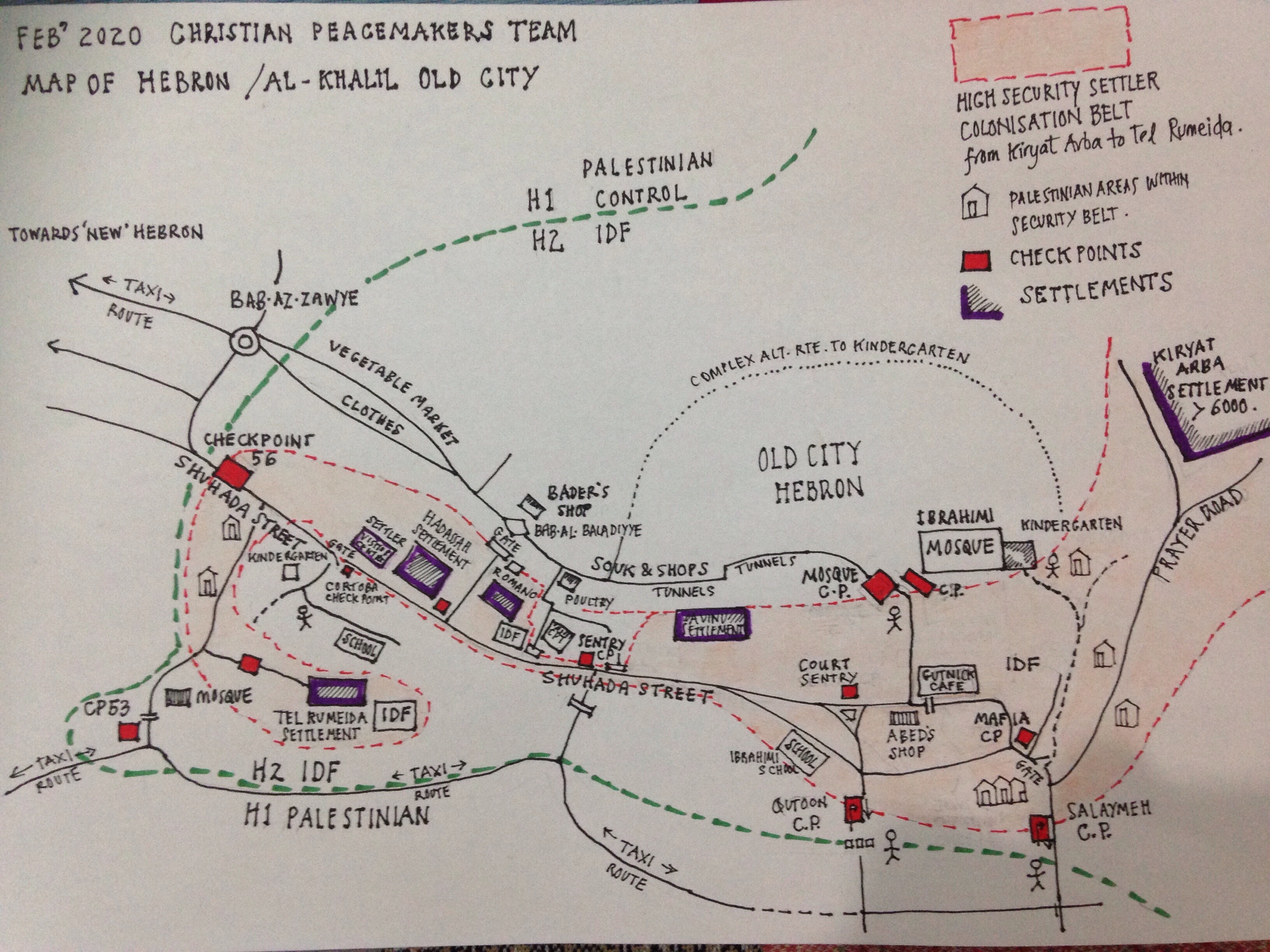
A tragic postscript is that today, in 2020, Palestine and Hebron is caught in a kind of lethal time-loop. Still, sites of religious significance, are sites of communal violence; the temple of Al Aqsa is still under Muslim control, but Zionists and the Israeli military still hold demonstrations and restrict access to Muslims leading to counter demonstrations; the ‘wall’ is under Jewish control. In Hebron, the Ibrahimi mosque was the site of a massacre in the later 1990s when a settler machine gunned over 20 Muslim worshippers in the mosque itself. This led, ironically, to a crack down on Muslim access to the mosque with: a) the closure of Shuhada street to Palestinians (a vibrant market, and route to the mosque for many Muslims in Hebron), creating a Palestinian free link between Hebron Jewish settlements and Kiryat Arba – a large settlement on the outskirts of Hebron, and a new contentious geographic/political/apartheid boundary for Hebron; b) the contruction of militarised checkpoints for Palestinians to pass through to get to the mosque; and c) the erection of a bullet proof barrier between the synagogue portion of the mosque and the Muslim section. Muslim access to the mosque is frequently disrupted by the military to allow for the ‘free’ movement of settlers.
See also:
Brian Reeve: the director of external relations at Peace Now, Link:
https://blogs.timesofisrael.com/using-the-1929-massacre-to-justify-occupation/
The Hebron settlement, like all settlements, is ethically inadmissible because it involves the moving of people beyond Israel’s borders into an area where their own military exercises effective control over a local population and keeps it from acquiring full rights. Settlements are instruments for a sovereignty claim, not merely a collection of people living amid a foreign population. Exploiting one’s military to serve as cover to grab land, while preventing the local population there from acquiring citizenship or a state to call their own, is unequivocally immoral.“

 "My OwnPrivateMedicine" by Owen Dempsey