Blog

  • The Mass Psychology of Fascism in the 21st Century – part 6 : The Sense of Place and Identity in Hebron

    Fascism is racist, and settler colonisation with ethnic cleansing breeds hatred and more racism. This is one of the features indicative of fascism.

    OCHA has recently produced an excellent summary of the deteriorating situation in Hebron.

    In Hebron a city of 200 000 there is the Old City of 30 000, where there are religious sites coveted by Zionist settlers, these under military cover are slowly but surely helping Israeli policies of geographic Israeli expansion through settler colonisation.

    Today, 5th Feb 2020, with CPT(Christian Peacemaker Teams). we went to a checkpoint in the Old City Hebron, within H2, an area of 30,000,under Israeli military control, to monitor Palestinian children, adults, and teachers on their way to school. They have to pass through these checkpoints – horrible cages with turnstiles, cold concrete, barbed wire and cameras.

    We record the numbers of children and incidents of body and bag searches, delays and denials, and other kinds of abuse. The children have never known any different. This is a scene that the unaccustomed observer (especially) will struggle to empathise with or make sense of. We, the foreigners with passport privilege, free to leave this land at any time, can have no idea of the real impact of these checkpoints on the Palestinians.

    This February morning, it was cold, and many children were going to school. After an hour, the last six boys were kept waiting for over 20 minutes and then the boys, waiting in the shade by the turnstile and no doubt cold, gave up and just turned back the way they came, away from school. No education for them today – effectively denied entry to their education by soldiers.

    This was just one ripple of abuse, denial of human rights, among so many ripples spreading through the Palestinian community far and wide.

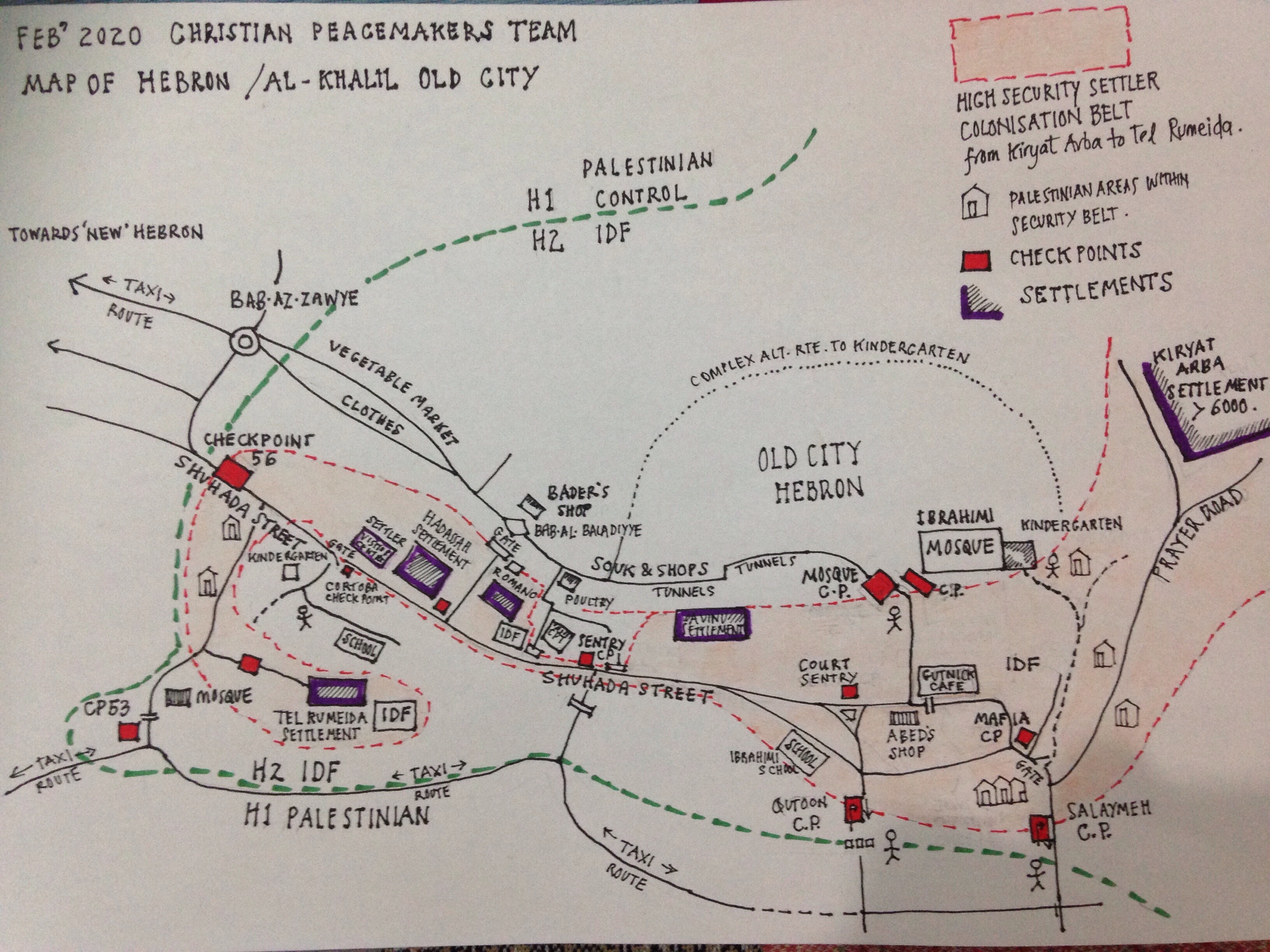
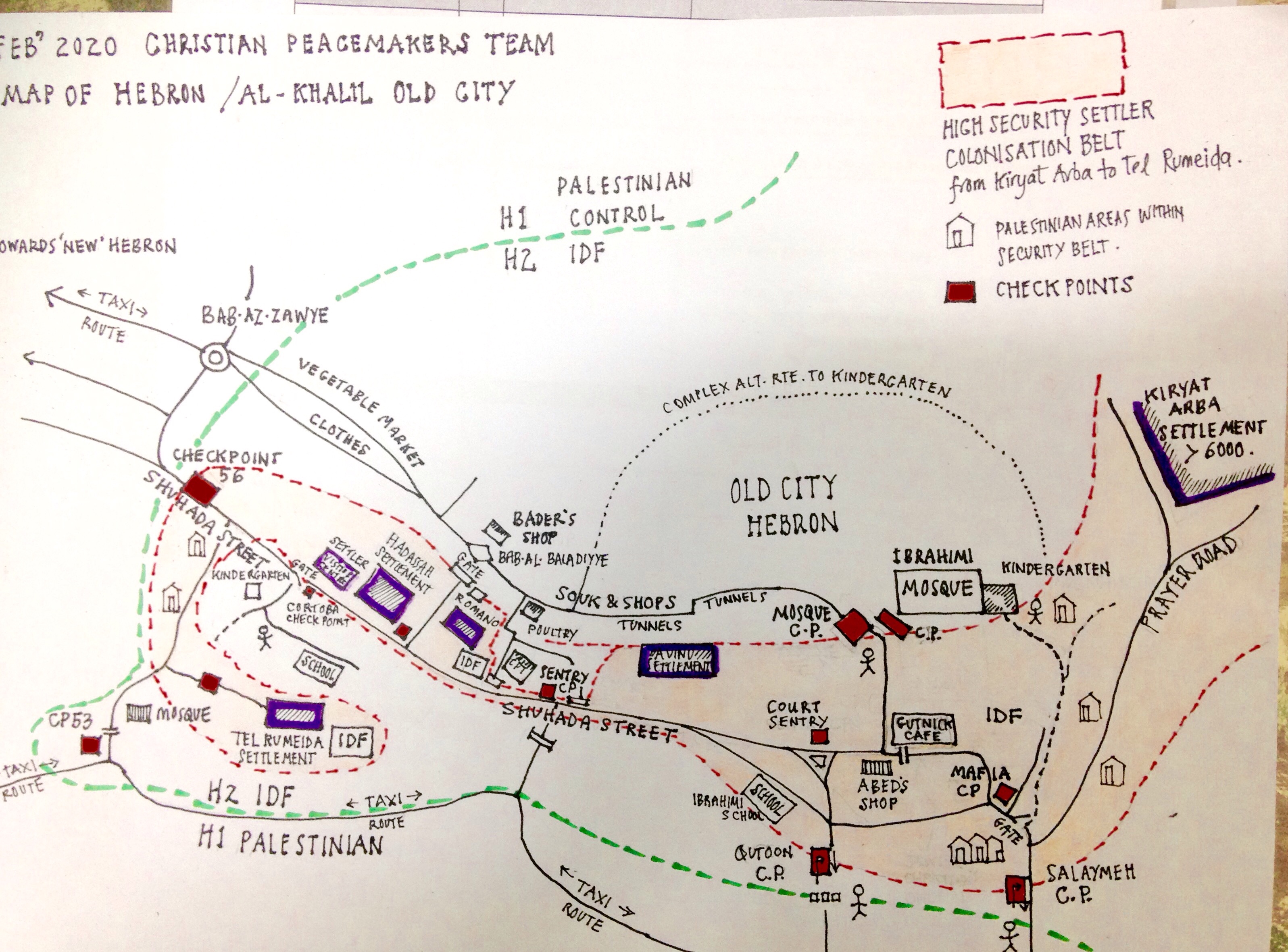
    This check point is a barrier between settler-free Palestinian territory, to the south of the Old City, under Israeli military control. and what might be called a settler colonisation corridor (from Tel Rumeida to Kiryat Arba), that runs in a heavily policed curve south of the Old City, following the line of Shuhada Street to the west, and up to Prayer Rd to the east. To the north of this corridor are further checkpoints separating the settler corridor from the Old City.

    The geography is extremely complex. A balanced community has been invaded by a malignant poison and this corridor is a poisoned place, poisoned by Zionist nationalism.

    Map showing a central settler-colonisation security/apartheid belt; secured by heavily armed military checkpoints (red blocks).

    Within the corridor lies Abed’s shop, owned by Palestinians who have lived here for generations. It lies smack bang in the middle of this apartheid corridor.

    Some Palestinians live and work within this poisoned place. The idea of a poisoned place has been written out before. For example see here

    By Edward Relph:

    “I have written about these pathologies of place attachment [and poisoned places] … This is the result when sense of place turns sour and becomes exclusionary. Much of what is positive in sense of place depends on a reasonable balance. At one extreme, when that balance is upset by an excess of placeless internationalism the local identity of places is eroded. At the other extreme, when that balance is upset by excessive commitment to place and local or national zeal, the result is a poisoned sense of place in which other places and people are treated with contempt.”

    In its extreme forms, … it is revealed in ethnic nationalist supremacy and xenophobia.”

    It looks and feels to me, actually being here, as if the Palestinians living here have been exiled to a poisonous place, a place poisoned by settler colonialism. But nonetheless they are desperately holding on to their home and heritage, trying to hold onto their identity and sense of this poisoned place.

    It is especially difficult for non-Palestinians to understand what is going on. or the thoughts and feelings of Palestinians. There are two opposing dangers, first, that we remain too aloof and detached or unfeeling treating the situation as a novelty, almost a tourist attraction, second, and by contrast, we could assume too much ‘as if’ we could ever know.

    One way for non-Palestinians to approach the situation could be through Palestinian culture: writing, poetry, art, cinema. To this end I’ve included here a poem that we read together this morning at our morning reflection the day after a 17 year old boy was brutally shot dead by the IDF, for throwing stones. We cannot over-emphasise the barbarity and fascist features of this extreme Israeli Zionist nationalist and expansionist programme.

    Through the words of Mahmoud Darwesh, a famous poem “Identity Card” written when he was only 24, and read by him in Nazareth in 1964, to a tumultuous reception.

    Identity Card

    Mahmoud Darwish – 1964 aged 24

    First read in Nazareth to a tumultuous reaction

    Write down!

    I am an Arab

    And my identity card number is fifty thousand

    I have eight children

    And the ninth will come after a summer

    Will you be angry?

    Write down!

    I am an Arab

    Employed with fellow workers at a quarry

    I have eight children

    I get them bread

    Garments and books

    from the rocks..

    I do not supplicate charity at your doors

    Nor do I belittle myself at the footsteps of your chamber

    So will you be angry?

    Write down!

    I am an Arab

    I have a name without a title

    Patient in a country

    Where people are enraged

    My roots

    Were entrenched before the birth of time

    And before the opening of the eras

    Before the pines, and the olive trees

    And before the grass grew

    My father.. descends from the family of the plow

    Not from a privileged class

    And my grandfather..was a farmer

    Neither well-bred, nor well-born!

    Teaches me the pride of the sun

    Before teaching me how to read

    And my house is like a watchman’s hut

    Made of branches and cane

    Are you satisfied with my status?

    I have a name without a title!

    Write down!

    I am an Arab

    You have stolen the orchards of my ancestors

    And the land which I cultivated

    Along with my children

    And you left nothing for us

    Except for these rocks..

    So will the State take them

    As it has been said?!

    Therefore!

    Write down on the top of the first page:

    I do not hate poeple

    Nor do I encroach

    But if I become hungry

    The usurper’s flesh will be my food

    Beware..

    Beware..

    Of my hunger

    And my anger!

    Anger, of course, but violence may well breed more violence. A dilemma, since Identity seems to demand a forceful response. Youths throw stones and are shot: people demonstrate peacefully, and are shot. The State of Israel wants and needs violence, to brutalise its own population, to cement an Israeli identity in thrall to a fascist hatred of Muslims and Christians in Palestine.

    We should note that Israel’s extreme nationalist colonialism is a form of ethnic cleansing and incremental genocide. Racism is a feature of fascism.

    These places that we monitor are poisoned places breeding and perpetuating xenophobia and fear and distrust on all sides, and note clearly that this cycle of hate is being triggered here by US/UK/NATO and even Gulf State backed Israeli invasion, settler-colonisation, and expansion

  • The Mass Psychology of Fascism in the 21st Century – part 5

    The battle with the unconscious and the mass psychology of fascism.

    One fascism leads to another.

    In the film ‘It Happened Here’ – a fictional and brutal account of a post Second World War Britain under Nazi occupation and a violent British partisan resistance – many Brits are portrayed accepting of the ideology of the Nazi fascist racism, and co-operating even with the killing programmes within Britain for East Europeans, the disabled and the elderly.

    This phenomenon, the oppressed cooperating with, and even identifying with, the brutality of the oppressor is played out again in Philip K Dick’s novel The Man in the High Castle.

    In this novel, whilst under Japanese occupation in San Francisco, Robert Childan, a North American, experiences and displays the multi-layered complexity of the way fascism self-perpetuates. At a meal with two younger liberal minded Japanese who implicitly question the ideology of Nazism, Childan is at first subservient, and even obsequious in his attempts to, at least, not upset his hosts, but this seems to be in bad faith, that is, his identity is of a man oppressed, and who knows it, but acts as if he isn’t. Then, he blurts out an obviously anti-Semitic sentiment: if the Nazis and Japs has lost the war then the world would be controlled by Jews – an idea that he has absorbed, perhaps, from Nazi propaganda, a sentiment which visibly ‘chills’ his Japanese hosts. At which point he, in good faith it is implied , at least now, embraces his own white supremacist identity which thinks of his young Japanese hosts as little more than subhuman, ‘monkeys’ with good memories and imitation skills, but no genuine critical facilities. Because he thinks this in (apparent) good faith, these thoughts seem to be self-fulfilling and reinforce his white supremacism and he leaves his hosts house full of his (racist) self-confidence.

    This is actually a vivid portrayal of a racist psyche at work from a man living already under oppression himself.

    And, the young Japanese that he is invited to dine with portray voices of quiet resistance to fascism as they describe the banned book The Grasshopper Lies Heavy which reimagines a world in which the Nazis and Japan lost the war.

    Fascism breeds fascism, oppression by fascism itself can breed fascism. Even those oppressed by fascism can work to support and sustain fascist ideologies.


    This is subjectivisation at work; the formation of a subjectivity (identity) by its subjugation to its objectivisation. A process described by Foucault who perhaps maintained this was done in full consciousness and explained by Lacan who attributed it to a capacity to make unconscious certain meanings in order to create an identity dependent on incompatible meanings.

    Today, it is possible we see the same phenomenon being played out in Israel and its apartheid (racist) so-called Jewish State and the occupied territories. Though I hasten to add that many Jews globally disapprove strongly of the Zionist concept behind such as state.

    The Jews, victims of the European Holocaust in the twentieth century, were oppressed by Nazi fascism. This may have inculcated or at least incited a reactive xenophobia, directed toward the Muslims in the Middle East, as some sought to invade and colonise Palestine. Now, it is the oppressed who have become the oppressor. Have the extremist racist political and religious zionists embraced the proto-fascist identities of their Nazi oppressors? It is good to colonise, to create Y’Israel, or so the 2018 Israeli Nation State Law proclaims. But this ideology is incompatible with caring with love for the indigenous natives of Palestine, the Arab Muslims and Christians and the Bedouin. The Palestinians, like Childan’s Japanese in Dick’s novel. are not valued as human but as ‘vermin’, as existential threat, to be despised. feared and destroyed.

  • The sense of place in Jerusalem: 2020


    The governed and the governors, the pull and (non) sense of place under occupation.

    In Philip K Dicks’ The Man in the High Castle, a post 2nd world war scenario is described played out that has contemporary relevance to life under military occupation in Palestine. In the novel the Nazis and Japan have won, the USA has been divided, with a settlement line, between a Japanese controlled West Coast and Nazi controlled East coast and New York, with ‘white’ Americans (not note the indigenous natives who no longer exist) holding second/inferior ‘place’, culturally, socio-economically, and generally hierarchically.

    Just as in the occupied territories in the novel, in Jerusalem the sense of this place is strong: feelings associated with knowing your place, knowing the correct codes of behaviour, the conscious efforts to be, of at least appear, neutral or subservient, to conform, and of mis-steps, faux-pas, failures of integration, and humiliation; these are all subtly played out in the early part of Dick’s novel, through the experiences of both the governed and the governing.

    ‘Place pulled’ is describing something that happens to you when the normality of your place in say a symbolic order, or social systems is momentarily disrupted, it is a phrase used by Dick. This refers to the pull to know your place: the feelings associated with sudden awareness of the way your identity (and place) is being imposed as you are pulled into place by a political order, and its assumed, if unwritten, codes and norms.

    Walking through the Old City of Jerusalem today, from Jaffa Gate to Damascus gate through narrow souks, the sense of place pulls, and is discomfiting for me, since visitors like us don’t know our place. The codes, and boundaries: geographical, ethnic, religious including costume and dress boundaries are visible; but even though the boundaries of communal violence and power are there, and sensed they are ill-defined, harder to see or experience.

    Two young Israeli soldiers/police (armed with machine guns), a young male and female, at a road junction in the market of the souk, stop two young Palestinian men aged about 16 and 12. The female soldier demands, with hand outstretched, and then takes, the older boy’s identity card and proceeds to hold it up and to slowly scrutinise it. The delay is palpably too long, too deliberate, imposing ‘place’ by force on the youngsters ( who are, we should notice, living in their home town under this military Israeli occupation). We stop and observe, trying to make our presence felt as if we can exude disapproval of this apparently random and deliberate intimidation of the governed by the governing.

    Along the narrow streets throng guided groups of Russian Christians each holding a crucifix as they file along the Via Dolorosa – reputedly the route Jesus took bearing the cross to his crucifixion – the way becomes congested as group of Jews in black garb, fedoras, kippahs, white shawls, and beards, some humming musically, are walking presumably away from praying at the Western Wall. And all these groups are marching past stalls, some Muslim, selling spices, incense, food juices and shoes, some Christian selling crucifixes, and, somewhat bizarrely, IDF (Israeli military) t-shirts.

    The Jews going about religious business impose place by walking through territory illegally occupied by Israeli military and imposing something hard to define on the governed.

    The Christians in religious trance-like fervour through their mysticism seem to filter out concepts of injustice and by so doing appear condone the injustice. Not, we might at least suggest, that the Jesus of the New Testament, would remain silent here.

    As a visitor here, the spectacle is experienced sensually but only superficially. We are welcomed, but I also sense less warmth, more tension than when I was here three years ago.

    An armed soldier stops us – it is closed- ahead is an exit out of the market – what’s up there? The Temple Mount. Is it closed to everybody or only open to Muslims. A perceptible pause. He may be a Palestinian policeman. In blue, Israeli soldiers stand nearby, in grey . Only Muslims, he says, the entrance from the western wall is open tomorrow. Well, that’s all clear then. Israeli controlled Soldiers/Police control access to the Al Aqsa mosque calling it The Temple Mount (the Jewish name) for Muslims only. This is a site of place, of communal boundary and, today, polymorphous symbolic violence – armed and religious.

    The religious devotions of the crucifix and ostentatious dress of Jews and (especially Orthodox) Christian clergy, is a display of mysticism, of derangement that, in my view, functions to distract many from the injustices being imposed here.

    In Dick’s dystopian novel the Japanese have imported a habit – the use of something like tarot cards and the I-Ching, to act as a kind of oracle to consult and guide decision making. This is another mysticism, a way for people to seek relief from the constant neurotic anxieties associated with either a) knowing one’s place is of the governed, or b) of not quite knowing one’s place, or c) of fearing losing one’s place as the governors.

  • Who will defend the defenceless? Fascism in action in Israel in 2020.

    This is a copy of an article posted by Amos Gvirtz an Israeli Jewish Peace activist who works tirelessly to reveal the incremental ethnic cleansing of the Bedouin in the Negev in Israel who are being hounded out of their homes and encampments into desperately cramped and poor special ‘townships’, to make way for Israeli Jewish owned settlements and roads and factories.

    This is apartheid and incremental genocide in action in Israel. The Bedouin do not have protection of their rights under the Israeli Nation State Law.

    Is this fascism? It has features of proto- or what Eco calls ur-fascism: it is racist, it is nationalist and uses mythic origin stories (eg the Bible) to justify actions, it is right wing as it exacerbates social inequalities as if they are necessary and just.

    WHO WILL DEFEND THE DEFENSELESS?
    By Amos Gvirtz 

       Throughout Israel’s existence its various governments have regarded members of Israel’s Bedouin population as undesirable citizens: after initially expelling most of them from the country, the state concentrated those that remained in the Sayag area and after that in townships.
       In 1948, most of the Bedouin who lived in the Negev were deported in the “heat of the battle” during the War of Independence. Deportations continued until 1959. After the establishment of the state, military rule was imposed on the Bedouin, as on all other Palestinian Israeli citizens. The military government gathered most of the Bedouin remaining in Israel into the Sayag area (south of the West Bank), confiscated their lands (of those who removed from their places) and restricted grazing areas for their sheep. Declaring firing zones was another way to close off large areas of grazing land.
       The state did not recognize the Bedouin villages – neither those in the Sayag area that predated the founding of the state, nor those created by the government to house the Bedouin who were transferred there. The refusal of the Israeli authorities to grant recognition to these villages rendered all building within them illegal by definition, and turned the Bedouin themselves into reluctant criminals.  The lack of recognition and of any master plan precluded the possibility of building legally in the villages. An unrecognized village does not even receive water, electricity or municipal services from the government.
       The state exploits the fact that most Bedouin did not register ownership of their land with the Tabu (Ottoman Land Registration), preferring instead to rely on traditional land ownership practice. It is important to remember that Jews, who purchased land from the Bedouin before the establishment of the state, did so in accordance with traditional customs.
       At the end of the 1960s the government began implementing its policy of transferring the Bedouin of the Negev to the townships. Presently about 60 percent of the Negev’s Bedouin population lives in these townships. In order to “encourage” the remainder to move, their houses are demolished – after all, they have been illegally constructed; crops are destroyed – the state claims that the land is not theirs to cultivate; they are denied water and electricity (in some of the villages a connection to the water supply was installed but it was left to the residents themselves to connect it to their homes); and there are no municipal and health services. Under these conditions, Bedouin who are determined to continue living on their land in keeping with their traditions, are criminals in the eyes of the law. This is criminalizing the victim. Only by capitulating and moving to a township can they acquire legal status.
       Even the peace agreement with Egypt was used as a pretext for further expropriation of Bedouin land in the Negev, forcing thousands of Bedouin to move into the townships when 120,000 dunams of Bedouin land were confiscated in order to make way for military bases.
       There are currently seven Bedouin townships in the Negev. They have the highest rates of unemployment, the most severe levels of poverty in the country and the highest crime rates, reflecting the abject failure of the government to fulfil its obligation towards its citizens. But have no fear, failure does not deter the government from pursuing its policy of concentrating the Bedouin in townships. After all, the townships are the smallest area into which these undesirable citizens can be crammed. On the other hand, under populated Jewish settlements are springing up and flourishing in the Negev (“solitary farms”) whose residents enjoy support from, among various other sources, the government, the Jewish Agency and the Jewish National Fund. Only the Bedouin farmers of the Negev have been targeted for removal to the townships which suffer from high rates of unemployment and crime.
       Since the beginning of the 2000s efforts to forcibly remove the Bedouin from their villages and into the townships have escalated with many and various mechanisms being devised to achieve this objective: besides demolishing houses and destroying grain crops, the JNF plants forests in the Negev to prevent the Bedouin from returning to their land, and also as a means of demolishing villages. To date two villages have been completely flattened (Al-Araqeeb and Twail Abu Jarawal) and there are plans to demolish the village of Atir as well.
       Another method used to forcibly displace populations is to plan a Jewish settlement on the site of a Bedouin village. For example, the Jewish town Hiran is being built on the ruins of Umm-al-Hiran (which is in the process of being evacuated). There are plans to establish Jewish settlements on the ruins of other villages which are marked for demolition as well. 
       Building new roads – without any consideration for existing villages, let alone for their benefit – are also used as justification for demolishing homes and expelling Bedouin from their villages. Highway 6 was planned so as to necessitate the demolition of hundreds of Bedouin homes and transferring their occupants to the townships. Similarly, this approach also guides the planning of factories and military industries: destruction, expulsion and devastation for hundreds of families. Plans to build a phosphate mine on the site of the Bedouin village al-Fur’ah will result in the forced displacement of its inhabitants.  Fortunately, Arad (the Jewish city) has raised objections to the projects because of potential air pollution in the city.
       And to add insult to injury, the Kaminitz amendment to the Planning and Construction Law was passed by the Knesset. Now it only remains for the victims to be forced to demolish their own homes, or bear the costs incurred by the authorities in their demolition. And so, the number of demolitions of Bedouin houses in the Negev has risen dramatically since the amendment to the law was passed, to more than two thousand a year! On top of all this, refugee camps are being planned for the victims of this policy of expulsion, making caravans available as “temporary housing” for the evacuees.
       The policy of the Israeli authorities towards the country’s Bedouin citizens seems to suggest that the War of Independence has never really ended in the Negev. The Israeli government is still trying to create internal refugees and is waging a unilateral war against defenseless citizens. The police have set up the Yoav Unit for the express purpose of ensuring that the government’s policy is enforced.
       This begs the question: “Who will help the defenseless?” It is generally assumed that citizenship offers protection to citizens. But what happens when citizenship withholds protection? Where is the civil rights movement in Israel? Where are the civil rights movements in the rest of the world? And perhaps we have to appeal to the United Nations and ask for defense for the defenseless?1

  • The Mass Psychology of Fascism in the 21st Century – part 4 – The Parable of the Sower

    What can we learn from ‘The Parable of the Sower’ by Octavia Butler

    A reading of the parable of the sower by Octavia Butler, Headline Publishing Group, London, 1993

    The story begins in 2024, somewhere in California, in a disintegrating world, in a walled community hanging onto a Christian faith and patriarchal family structures, and beset by wild terrorists beyond the wall.

    Eventually, as their village is invaded, and eventually burnt to the ground, our heroine is forced to leave, and begins to set in place her mission, her philosophy, gathering a primitive group around her as they wend their way north through a war-torn, violent and dangerous landscape.

    To begin with I will outline a surface reading, an interpretation of what Octavia Butler’s novel appears to be saying, on the surface, as if self-evidently or obviously; and then I will provide a different, darker, interpretation.

    To foreground this let me quickly summarise: first, the surface reading is of a feminist heroine about to rescue humanity from its self-destruction by founding or at least aspiring to found, a community, ‘Earthseed’, in the stars, with a philosophy of Truth or God is ‘Change’ and that human action will change that Truth for the better.

    God is Power – Infinite, Irresistable, inexorable, indifferent, And, yet, God is pliable, Trickster, Teacher, Chaos, Clay. God exists to be shaped. God is Change.

    page 24

    Then, second, we have a deeper reading: that of a charismatic cult leader, aloof from the rest of humanity because of apparent special hyper-empathic powers, who has a kind of second-sight, a vision of a humanity and brotherhood in the stars, who, alone, knows how this should be organised, and who gathers a group of followers/believers, in ways that, I suggest, are characteristic of early cults, religions, or fascism.

    By fascism here I draw from Umberto Eco’s analysis, and mean a social structure that: a) has a glorified figurehead of some kind; b) with special powers and insight; c) a myth around that society’s origins; d) of a collective aspiration to restore that society’s former glories even at the expense of the individual; and e) in ways that are racist and demonise real or imagined threats outside of that society.

    Some aspects of the story are reminscent of Kroptkin’s writings on anarchic communism, the dangers of the national State, and patriarchal authoritarian family structures. So, on one level, this novel is a story of an enforced new primitive settlement, an embryonic tribe or clan, with issues of governance, authority, trust, reciprocity, responsibility. generosity, and suspicion, being played out within the group.

    Right from the start there are clues to an ongoing corporatised or State-like wider control, with the existence of increasingly disenfranchised, but still patriarchal and authoritarian communities:

    This morning’s sermon was on the ten commandments with extra emphasis on ‘Honour thy father and they mother’

    page 88

    In the story these communities are barely surviving behind increasingly fragile walls, protecting them from increasingly desperate ‘lumpen’, those no longer part of any distinct community structure but instead lawless, drugged, and terrorising wherever and however they can.

    Following the eventual invasion and destruction of our heroine’s village our primitive group has come together by chance ; and they are making their way north to what they hope will be safer territory. This is how we might imagine the experiences of a family, even today, fleeing oppression and warfare, as refugees, making their way through a war-torn landscape full of bandits.

    ‘People get shot every day trying to get into Canada. Nobody wants Californian trash.’ ‘But people do leave. People are always moving north.’ ‘They try. They’re desperate and they have nothing to lose.’

    page 78

    This primitive group, so far, is just one ‘family’ type of unit – but it is already developing its codes of conduct – such as a horror of killing – but also a need to defend itself by killing – where guns, blood and bleeding are frequently mentioned; possessions do seem to be mostly mutual and shared, so there is little sense of personal property here apart from the minimal essentials.

    Our heroine, Lauren has hyperempathy delusion syndrome, as a kind of special power, or possibly disabling talent, with which she feels, both bodily and emotionally, the pains of others near her. On first reading this could indicate the political benefits of a kind of moral code, a kind of law, of inter-personal love, which is a Freudian kind of caring that is qualitatively fully sexual but aim-inhibited, this is love that tries, at least, to be caring in ways that do not cause harm to the other. In other words, to have a sense or awareness whenever one has caused pain to another would inhibit behaviours that harms others; but this is flawed and only part of the picture, as I discuss below, because it makes it impossible to have relationships with others because a) these always carry the certainty of even unintentional pain to the other which will rebound; and b) will make the hyper-empath vulnerable to others who would be able exploit this as a weakness.

    The quest for the primitive family grouping is a life of misery, under an apparently anti-religious ‘Earthseed’ theology, where ‘God is change’: amoral, uncaring, but with the potential to be shaped as well; and with an implied higher purpose of some kind, to be found in the stars.

    So, now let me move on to a darker deeper reading: this is a complication of the previous surface reading of the story:

    in summary, I think The Parable of the Sower teaches us how to be alert to the early signs of fascism, an important skill, now more than ever, as State Control, globally continues to shift and drift relentlessly towards a barbaric and, at least, proto-fascist political right.

    Very briefly, to re-cap, in an apocalyptic and dystopian future world (in fact a world already present for too many in war torn lands full of refugees fleeing violence), there is a heroine, Lauren. Two things to note about Lauren: first, she has what Butler called hyper-empathy delusion syndrome; and second, Lauren sees herself as the holder of the knowledge required to save mankind by setting up a community: ‘Earthseed’, somewhere amongst the stars in outer space. I want to focus on two ideas: Hyperempathy, and the Guru or Leader.

    My first argument is that ‘hyper-empathy‘ actually represents the end result of a fantasy already constructed for us, today, by capitalism and authoritarian states: state capitalism; and is one of the features of fascism. We will need to go back a couple of steps here to see these links.

    The idea that ‘we’ (as obedient servants of the state; and also apparently fully self-conscious and free decision makers – a contradiction already) know what is best for the other, is an idea promoted by authoritarianism in the name of some abstract idea, be it ‘life’, ‘our great nation’, ‘our sacred way of life’, etc. Some ‘rule’ is decided as a good thing for all, for us citizens, often involving consumption and embodiment of some technology that restrains our freedoms in the name of making us safe from external, foreign, threat, be it disease, or immigrants or terrorists. This rule functions as an unconditional demand on us, unconditional because it applies to all and is not conditional on any individuality a person may have. Importantly this means that the rule assumes knowledge of what is best for the other, rather than allowing for the possibility that we can never know what the needs of the other actually are but can only ever try to, but always inevitably fail, to imagine them. This, in turn, means that it is no longer necessary, or even possible, to love the other – where to love is to care for the other without causing them harm, to care in a way that is not at the other’s expense. Now, to feel that an unconditional demand on the other is a good thing, and, at the same time to justify this demand, requires that we fantasise that we already always know what the other’s needs are and what the other is feeling. ‘I’ feel justified in telling ‘you’ what is good for you, because I know what you need and feel. This, I am arguing here is the contemporary hyperempathy delusion syndrome. In practice this means two things: first, for the care-giver the possibility of loving (caring in ways that are not at the expense of the other) is removed, and second, any harms caused may be technically ‘known’ about and measured etc. but are not valued as harms as such but instead as just so much inevitable and necessary collateral damage.

    In the story Lauren’s hyperempathy delusion syndrome has become a kind of embodied reality for her so that she actually feels the pain of others (physical or emotional). In the story this is signified as some kind of special power, though it is never clear what advantage, if any, it bestows. This syndrome if it existed would have effects like the hyperempathy fantasy of today, and make inter-personal love impossible because it would involve too much suffering on the holder’s part. In this sense such a syndrome is powerfully anti-sexual. It would, I suggest, following Wilhelm Reich’s argument, in ‘The Mass Psychology of Fascism’, lead to pent up sexual energy that would be displaced into a perverse fanaticism and identification with authoritarian figureheads and their rules. It would make for the ideal breeding ground for cult followers and fascism.

    So, I am suggesting that the hyper-empathy delusion syndrome actually exists today. Hyper-empathy, appears to be the most caring and compassionate behaviour, but is, instead, a sign of incipient proto-Fascism, and should be recognised, called out and resisted.

    Acting as if you know what the other’s needs are, that is, what you know is best for the other, is to make an unconditional demand upon the other to obey you. So, in effect you are controlling the other. This may occur at a ‘mass’ population based levels with a population-based programme of some kind (such as the kind of cancer screening programmes that I have studied), or even more insidiously at the apparently inter-personal level where a therapist becomes ovberly or hyper-empathic seeking to fully understand the other, and acting as if the therapist him or herself already has a full self-awareness or understanding, regardless of social structures. This is dangerous territory because it gives the therapist too much self-aggrandisement, too great a sense of entitlement, and too much power.

    Adam Philips and Leo Bersani, psychoanalysts, talk about the concept of impersonal narcissism (see the book ‘intimacies’ The University of Chicago press, Ltd., London, 2008, Bersani, L, and Phillips, A.) in which there is a recognition of the impossibility of full self-awareness, and of the impossibility of ever knowing the needs of the other. This recognition is not completely nihilistic however because it is still possible to disrupt the other’s sense of self so that they can make choices and change direction. An interesting development of this idea is that one should be wary of relying on one’s sense of self as a moral guide ot behaviour, this is because one’s conscience (or super-ego to use Freud’s term) may cause one to feel guilty about a path of action, such as refusing to countenance continued exposure to an abusing other, but is actually only producing guilt because one has been conditioned to desire the approval of, to be oppressed by and to provide for the needs of the abusing other.

    The second idea is that of the Guru, who knows, the cult leader with a myth to sell.

    ‘We were Baptists … My father was the minister, I kept quiet and began to understand Earthseed.’ ‘Began to invent Earthseed’ he said, ‘Began to discover and understand it ‘, I said. ‘I mean to guide and shape Earthseed into what it should be.’

    page 247

    This is a myth that may hold contradictory ideas to be true simultaneously (what Umberto Eco refers to as syncretism, see here for an excellent essay on ur-fascism by Eco), and that promises the existence of some kind of primeval Truth, in the story this myth takes the idea of ‘Earthseed’ (The Nazi’s myth was one of ‘Blood and Earth’); and Truth as Change.

    2027

    We are Earthseed. We are flesh – self-aware, questing, problem solving flesh. We are that aspdect of Earthlife best able to shape God knowingly. WE are Earythlife maturing, Earthlife preparing to fall away froom the parent world. We are Earthlife preparing to take root in new ground, Earthlife fulfilling its purpose, its promise, its Destiny

    page 141

    The heroine, Lauren, claims most persistently that humans, through action, can change the world (by Godshaping), for, it is implied, the better. This narrative makes a nod to, but does not really allow for, the human who can never be fully self-conscious and whose (political) consciousness (what he or she believes to be good or bad) is, in fact, shaped by social structures and norms. Lauren’s idea of Truth is Change, and God is Change, and that humans by actions can cause Change, mixes up three flawed ideas: Truth is Change omits the idea of cause; God as Change is the idea of a universal purposive original truth as creator, and human action in charge of Change creates a myth of all powerful humanity with the correct guidance, Lauren’s. This confusion itself is a marker for what Eco calls ur-fascism. Action is ‘Godshaping’, action to change God, Destiny, that is purposeful, as if progressive and a kind of social Darwinism.

    How is it that we had never establsihed an outside meeting place – somewhere the famiily could re-unite after disaster. (Poor Godshaping. Lack of forethought)

    We should be wary of the charismatic leader, the other who seems to be able to care too much, who is talking in terms of knowing any kind of truth as if it exists ‘out there’ somewhere, or origin myth, or of some kind of mythic original unity of human consciousness and nature that can be restored, as if to its full glory. We need to be wary of those, pragmatists, whose opinions are treated as if they are empirical truths, and who promote ‘action’ at all costs, regardless of collateral harms. These kinds of mysticism abound in religions and cults and are markers for a dangerous fascism, at more inter-personal or more societal levels, that can degenerate into the abuse and genocides humanity has experienced, and a manufactured hatred of the other who is not one of us, or who does not obey ‘our way of life’.
  • What is fascism?

    From Umberto Eco’s ‘ur-fascism’ June 22 1995

    Eco compares the concept of fascism with Wittgenstein’s concept of a game, with what Wittgenstein called a ‘family resemblance’ between games, but many different forms.

    1 2 3 4

    abc bcd cde def

    “Suppose there is a series of political groups in which group one is characterized by the features
    abc, group two by the features bcd, and so on. Group two is similar to group one since they have two features in common; for the same reasons three is similar to two and four is similar to three. Notice that three is also similar to one (they have in common the feature c). The most curious case is presented by four, obviously similar to three and two, but with no feature in common with one. However, owing to the uninterrupted series of decreasing similarities between one and four, there remains, by a sort of illusory transitivity, a family resemblance between four and one.
    Fascism became an all-purpose term because one can eliminate from a fascist regime one or more features, and it will still be recognizable as fascist. Take away imperialism from fascism and you still have Franco and Salazar. Take away colonialism and you still have the Balkan fascism of the Ustashes. Add to the Italian fascism a radical anti-capitalism (which never much fascinated Mussolini) and you have Ezra Pound. Add a cult of Celtic mythology and the Grail mysticism (completely alien to official fascism) and you have one of the most respected fascist gurus, Julius Evola”.

    And ….


    If you browse in the shelves that, in American bookstores, are labeled as New Age, you can find there even Saint Augustine who, as far as I know, was not a fascist. But combining Saint Augustine and Stonehenge – that is a symptom of Ur-Fascism.

    Traditionalism and syncreticism

    Here, the feature of fascism is both syncreticism, a combination of even contradictory belief systems as well as the assumption of an already existing primal truth being progressively revealed.

    By the by, here, we can think of an area I have written about: Evidence Based Medicine’s rhetorical justifications for population based diagnostic disease screening technologies. These justifications are syncretistic, for example, the belief that all screened-diagnosed cancers are ‘real’ cancers, whilst knowing that many are overdiagnosed and harmless. There is an assumption here that there is a primal truth, the cancer as lethal threat, that can be progressively revealed by diagnostic technologies.

    This begs the question: Is EBM an aspect of contemporary life and technology around which fascism can. and perhaps is already, coagulating?

    Irrationalism and the rejection of critical analysis

    Although technology can be worshipped, at the same time it can be used in an atmosphere where critical analysis and rationality are suspect, accused of degeneracy. It is bad form to point out contradictions in the justifications for the way technology is used. For example, it is bad form to point out the irrationality in defining a diagnostic tests as a gold standard when this is a) commonly understood to mean 100% accurate, b) when it may be far less than 100% accurate, c) when it is claimed to mean ‘the best available’, and d) when this claim is used rhetorically to squash criticism of the test’s use. An example of this in medicine would be the ‘gold standard’ screening mammographies and biopsies used in breast cancer screening programmes, which are only between 60 and 40% accurate.

    Action (as if) for Actions Sake

    This is an interesting one, the cult of action: “something must be done”, is clearly here today in 2020. Today, these actions have the cover scientific blessings of the experts in power. These experts are in power because they have been appointed by the ruling classes as the experts to be believed. Their thoughts are valued as if empirical, sensed, demonstrable and scientific fact. These actions have some (apparently desirable) effects that provide added justification (for example, the prevention of some cancer deaths) that precludes the valuation of other, harmful, effects (for example, overdiagnosis, the mis-diagnosis and treatment of false positive and so harmless ‘cancers’). In this cult it is considered blasphemous to suggest that it would be better to do nothing, that is to say, to not act, or to not offer cancer screening tests in population based programmes.

    A fear of diversity

    For Eco, Ur-Fascism:

    grows up and seeks for consensus by exploiting and exacerbating the natural fear of difference. The first appeal of a fascist or prematurely fascist movement is an appeal against the intruders. Thus Ur-Fascism is racist by definition.

    This is also interesting because the appeal of fascist cults might be an apparent claim for democratic socialist inclusivity, whilst actual membership of the cult, in practice, proves to be both exclusive of and fearful/aggressive towards outsiders.

    The persuasion to obey, as if moral and mandatory, population-based programmes, rules, or customs, treats each individual only as a member of a collective – to the extent that each individual should be, and is assumed to be, prepared to sacrifice his or her life for the sake of the collective ‘life’.

  • Israel/Palestine – what can we learn from the 1929 riots

    Israel/Palestine – what can we learn from the 1929 riots

    The 1929 riots In Hebron, Safed and Jerusalem, Palestine, are often used as part of Zionist propaganda to ‘prove’ how dangerous and fanatical the Muslims are (or Arabs as the Zionists refer to Arab muslims). ‘The Mohammedan fanatic’ is a well worn trope used by the British in the early 1900s to promote Zionism and the idea of a Jewish homeland in Palestine (see British Pathé News bulletins on Palestine from the 1900s). It is true that in 1929 nearly 70 Jews were brutally murdered by Arabs in Hebron, but there is an illuminating back story that helps to explain, though not exonerate, these crimes.

    “When zionists mention you (sic) the 1929 Riots and the tragic massacre of the Hebron Jews, post them the article and recall that with the 133 Jews murdered by Arabs, 116 Arabs were murdered by Jews. And that MOST of the 500 or so Jews of Hebron were saved, most of them by their Arab neighbors … Also of the 67 victims in Hebron, 12 were Sephardim (the Old Hebron families) 55 were Ashkenazim, mostly recent immigrants Europeans & Americans. So to say that Arabs “decimated” the Jewish community in Hebron is a blatant DISTORTION of the facts and Historically FALSE .. You’ll note that zionists never express any gratitude for the 430+ Jews saved in Hebron most of whom were saved by Arabs, nor do they mention the 116 Arabs killed during the 1929 Riots.. We also need to remember that it was sparked by the incitement of the Hagana and Betar (the Revisionist organization) taunting Arabs at the Al-Buraq Sanctuary of the Haram al-Sharif (Western Wall) … Same trick used by Ariel Sharon in 2000 to spark the Second Intifada …

    for reference see here (click on link)

    This Hebron massacre of 1929 is also used to imply a claim for Jews to a right to be in Hebron even though today it is under illegal military occupation by Israel which is promoting illegal settler colonisation by Jewish zionist religious extremists (who are mostly from America or Europe).

    My main source of reference here is “The ‘Western Wall’ riots of 1929: religious boundaries and communal violence”, Alex Winder, Journal of Palestinian Studies vol. XLII, No.1 (Autumn 2012) pp6-23.

    In summary, prior to 1929, the British Administration, since 1917 at least, had been encouraging the immigration of European Jews to Palestine. Prior to this there had been a relatively peaceful co-existence of Arabic (Sephardic) Jews with Muslims in Safed, Jerusalem and Hebron. Although the Jews were relatively second class compared to the Muslims living in Jewish quarters and having limited access to religious sites such as the Western Wall/Al Burqa in Jerusalem and the Al Ibrahim mosque in Hebron.

    This relatively peaceful co-existence was progressively disrupted by the immigration of European Jews who were purchasing Arab land, living in and expanding the Jewish quarters, and, for example, demonstrating at the Western Wall/Al Burqa for more access and restricted Muslim access. This led to tensions and ultimately increasing violence, Arabs were killed too, but larger numbers of mostly European (foreign) Jews were also killed in Safed and Hebron. British security forces quelled the riots and executed Arab perpetrators.

    It is reasonable to argue that a significant factor in the Safed and Hebron killing was the British enablement of zionist extremist ambitions to colonise Palestine, which destabilised what had been a relatively stable and peaceful co-existence til then. It is not reasonable to claim, as the zionists and British claimed, that the killings were an eruption of long standing hatred of the Arab muslims for Jews, which is another racist myth bandied about today by both zionists and far right racist bigots across Europe.

    Very few of the Jewish settlers in Hebron have any connection, genetic or otherwise, with the Sephardic Jews that lived in Hebron prior to 1929.

    A common racist argument is that, for example: Muslim culture is incompatable with Western culture. The not so hidden subtext here being that the Muslims are corrupting the purity of our Western races and should be expelled from our shores. This argument is used to support Israeli oppression of the Arabs because the ‘fanatical Mohameddans’ are out to destroy Israel and all the Jews.

    However, this raises two questions, first, what are the features of some cultures that other cultures find difficult? And, second, what cultures are currently oppressing other cultures? To suggest a generalised approach to answers to these questions:

    First, there are dangerous features of so-called western culture exemplified by, say, greed and the profit motive, and white supremacy allied with destructiion of ‘others’ on, a global scale for power.

    Second, it is a barbaric form of western culture in Israel that is committing crimes against humanity in the occupied Palestinan territories.

    These are the problems to be addressed, problems that are exacerbating racism globally.

    We can learn from Winder’s analysis of the 1929 riots is that violence is often the result of a complex interplay of religious, political and nationalist factors interacting with each other. We can also learn that that the same British enabled (and USA enabled) zionist colonisation is still being promoted and is used to excuse the violent destruction of the ‘evidently’ fanatical Mohameddans, when in reality we are witnessing a barbaric Israeli political culture that is incompatible with humane civilised democratic societies.

    Winder shows us that Jewish and Muslims can live side by side peacefully, but that there needs to be a relative balance of power and right to self-determination, something missing today. Cultures have different customs but they can reach arrangements for respecting the right of an other culture to self-determine its path.

    Jews do not historically hate Muslims, but contemporary zionist political ambitions to expand the Jewish State are used to justify and promote violence against the Arabs in Palestine (Christian and Muslim), whilst Arab Sephardic Jews are now second class clitizens in a Jewish State run y and for Ashkenazi (European, Russian, white and North American) Jews

    A tragic postscript is that today, in 2020, Palestine and Hebron is caught in a kind of lethal time-loop. Still, sites of religious significance, are sites of communal violence; the temple of Al Aqsa is still under Muslim control, but Zionists and the Israeli military still hold demonstrations and restrict access to Muslims leading to counter demonstrations; the ‘wall’ is under Jewish control. In Hebron, the Ibrahimi mosque was the site of a massacre in the later 1990s when a settler machine gunned over 20 Muslim worshippers in the mosque itself. This led, ironically, to a crack down on Muslim access to the mosque with: a) the closure of Shuhada street to Palestinians (a vibrant market, and route to the mosque for many Muslims in Hebron), creating a Palestinian free link between Hebron Jewish settlements and Kiryat Arba – a large settlement on the outskirts of Hebron, and a new contentious geographic/political/apartheid boundary for Hebron; b) the contruction of militarised checkpoints for Palestinians to pass through to get to the mosque; and c) the erection of a bullet proof barrier between the synagogue portion of the mosque and the Muslim section. Muslim access to the mosque is frequently disrupted by the military to allow for the ‘free’ movement of settlers.

    See also:

    Brian Reeve: the director of external relations at Peace Now, Link:

    https://blogs.timesofisrael.com/using-the-1929-massacre-to-justify-occupation/

    The Hebron settlement, like all settlements, is ethically inadmissible because it involves the moving of people beyond Israel’s borders into an area where their own military exercises effective control over a local population and keeps it from acquiring full rights. Settlements are instruments for a sovereignty claim, not merely a collection of people living amid a foreign population. Exploiting one’s military to serve as cover to grab land, while preventing the local population there from acquiring citizenship or a state to call their own, is unequivocally immoral.“

  • Peacemaking Work in Hebron, Palestine

    Peacemaking Work in Hebron, Palestine

    Here are some resources to use when talking about peacemaking work in Hebron Palestine.

    Introduction.

    Hebron is the largest city in the West Bank, Palestine (population about 250 000). The West Bank is the area of Greater Palestine that received large numbers of the refugees (approx 700 000) in 1948 that fled from Greater Palestine when it was invaded and when over 500 Palestinian villages were destroyed by Zionist terrorist militia (following years of European Jewish immigration since the Balfour Declaration (promising the Jews a ‘homeland’ in Palestine) in 1917).

    The West Bank was the area of Greater Palestine that the Zionists (people who wanted to create a Jewish State or ‘homeland’, taking advantage of the British Balfour declaration, in 1917, that Jews could found a homeland in Palestine), did not invade in 1948 but decided to leave under Jordanian control, at least until 1967 when Israel invaded and began its military occupation and settler colonisation, and demolitions, land theft, annexation of the (fertile) Jordan valley, uprooting olive groves, destroying water wells, displacing Bedouin, and creating a segregated network of roads and facilities for Jewish settlers. All of which amounts to the forced displacement, or transfer, of the indigenous population, under a military occupation, a process illegal under international law and which amounts to ethnic cleansing or incremental genocide.

    Hebron contains the mosque over what is thought to be Abraham’s tomb, an important religious site for Jews and Muslims. Hebron had been home to Jewish Arabs in the late 19th century, but following confrontations over access to the Al Aqsa mosque in Jerusalem, aggravations due to the influx of European Jews, and difficulties due to loss of land, there were riots in Jerusalem, Safed, and Hebron where about 67 Jews (out of about 500) were killed by Arabs, with the rest eventually evacuated by the British administration ‘for their safety).  This massacre strengthened the influence of Jewish military units such as the Hagenah, instrumental in the subsequent brutal terrorist attacks and ethnic cleansing of the Nakba (catastrophe)  in 1948.  As a site of such religious significance it has been the prime target for settlement by the most extreme religious Jewish elements.  This settler colonisation has led to the development of  a settlement of about 7000, called Kiryat Arba, which is just outside Hebron, accessed by a main road from Israel, and which is now linked by militarily protected roads, with severe restrictions on Palestinian movement, and which provide continguous links and access to settlements within Hebron Old City itself, of about 500 settlers.

    Within Hebron, under military control and law, the occupation makes life for Palestinians difficult, as it does through the occupied territories, with movement restrictions affecting: the economy, access to resources such as water and healthcare, schooling; as well as night raids, the illegal detention and torture of minors for e.g. throwing stones, and enforced demolitions of businesses and homes.

    CPT, Christian Peacemaker Teams, have a team in Hebron, where they work in partnership with the Palestinians to transform violence and oppression through non violent direct actions. Key aims include, to:

    • Honor and reflect the presence of faith and spirituality
    • Strengthen grassroots initiatives
    • Transform structures of domination and oppression
    • Embody creative non-violence and liberating love

    In Hebron the team has regular activities involving monitoring access of children to schools and Palestinian worshippers to religious sites such as the Ibrahimi mosque, as well as being on call for incidents, as they occur, involving, for example, aggression from the military or settlers, this may include being called to violent clashes, demonstrations, and night raids. Team members take turns to perform these activities as well as the other tasks for maintaining the team: shopping, cooking, washing , cleaning, social media and team briefings, reflections and co-ordination with partners and other agencies in Hebron.

    Children are vulnerable to the aggression of the military occupation, and often detained on the pretext of stone throwing, and subject to torture.

    A Recent report by independent experts commissioned by the UN, the committee on the rights of children has confirmed that Israel routinely tortures children as young as 5. Bearing in mind that under Israeli military law a child is under 12, and for international law is under 18.

    From the UN

    “[Palestinian children are] systematically subject to physical and verbal violence, humiliation, painful restraints, hooding of the head and face in a sack, threatened with death, physical violence, and sexual assault against themselves or members of their family, restricted access to toilet, food and water.

    “These crimes are perpetrated from the time of arrest, during transfer and interrogation, to obtain a confession but also on an arbitrary basis as testified by several Israeli soldiers as well as during pretrial detention.”

    What is the Convention on the Rights of the Child and its Optional Protocols?

    The CRC is the most widely ratified human rights treaty in the world. It contains a full range of human rights – civil, cultural, economic, political and social rights. The four Guiding Principles of the CRC are:
    • the right of all children to survival and development
    • respect for the best interests of the child as a primary consideration in all decisions relating to children
    • the right of all children to express their views freely on all matters affecting them
    • the right of all children to enjoy all the rights of the CRC without discrimination of any kind.

    1. A brief historical survey. 2 minute Film summarising events since 1900,

    https://www.aljazeera.com/indepth/interactive/2016/06/vanishing-palestine-making-israel-occupation-160605090749034.html

    2. The occupation in Hebron : B’tselem video “Playing the security card”

    https://www.btselem.org/video/20190925_playing_the_security_card

    3. CPTs work CPT 3 minute video of child being detained

    other useful resources:

    Interactive map Hebron

    https://www.hebronapartheid.org/index.php?page=map

    Mapping the apartheid; Shuhada Street Hebron

    https://www.hebronapartheid.org/index.php?map=4

  • The Mass Psychology of Fascism in the 21st Century – part 3

    At some point I will write about the way our identities are culturally formed in terms of whether we are programmed to love the other or to simply not value the life of the other at all (to value some other bureaucratic and rule-based goal).

    The way we are programmed is a psychoanalytic process that I won’t describe here.

    Here, I just want to point to a paragraph in an excellent essay by David Graeber, titled: “The centre blows itself up – care and ‘Spite’ in the Brexit election”.

    This is the paragraph:

    Whereas the core value of the caring classes is, precisely, care, the core value of the professional-managerials might best be described as proceduralism. The rules and regulations, flow charts, quality reviews, audits and PowerPoints that form the main substance of their working life inevitably color their view of politics or even morality . These are people who tend to genuinely believe in the rules They may well be the only significant stratum of the population who do so. If it is possible to generalize about class sensibilities, one might say that members of this class see society less as a web of human relationships, of love, hate, or enthusiasm, than, precisely, as a set of rules and institutional procedures, just as they see democracy, and rule of law, as effectively the same thing. (This, for instance, accounts for Hillary Clinton’s supporters’ otherwise inexplicable inability to understand why other Americans didn’t accept the principle that if one makes bribery legal—by renaming it “campaign contributions” or half-million-dollar fees for private speeches—that makes it okay.)

    The key point here is that ‘love’ – defined here as the desire to care for the individual other without doing them harm (no matter how hard that might be) – is no longer valued. Wilhelm Reich in his 1942 ‘The Mass Psychology of Fascism’ (TMPF) talks about the non-political ‘man’: the person from an authoriatrian patriarchal, perhaps religious family, which is implicitly anti-sexual, (or I would say as well, anti-love), who is encultured to identify with authority figures like Boris Johnson, as sovereign, no matter how random and arbitrary his ‘rule’ seems to be. The non-political person’s libidinal energies need to find release and cannot find it in love and so turns to bureaucratic rules that no longer care or love the individual but impose blanket ‘rules’ that must be obeyed by everyone. An example of this would be cancer screening in programmes that I have analysed from this perspective in my book: ‘Anticipation and Medicine – a critical analysis of the science, praxis and perversion of evidence based health care’.

    The psyche of this so-called non-political man is an important ingredient in the development of fascist politics. Hitler, as Reich pointed out (p200, TMPF), succeeded in appealing to this sexualised frustration at the source of his or her ‘social irresponsibility’ as Reich put it, or if his or her incapacity to love the other (as I would put it).

  • The Mass Psychology of Fascism in the 21st Century – part 2

    The subjugation of the psyche of the middle classes (by what Reich called mysticism, or by Lacan, fantasy) is illustrated by Richard Murphy’s comment in his blog written as a new year summary, shortly after the UK Labour Party suffered a resounding General Election defeat in 2019.

    “Most (on the left) instead obsessed about identity issues of little consequence to most people and about which nothing could be achieved without power. At the same time they becoming increasingly fixated on concepts of socialism based on material constructs of well-being and notions of class that have long been dead and now appear patronising.

    Murphy appears to be saying something about notions of class being ‘dead’. But what are these notions?

    Could they include the idea, and I think clear fact, that increases in material economic inequality are due to the continuing and worsening exploitation of the worse off (a lower socioeconomic class) by the better off (a higher socioeconomic class). This is shown by increases in in-work poverty, the need for food banks etc. I don’t see this as a dead notion but one that is very much alive.

    His comment about people apparently feeling patronised by such material notions of class suggests to me two things. First, some do not realise they are being exploited by employers and the state partly because they are satisfied with their current status, let’s say for argument sake, lower middle class, in a simple semi on an estate, with some inherited wealth – enough to buy a few extras and handouts for the kids. Whilst ‘comfortable’ they are still less well off than many even though they feel their needs are met. That may also be petit bourgeoisie having rented out a flat and enjoyed the profits and proceeds of rent at the expense of others. Second, feeling ‘sufficiently comfortable’ blinds them to their exploitation, even makes them prone to being frightened by the prospects of losing their wealth at the hands of any kind of political move to the left that threatens to re-distribute wealth, and so they vote for the most right wing party they can find.

    The relatively large numbers of sufficiently satisfied lower middle classes voting for right wing political parties are what sustains right wing and ultimately the kind of authoritarian governments that we now have in the UK today.

    Being blinded to your exploitation and blind to the value of the lives that are exploited and sacrificed to sustain material inequalities is the way ideology works under nationalist and imperialist capitalist regimes to construct the enslaved psyche of the masses.

    The psyche is subjugated by a right wing ideology that preaches: more security against the left and the poor (and the alien immigrant other) is always a good thing because they are the threat to your comfort that you must fear and cannot overestimate.

    It is through fear (and other abstract concepts such as conservative patriotic values, honour etc.) that the psyche of the masses is controlled.

    More can be said about this, but, briefly, such self-control, under the illusion of freedom, is generating ever more authoritarian and racist regimes. This is leading to greater instability globally and is bound to lead to the collapse of existing social structures. In the drive for individualised and selfish security man is creating insecurity for all.