Blog

  • The Mass Psychology of Fascism in the 21st century. Part 1

    Fascism:

    A system of government marked by centralization of authority under a dictator, a capitalist economy subject to stringent governmental controls, violent suppression of the opposition, and typically a policy of belligerent nationalism and racism.

    An example:

    Branding the Extinction Rebellion (XR) movement in the UK ‘extremist’.

    Today, 11/01/2020, XR was declared, by the security forces in the UK, to be an ‘extremist’ organisation.

    As Richard Smith posted on his blog here commenting on the criminalisation of XR:

    “Seeking ‘system change’ is the crime it is the defenders of the status quo who should, in many cases, be defined the extremists: it is their behaviour that is usually anti-socialThe police say that XR might mislead vulnerable people. I suggest it is the police who are deliberately seeking to mislead.

    This extremist label sustains a situation that is signified as ‘normal’ by an elite who have vested interests in corporate control over innovative technologies and in the power of the nation-state.

    This is the image produced by the state:

    This criminalisation of non-violent civil disobedience is close in kind to the way Nazi Germany’s so called National Socialism under Hitler in the 1930s violently crushed political opposition.

    To criminalise non-violent civil disobedience is to remove one of the final ways a society may resist the oppression of excessive nation-state power. And such excessive power here has fascist characteristics: the subjugation of the masses by a strong authoritatian state that uses propaganda to demand the criminalisation and sacrifice of protesters for the sake of the totalitarian and anti-democratic nation-state.

    The Home Secretary Priti Patel defended the inclusion of XR in the report on extremist groups in the grounds of risks to public security. See Here

    In the UK in 2020, After Johnson’s election, and his nationalist and elitist cabinet, we have a shift to the right and a shift towards increasingly dictatorial power that feels free to ignore and subvert so-called democratic norms.

  • Shuhada Street Hebron

    Shuhada Street:

    Shuhada Street is in Hebron, the largest city on the West Bank with about 230,000 inhabitants (Inverness has 64 000, and Forres about 12 000, and Huddersfield 160 000), The Old City under military control has about 30 000.  Hebron is only 14 miles from Bethlehem. Hebron has a chequered history, under Egyptian and Ottomon control for many years in the 1800s. Jews lived in Hebron, but following a massacre of about 70 Jews in Hebron in 1929, the remaining Jews were evacuated by the British for their safety. This massacre is used by messianic Zionist settlers in Hebron as hugely biased and misleading propaganda to highlight the alleged victimhood of Jews, Zionist heroism, and alleged Palestinian (Muslim) hatred of Jews – in order to justify their illegal settler-colonization and incremental genocide of the Palestinians.

    This propaganda is pushed hard politically, on social media and at American Jewish youth on Aliya; their birthright visits to Israel and the occupied territories. The 1929 massacres followed a concatenation of conflicts at political religious and ethnic communal boundaries following the influx of European Jews and especially the radical Zionist elements among these immigrants who fomented unrest by trying to seize sovereignty over the Al Aqsa mosque. And were in part due to …

     Arab fears of Jewish immigrants “not only as a menace to their livelihood but as a possible overlord of the future.”[

    See here for more on this. The British Shaw commission found that the event that triggered the riots was a demonstration on 15th August by revisionist (Zionist extreme religious) European youth demonstrated at the Western Wall:

    On 15 August 1929, Tisha B’Av, the Revisionist youth leader Jeremiah Halpern and three hundred Revisionist youths from the Battalion for the Defence of the Language and Betar marched to the Western Wall proclaiming “The Wall is ours”. The protesters raised the Zionist flag and sang the Hatikvah and were said to have insulted the Prophet, Islam, and the Muslim community at large, and also to have beaten up Muslim residents.[13] The demonstration took place in the Muslim Maghribi district in front of the house of the Mufti.

    Two days later, in raised tensions caused by a 2000-strong Muslim counter-demonstration after Friday prayers the day before, a Jewish youth, Avraham Mizrahi, was killed and an Arab youth picked at random was stabbed in retaliation.[14] Subsequently, the violence escalated into the 1929 Palestine riots.

    The demonstration by Revisionist youth of 15 August was later identified as the proximal cause of the riots by the Shaw Commission.[15]

    The military occupation of the West Bank after 1967 precludes the legality of settler colonisation and virtually none of the 500 or so settlers in the Old City have any family ties to the Jews that lived there in 1929.

    Israel’s criminal violations of human rights have been monitored and recorded over many years. One example of a report (among many) is the report to the UN by TIPH, see below. This report which condemned Israel’s actions and policies led to them being banned from Israel – despite their International mandate as monitors of human rights since the Oslo accords, in 1997z

    The Temporary International Presence in Hebron (TIPH) was an international organisation established in 1997 as part of the Oslo Accords’ Hebron Protocol, which allowed the partial redeployment of Israeli military forces to the part of the city that remained under its control. It monitored the effects of military control on Palestinian civilian life, and published a damning report in 2017, after which Israel refused to extend its mandate effectively disbanding and deporting them.

    TIPH reported, inter-alia, based, among other things, on over 40,000 “incident reports” compiled over the years by TIPH’s team:’

    Israel is violating the right to non-discrimination as stated in the International Covenant on Civil and Political Rights, ratified by Israel in 1991, according to the report. Palestinians living in the Israeli-controlled area of the city lack of freedom of movement and the right to worship, clear breaches of this right, the report says. In addition, TIPH says, Israel is constantly in breach of Article 49 of the Geneva Convention (IV), forbidding the deportation of protected persons (those living under occupation who are not citizens of the occupying country) from occupied territory.

    A diplomat who has seen the report told Haaretz that it says “this basic human right is breached regularly and more and more severely for the Palestinians in Hebron – and particularly for those living in H2 – relating to lack of freedom of movement and the right to worship.”

    “Normal life,” especially in Hebron’s Old City area in the Israeli-controlled area of H2, is nowhere to be found, the report says, referencing the TIPH mandate that states that the mission “assists in monitoring and reporting efforts to maintain normal life in the city of Hebron.” Furthermore, the old Palestinian vegetable market has become an Israeli military zone, often occupied by settlers and a playground for their children, according to the report.

    The report also disputes land ownership claims in Hebron’s Old City made by settlers who say they represent previous Jewish owners who fled or were murdered during the 1929 Hebron massacre. Today’s settlers, the report says, have no family ties with previous owners of the property, and the question of ownership of land that had been inhabited or used by Jews prior to 1929 has still not been answered clearly. Regardless of these ownership claims, TIPH says the presence of any Israeli settlement in Hebron is considered a violation of international law.

    The report also notes the exodus from H2 of those Palestinians who can afford to move to Palestinian Authority-controlled H1, where they face fewer restrictions. Those who can’t or don’t want to leave H2 have to confront “radical Israeli settlers” who are supported by the Israeli government and Jewish foundations abroad, the report claims.

    The division of security responsibilities in H1 and H2 works in contradiction to the Hebron agreement and is hindering the movement of people, goods and vehicles within the city, the report warns. Obstacles and barriers between the two areas have developed into a military fortification consisting of numerous closures and checkpoints manned by Israeli security forces, especially controlling the city’s Palestinian inhabitants.

    The report highlights Shuhada Street, which is probably Hebron’s most famous thoroughfare. Once a thriving Palestinian market, today it is devoid of Palestinians and its shops are shuttered. Palestinians are still not allowed to drive on the street and can’t access parts of it on foot, the report notes, adding that, over the past 20 years, TIPH has witnessed how these tight movement restrictions for Palestinians on Shuhada Street have spread to other parts of H2.

    In contrast, Israeli drivers are granted access to all of H2’s roads. Gradually, the report says, settlers have been given the right to build and extend their settlement activities, including on Palestinian land. Infrastructure construction and maintenance for roads, water and access have also been prioritized for Israeli settlers, the report says.

    TIPH also says it has seen land in the settlement of Tel Rumeida, rented by Palestinians for more than a generation, being closed by Israeli military orders and used for archaeological excavations, seeking to prove a Jewish presence there from the first century B.C.E.

    Simultaneously, the TIPH report says, freedom of movement for the Palestinians living in Tel Rumeida has been seriously curtailed. Over the years, it has been enclosed and surrounded by several checkpoints – with dire consequences for its Palestinian inhabitants. They are not allowed to receive visitors who are not registered on a list held by the checkpoints guards. TIPH notes that Palestinians are often harassed at these checkpoints, and that the only way to bring food and other provisions to their homes is by foot. Studies, work and family relations are also very challenging for these residents, it writes.

    TIPH also witnessed how paths and roads have been established on Palestinian farmland over the years, in order to create exclusive routes for Jewish worshippers heading from the settlement of Kiryat Arba to downtown Hebron. In addition, old Palestinian houses from the Ottoman era situated along this path were demolished in order to widen it.

    The observatory mission also notes that Palestinians face numerous obstacles trying to access the Ibrahimi Mosque – which is an important religious site to both Muslims and Jews (the Tomb of the Patriarchs is also situated there). There are now only two access points to the Muslim holy site and worshippers have first to pass several Israeli-manned checkpoints. Worshippers are searched and sometimes required to lift up their clothes. The muezzin, TIPH notes, is not allowed to call worshippers for prayer on Friday evenings and Saturdays due to the Jewish Shabbat. The group adds that while some 1,600 Palestinian worshippers were counted attending the mosque on a given Friday in 2003, that number had been halved by 2017.

    maps-palestine-today-744x966

    From Elat in the south to the Golan heights is approximately the same distance as from Glasgow to John O’ Groats, Hebron to Elat about 130 miles, the same as Elgin to Glasgow.

    Shuhada Street lies at the south western edge of the Old City, and forms part of a margin or back-border with existing Jewish settlements within the Old City of Hebron, settlements that have been illegally created over the years since 1967. It leads to the Ibrahimi mosque and has been closed to Palestinians and the shops welded shut since the massacre of 29 muslim worshippers in the mosque in February 1994.  Its western entrance is guarded by the infamous checkpoint 56.

    1029961969

    201909_hebron_map_eng_0_Fotor

    Maps showing the yellow and red roads controlled by the Israeli military for settler use , the red road to the left is Shuhada street  – off limits to any Palestinians.  The blue areas are Israeli settlements, all of these and the centre of the Old City of about 35000 inhabitants are in the grey area, H2, under Israeli military control and law. The small red circles with crosses in them are military checkpoints.

    20120728_mam900_Fotor

    Map more clearly illustrating the circulations between the settlements and the crucial role intended for Shuhada Street.

    The position of Shuhada Street provides a transport, and resources conduit from Kiryat Arba to the settlements in the Old City itself and  is the reason for its significance for the Zionist colonisers which lies in its function for enabling increased aggressive settler colonisation of the old city. by Zionist here I mean people who consider Y’Israel as far as the Jordan should be a Jewish State which excludes full rights for Palestinians.

    So then, Shuhada Street is a crucial link between Kiryat Arba, a settlement of over 7000 inhabitants about 1 mile to the east of the old city, and the settlements in the city centre. Once Shuhada Street is settled – which is planned (see below) – then a ring of settlements linked together will surround Hebron enabling the settlers to exert even more pressure, and aggressive harrassment to drive out the legitimate indigenous inhabitants of the Old City. This amounts to the forcible transfer of the inhabitants of an occupied territory whihc is illegal under international law.

    Shuhada Street is also important because it runs close to the mosque and Tomb of the Patriarchs, a holy site for both Muslims and Jews; and this is another reason why Shuhada Street is being appropriated by Jewish settlers. (see map above , B’tselem)

    Zionist propaganda tells of the apparent Palestinian ‘myth’ of Shuhada Street as Palestinian propaganda that Shuhada Street was an important commercial site for Hebron. The Zionists point to the new city and claim Shuhada Street was just a minor road leading to a cemetey and of no importance. In fact Shuhada Street was a thriving market near a bus station that provided economic life to the Old City. It’s closure by the military in 1997 involved the welding shut of the market units and houses and the closure of 180 shops, and the displacement of several hundred Palestinians. ot closure has all but made the Old City economically bankrupt – forcing the displacement of Palestinians (a war crime) – and at the same time opened up settlement expansion opportunities for the Zionists.

    As you can see from the maps above Shuhada Street was an important link between the south west of Hebron and the markets on the Old City.

    The ‘new’ city of Hebron may look to be flourishing; but this does not show the restrictions of movement for Palestinians, or the continued efforts to displace Palestinians in the West Bank by restrictions of movement,and the theft and destruction of land, building and resources.

    The expansion of colonisation acts like a pincer movement, slow and relentless, and closing Shuhada Street was a forceddisplacement, ironically, after Palestinians were massacred in the mosque by an ultra-extremist settler from the nearby settlement at Kiryat Arbat around 1995.

    USA announcement that settlements are not illegal has intensified Zionist colonisation activity and even Shuhada Street is now earmarked for settler units.

    See, for dates and more info.:

    https://electronicintifada.net/content/israel-expand-colonization-hebron/29091

    As Amira Hass reported, in December 2019:

    “Defense Minister Naftali Bennett (sent a letter to) the office of the Coordinator of Government Activities in the Territories. In the letter he instructed the Civil Administration to begin procedures for an urban renewal plan in the old Hebron market: in other words, to demolish the structure in which the Hebron municipality is a protected tenant, and to build in its place housing units for Jews.”

    At the same time, the International Court of human rights is opening investigations into Israeli war crimes, but will meet fierce Israel/USA opposition.

    **

    See, by Ramzy Baroud

    https://www.middleeastmonitor.com/20191125-israels-next-move-is-the-real-danger-in-the-us-decision-to-normalise-illegal-jewish-settlements/?fbclid=IwAR0r1fH5VV9UVrafHepW8bGWQbFiM1v82U5h7yobHnl2mufiKCmkvmECpCY

    **

    Pompeo has said that God has sent Trump to ‘save’ Israel; by which he means saved Israel for the Christians not for the Jews who will, according to Christian Zionism, will have to convert to Christianity (or presumably go to Hell).

  • The Lady of the House of Love by Angela Carter

    29 Nov 2019

    The bloody chamber by Angela carter:

    The bloody chamber is a book of short stories. Today our reading group met in Forres and we had a really stimulating discussion. The short stories are justly famous in the literary world for their take on feminism and for how they usurp the usual patriarchal fairytale genre.

    Others have used psychoanalytic ideas to explore the meaning in the stories – including Kristeva’s use of Lacan’s notion of abjection Here, and the idea of symbolic castration Here.

    And, the story has even inspired kitsch punk rock:

    Here I also use Lacan’s ideas on the formation of a never fully self-aware human subjectivity, a process that takes place through symbolic castration. This is a complex idea.

    The formation of human subjectivity through symbolic castration:

    Briefly put: a human only becomes a subject, or is able to achieve a sense of self (that is always inadequate and only ever partial), by repressing his/her desire for the mother, and turning to the father’s authority, in the form of a social symbolic language that determines moral values for what is good or bad. This requires a subjection to the Law of the Father, which in order to maximise the sense of identity achieved, becomes not just a desire for the father’s authority but an affirmation of the father’s power over the subject by turning that desire for desire by the father into a felt demand for subservience to the Father, or in social terms, subservience to the (here, patriarchal) cultural laws of society. This is a process known as symbolic castration.

    I focus on one story: The Lady of the House of Love. Using Lacan – I see here a story of the development of subjectivity in a patriarchal society, where the female vampire represents an aspect of the potential psyche-to-be, that is pre-subjective, and unruly, perverse, troubled, destitute and where the other aspect is the potential aspect of psyche required (with the potential) to provide the (always failing) solution – the aspect that will accept the offer of, or demand of sex, the demand to be effectively castrated and to hand over the reigns of power to the social – the Law of the Father, and will accept Lacan’s version of castration, to become a human subject – here, portrayed by the young man, ‘donning the armour’ of his identity as a soldier, that goes to war to fight and die for his country.

    There is a collision here between two time dimensions: the eternal of the vampire (of perpetual dissatisfaction and jouissance – the painful pleasure of sex, consumption of a sex object, here blood, that requires sacrifice – pain, distress and more hunger; and the earthly time of man: the innocence of a child (the soldier), the vampire as the female (so, is this is a feminist take on The Law, where the power is possessed by the female?): at the same time she is one, (perhaps feminine?) aspect of human sexuality; the troubled, experiencing an insatiable hunger, and desiring the desire of the other at the same time. This pre-subjective ‘lawless’ state, is in a limbo between the union with her own mother, and castration by the father – a limbo which also contains the innocent virginal pre-subjective naive child (the soldier).

    The story moves on, and, post- castration the eternal desire for the union with the (m)other has died, or is repressed – the presubjective is dissolved (dissolution after death through ‘wisdom’); and in its place, after ‘the kiss’, a sexual act, or castration, the (patriarchal) man is constructed, left now ‘wise’ – knowing, where before he was unknowing, but only knowing that which is being arranged for him in the earthly social world he lives in, his ordained role as soldier, and his death in war.

    This is less a feminist tale, than a tale to illustrate the tragedy of patriarchy, where patriarchy requires the construction of a kind of manhood out of the (sexual) appropriation and destruction of the lawless feminine aspect of the psyche within.

  • A novel: All the names by José Saramago

    A beautifully crafted and written tale about what it is to be human having thoughts, desires, making decisions. Through the mind of a lowly clerk – the novel takes us on a journey, or even an adventure, of the mind. Senhor José’s strange hobby: collecting media reports about celebrities, becomes a perverse fetish: the hunt for an unknown woman.

    Is he the universal ‘human’, who is perverse, and ‘enjoying’ his symptom? Who seeks, but fails to find, freedom from his incompleteness and subjugation by following his desire – apparently ridiculous, irrational, inexplicable – relentlessly, never satisfied, desire followed through continually new, endless, demands and objects: to satisfy his need for knowledge of the other (described in the novel as being identical to ‘love’ of the other), to try but always fail to, I think, complete his sense of himself.

    So this novel is about perversion, the unconscious, desire, lack, failing but failing better. And it appears to end on an optimistic, perhaps overly optimistic note, as his erstwhile dictatorial boss becomes his admirer and accomplice, setting him free to continue looking for love through the fantasy of the anonymous and immortal other.

    However, there is a much less optimistic, darker undercurrent; he objectivises the unknown woman, even as a sex object; and her suicide, it is obliquely implied, may be a direct result of his enquiries. She ‘doesn’t want to be found’ but he pursues her relentlessly. He wants to own her it seems.

    This may be a pessimistic perspective on man’s incapacity to ever truly love, with love that isn’t, at least partially, at the expense of the other.

  • Slow violence and anticipatory medicine

    The ‘slow violence’ of Human Eco-Biological destruction by anticipatory medicine and a strategy of selective non-violent resistance.

    Adapting Nixon’s (Robert Nixon: 2011 Slow violence and the environmentalism of the poor. Cambridge. Harvard University Press) concept of slow violence through environmental damage: we need new terminology to capture the idea of a human biological environment – a human ecobiological environment – the idea or concept of a person’s biological ecosystem: not as something perfectly capable of sustaining function, but something vulnerable to harm through medical intervention – an ecobiology crucial to individual and collective potential, vicariously, to function as well as possible.

    Overtreatment; medicalisation and overdiagnosis:these are the humanly suffered forms of invisible slow violence equivalent to environmental damage : these form of slow violence are slowly dissipating through time, space and human bodies and slowly having effects on collective health through, for example, increasing overdiagnosis due to anticipatory technologies: unsolicited yet still applied or apparently just ‘offered’ to the asymptomatic population – this is causing a slow and insidious expansion of the screening diagnostic tools for screening and names, like pre-diabetes, applied to the de-individualised body/mind: just as technologies, such as de-forestation, intensive farming methods and fracking are applied to the earth’s crust. Yes, gas can be produced by cracking open the crust, but at what collateral environmental cost? Yes, screening can prevent cancer, but at what human eco-biological cost? Overdiagnosis, Overtreatment and medicalisation are invisible, because nobody ever knows they’ve been overdiagnosed because the treatments eradicate the future you might have had. And so the ‘problem’ of overdiagnosis does not capture the public imagination. Invisible because people do not want to know they may have been overdiagnosis because, then, all the anxiety, pain, ill health, and relationship problems caused by the intervention, shall have been as if for nothing.

    A lot of health scientist and medical concern about overdiagnosis is by those who seem either to want to improve the science, or to improve the methods of communication about risk – both of which in fact only, and perversely, serve to reinforce the ideologies that: a) ‘innovative science is good’: thereby expanding technology using empirical science and b) ‘transparency and eliciting values leads to democratic decision-making’, thereby de-individualising the individual in the name of humanising the patient and ‘eliciting her values’ – as if the market and its offer to apply better objective science to diagnose ‘your’ cancer early, has no impact on personal values. And yet our values are constituted through and amongst a) our existential struggles for identity, b) with fear/desire/guilt and with c) the apparent moral imperative to consume.

    Healthcare may have something useful to learn from the politics of non-violence (see Gene Sharpe 1973, The politics of non-violent action, referenced in Glaser 2019. Jeffers’s axe: the instability of non-violence. Psychoanalysis, Culture and Society. Vol. 24. 1. 1-14). Whilst a comprehensive ethical stance that aims to never do harm (violence) is impossible for care providers since most treatment of illness or suffering carry a risk of harm. Yet, a strategic policy of selective non-violence may be effective (as it has been politically in other arenas such as combating colonialist oppression in India) with a particular goal in mind, such as reducing overdiagnosis.

    One could have a policy of selective non-violence by targeting a particular form of healthcare oppression. I am thinking here of a form of oppression that is a) anti-democratic because it uses rhetorical slights of hand that demand consumption and relies on both the incitement of people’s irrational fears of ill-health as well as desire for commodities that promise to, but often fail to, provide the security of surplus life; b) causes harm: overdiagnosis, that is never valued adequate to the harm it causes and is invisible because no one ever knows they’ve been overdiagnosed, or, therefore, experiences it as such, and c) reduces both the opportunity and human potential for delivering care-with-love, or kindness, to individuals who are suffering. This form of oppression is due to a particular cause of slow violence through collective and personal human eco-biological destruction: namely, unsolicited population-based anticipatory diagnostic medical nominal expansion and screening.

    A strategy for selective non-violence to resist and reduce overdiagnosis of the asymptomatic would be for care-providers. to refuse to offer this care to, or even counsel against this form of care for, the public. And, for care-consumers and labourers to campaign against, sanction, this form of care

    Afterthought:

    The end of capitalism is tricky / it feeds off its own disasters : because mystical intuitive pragmatism shrieks and finds another commodity to fix it.

  • Anticipation and Medicine: a fetishised commodity and vulnerable human subjectivity

    News

    GPs order three times as many diagnostic tests as 15 years ago, study finds

    BMJ 2018; 363 doi: https://doi.org/10.1136/bmj.k5093 (Published 29 November 2018)Cite this as: BMJ 2018;363:k5093


    Why has there been such an increase in diagnostic testing?


    I think we should take seriously the interaction between a) diagnostic tests that evoke a sense of anticipation of more secure future personal health and b) the human individual whose sense of himself or herself is intimately bound up with cultural expectation and norms.


    This interaction is between:


    1. Tests that seem to possess a mystical power to secure life itself, in other word tests that are fetishised as commodities that are intensively and freely marketed and available for exchange; and


    1. The human being whose very identity and values, beliefs and behaviour, as a well person, is unsettled by the availability of tests, and whose identity as a moral citizen (doctor, parent, citizen etc.) relies upon following cultural norms.


    And there is no doubt that screening by testing the asymptomatic has now become a cultural norm: regarded as a ‘good thing’.


    The power of a fetishised test to unsettle and capture the identity of us all is leading to increasing harms to healthcare services as well as to the health of the asymptomatic, (or say minimally symptomatic) especially.


    EBM ‘shared decision making’ (SDM) practice sustains this harm because it assumes that a person’s identity, values and preferences can exist and be identified, as if they are independent:  a) of the way commodities are over valued; and b) of the way tests incite fear and lead to a compulsion to agree to testing, even when presented with ‘balanced pros and cons’ as if the process is ‘fair’.


    Perhaps, as a start, screening tests should come with a very clear health warning, as with cigarette smoking: that “Having a diagnostic screening test when you are well can seriously damage your health.”


    I have explored these issues in detail in my recently published book:


    Book Cover

    New Book by Owen Dempsey:

    Anticipation and Medicine: A Critical Analysis of the Science, Praxis and Perversion of Evidence Based Healthcare


    Blog:

    https://myownprivatemedicine.com/

  • A new book: Anticipation and Medicine

    Routledge has just published this new book.

    I have been researching and writing this over the past ten years or so. By way of knowledge and so called ‘expertise’, I have experience as a UK GP,  of  teaching,  and of some health services research, and an MSc in Health Sciences and Clinical Evaluation.

    The book addresses the anticipatory care paradox: the way in which, in the Western World at least, the continuing expansion of anticipatory care – such as population based cancer screening programmes that are promoted in the name of doing good – is in fact causing increasing harms to the capacity to care with love, individual health, and to overall healthcare service accessibility and effectiveness.

    Book Cover

    For a link to the publishers site and a list of the contents go to:

    https://www.routledge.com/Anticipation-and-Medicine-A-Critical-Analysis-of-the-Science-Praxis-and/Dempsey/p/book/9781138552180

    The book is written in a clear accessible style and avoids arcane jargon as far as possible.  It is aimed at undergraduate and postgraduate students of healthcare, and healthcare practitioners, as well as educators of evidence based critical appraisal research, methods and implementation – including those addressing the problems of industry bias, eminence based medicine, overdiagnosis and shared decision-making.

    This book is highly recommended as a tool for evidence based heathcare education.  It introduces, and explains clearly, with case histories, radically new, but crucial concepts for the way anticipatory healthcare interacts with a) science, b) politics and c) our values, in the real world.  This is a book for real EBM.  It goes beyond empirical science: the how and the what of EBM, and the harms of medicalisation, to address why the human condition is vulnerable to oppressive ideologies and sustains the anticipatory care paradox. The book, then, is able to point us towards still partial, but, at least, more emancipatory solutions.

    The book challenges the apparently self-evident good sense of the idea that early diagnosis by population based screening saves lives and is a good thing. As an alternative the emphasis is, instead, shifted towards a healthcare model that aims to protect the individual from apparently knowing interventions, and, at the same time, to liberate the individual’s unknown capacity to self-actualise his or her own optimal potential for health.

    The book asks: a) how and why are powerful medical elites wedded to a pragmatist version of science that decide what effects of care should determine anticipatory healthcare public policy and guidelines and b) why do practitioners and the public alike find such guidelines acceptable, and even desirable?

    To address these questions the book moves beyond the science of EBM, to use three additional sites of knowledge production and meaning making.  These are sites of:  a) political-economic sensibility: that sees capitalist structures and relations as inherently mesmeric and potentially exploitative; b) epistemic (knowledge/truth forming) sensibility: that sees how expert elites use the combination of empirical science andlanguage to shape social beliefs by transforming the meanings of the effects of anticipatory care to: (i) promote the meaning of intended effects to market interventions, and (ii) demote the meaning of collateral harms as harms, that might restrict marketability; and c) psychoanalytic sensibility: that sees the human condition as always embedded within socially produced belief systems, and thereby always vulnerable to exploitation because of its search for, and the necessity to construct, its own values and identity.

    The book identifies a series of collateral harms, that, taken together, cast huge doubt on the healthcare value, and acceptability of the vast majority, at least, of population based anticipatory diagnostic interventions and care.

    In brief, the book identifies six major forms of collateral harms, these are: a) the exploitation of individual desire for commodities of this kind by using  persuasive rhetoric that incites fear, de-values harms, and promises much, and which, in the end, becomes coercive,  b) the impossibility that the fact of over-diagnosis can ever individually be adequately valued as the harm it actually is.  This is because overdiagnosis is never personally experienced, or imaginable as a harm by any one individual – this means that recourse to providing information of the scale of overdiagnosis as a means of suggesting that the shared decision making process is fair is actually simply cover for an insidiously anti-democratic process, c) the continued diversion of limited financial resources to new forms of anticipatory care that is slowly crippling the capacity of carers to respond with interpersonal love to present day suffering, d) individual financial toxicity in places where there is very limited publicly funded healthcare as in, for example, the USA, e) the depersonalisation of inter-personal caring in a system that incites ever more zealous, even perverse, commitment to meeting screening uptake targets as if for the target’s sake, and f) the unknown, but very likely, and unpredictable harms of medical interventions on the delicate ecosystems of the  total-individual, mind and body, to respond to life’s tribulations, and to auto-correct, re-set, self actualise and maximise his or her own  health on an ongoing basis.

    If there is a call for action here, it is simply: a) to educate future and present health carers about these sensibilities and harms, b) to ask individuals, carers and the public at large, to consider re-evaluating their trust, faith and belief in the elite expert authority and institutions that warrant this form of care and these harms, and c) ultimately, to question whether the vast majority of population based anticipatory care is really a good thing.

  • Chemotherapy Guided by a 21-Gene Expression Assay in Breast Cancer

    See here for article and comment

    https://www.nejm.org/doi/full/10.1056/NEJMoa1804710?query=RP

    This paper suggests that this test, a new high tech ‘personalised’ (but actually still a population risk score) genetic signature, enables women to judge whether it is worth risking chemotherapy (in addition to the mastectomy they have already had etc) to prevent a recurrence. In effect it promotes use of the test. But there is more to this than meets the eye.

    This is my comment

    The wrong Question?

    This research promotes the use of this test.

    The list price of this test is £2500 a time, in the UK.

    It will be offered as ‘good practice’ to thousands of women.

    It will cause financial hardship to those who pay privately – many in countries such as the USA without adequate public health services financing.

    A few key points:

    • The test has not been compared with the currently available free test to assess recurrence risk.

    • As such it may be adding zero clinical benefits and only adding cost.

    • When budgets are limited for healthcare ( as they are for publicly funded health services as in the UK NHS) such ‘new’ tests must be paid for out of existing monies: so, a) that money is not available for other services and b) replaces other more cost effective care so that overall health gain is actually reduced.

    • Many patients being over treated with chemotherapy to prevent recurrence have already been overtreated with mastectomy as a result of overdiagnosis by screening.

    The ‘science’ and discourse of this research promotes a neoliberal pragmatism wedded to innovation and a flow of new products for the market.

    It should be put in a diagnostic and socio-economic context otherwise it is harmful and misleading.

    The test is OncotypeDX

  • “Everybody knows the 2 state solution is dead and gone”

    It is commonly said, and I quote from a recent letter from my conservative MP Douglas Ross dated 14th May 2018 (even as IDF snipers are cold bloodily killing peaceful protesters in Gaza) that: “A two state solution brought about through agreement is the most effective way for Palestinian aspirations of statehood to be met”.

    In fact, a two state solution has always been an impossibility ever since the UN General Assembly agreed to partition Palestine in 1947, because this partition gave the zionists and its militia the go ahead to expel the Palestinians with impunity, and to colonise Palestine and to continue colonising Palestine to create Greater Israel: a ‘nation’ sans frontiers. 

    Facts on the ground:

    One of the ways the racist Israel state expands is by creating facts on the ground: settlements, which it can do with impunity largely due to continuing USA support, military aid, UN vetoes and propaganda.

    The following graphic illustrates the way the illegally occupied territories, here the West Bank, have been increasingly, illegally according to international Law, colonised by Jewish settlers.

    Two things should be clear:

    a) with the West Bank so heavily colonised and broken up a Palestinian state could not function.

    b) the persistence rhetoric of an eventual 2 state solution is deceitful and fulfils a function as propaganda for the current apartheid Israeli state that makes continuing colonisation publicly acceptable.

    The following maps show how Palestinian land has been stolen and is disappearing.

    This video provides a little more background. The important points being the massacre and expulsion of up to 1 million Palestinians from their homes and land that provided them with the mean to survive, and the ongoing settler colonisation of the Occupied Palestinian Territories such as the West Bank.

    Therefore:

    a) anybody who is still talking of a two state solution is complicit in Israeli state plans to continue colonising the occupied territories, and is complicit in effect in an ongoing genocide of the Palestinians in Palestine that began in 1948.

    This includes not only Douglas Ross, my conservative MP, but also, for example, UK’s so-called Labour Friends of Israel.

    b) the only just solution is a single binational democratic state from Jordan to the sea, where Jews, and all other denominations and citizens have equal rights and nationality.

    This has been described by Jeff Halper:  The ‘One Democratic State Campaign’ program for a multicultural democratic state in Palestine/Israel.

    As Jeff begins:

    As the Leonard Cohen song goes, “everybody knows” the two-state solution is dead and gone. Zionism’s 120-year quest to Judaize Palestine – to transform Palestine into the Land of Israel – has been completed. Every Israeli government since 1967 has refused to seriously entertain the notion of a genuinely independent and viable Palestinian state alongside the state of Israel. Any possibility of a viable Palestinian state in the OPT has long been buried under the massive “facts on the grounds.” Israel’s Matrix of Control has rendered its control over the entire country permanent.

  • Partition

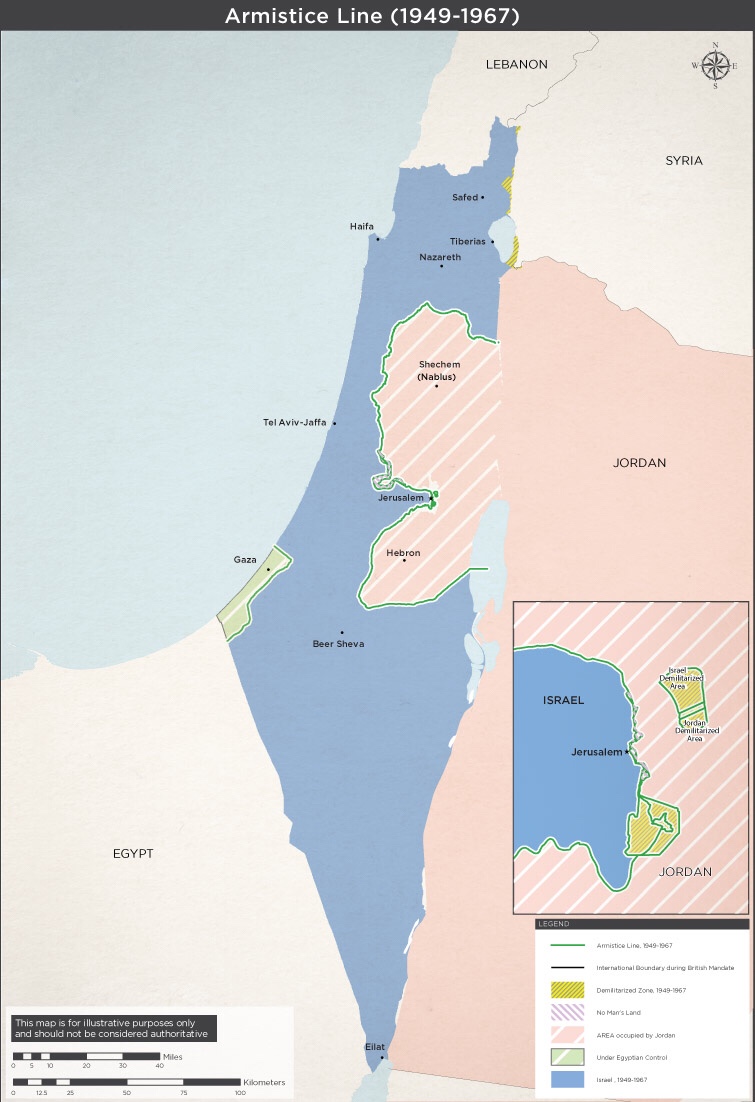
    This is a very brief background to the confusing border between Israel and the occupied West Bank. It differentiates between the planned but never to be ‘Partition’ and the Green Line, and emphasises the impact of the 1967 war and the subsequent Israel’s militarisation of the Green Line after the first intifada, 1987-1991.

    Up to 1948 Palestine was a relatively thriving area between Syria, Lebanon, Egypt and Jordan, cultivated, well educated, cultured, with good transport links between for example, Jaffa, Haifa and Lebanon. It was not as some zionists like to suggest ‘a land with no people’.

    Since the First World War it was under the governance of Britain which had been mandated to be the governing body by the European International Powers.

    Even well before the Second World War European zionists planned to colonise Palestine and turn it into a Jewish state called Israel. In the 1940s, even during the Second World War, Zionist terrorist groups were destroying Palestine’s infrastructure, terrorising the civilian population and attempting to drive the British, and then the Arabs, out, all achieved with, especially, USA Zionist support. (Suarez’ “State of Terror” provides a detailed account)

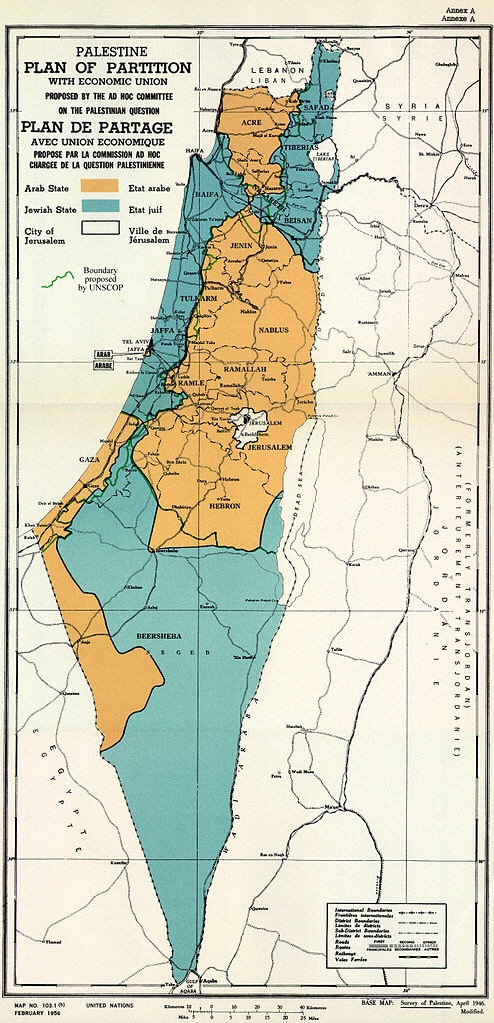
    The Partition was a plan to divide Palestine according to Resolution 181 in November 1947 of the UN General Assembly. It was suggested by USA/Europe a) as a way for Britain to wash its hands of Palestine and its Palestinian inhabitants, to turn its back, and b) for Israel to achieve statehood – a status that transformed its army from being regarded as terrorists into a national ‘state’ army and enabled rapid expansion of settler colonisation with impunity. It provided Israel with a beachhead – a military front from which the rest of Palestine could be conquered.

    Of course the partition was never going to be enough for the zionists. And in fact it never even materialised as a border of any kind.

    This plan never materialised because, before and during the Nakba (catastrophe) of 1948, the Jewish Terror units (Irgun, Lehi, Palmach and Hagana of the Jewish Agency) over-ran, massacred and displaced 750 000 Palestinians from their lands and homes and intensified settler colonising.

    Instead the zionists took 50% of the area allotted to Arabs under the Partition plan and a so called Green Line was marked out on the map in 1949 separating the State of Israel from the occupied territories.

    This could be crossed freely even after it was over-run after the 1967 six day war that drove Jordanian control out of the West Bank and East Jerusalem.

    From an article by Prof Newman in 2014 (dean of the Faculty of Humanities and Social Sciences at Ben-Gurion University) :

    Although the line was overrun by Israel during the Six Day War of 1967, it has never ceased to be the administrative line separating sovereign Israel from that area which is controlled/administered/ occupied (delete whichever terms is least suitable to your personal political preferences). Israel has never formally annexed the West Bank and, as such, has left the Green Line in existence by default. The one exception has been Israel’s policy regarding east Jerusalem.

    However, since the first intifada, (a Palestinian uprising against Israeli occupation 1987-1991), the Green Line became the line of curfews and check points.

    Those remaining inside Israel became Israeli citizens, while those in the West Bank were transformed into stateless citizens, initially under Jordanian administration and, since 1967, under Israeli control.

    Of course the wall is situated to take as much Palestinian land as possible and often strays well over the so called Green Line of 1949 into the occupied West Bank.