As Phil Hearse states, at the moment, September 2020, the hard conservative right (Patel et al) is ramping up anti-immigrant and racist rhetoric; it appears as if some more moderate conservatives and some right wingers (such as IDS) are resisting lockdown; and it also appears as if Johnson and Cummings are resisting lockdown too.
However, the apparent resistance to lockdown by the hard right may be an illusion. It is possible that J/C and their backers are hungry for power for power’s sake, and make policy on an ad hoc basis, arbitrarily buffeted by a) their perceptions of acceptability by political consecutive opinion; as well as b) public acceptability; alongside c) legal, military and civil service expectations. That is to say they are not self-consciously really being concerned about the harms of a lockdown, and may even welcome crises that make full lockdown unavoidable. It is quite possible that J/C and others of their populist right wing and authoritarian ilk, may be quite happy to see another lockdown being ‘forced’ upon them. They would/could blame elements of the public at large, the alleged freedom loving nature of Britons, and allegedly misleading scientific advice. A demand for lockdown, followed by lockdown could lead to civil unrest, just as the NHS and other public services such as the police could be overwhelmed, all of which may appear to justify draconian governmental emergency powers and further loss of civil liberties. This could put J/C as the figureheads of a fully fledged fascist state, providing them and their backers with what looks like omnipotent political power and scope for nationalist myth making and racist scapegoating.
The failure of pragmatist neoliberal capitalism.
Part of the reasons why the UK government is yo-yoing between one policy disaster after another in relation to the Covid 19 pandemic (for example the furore over discharging older people with coronavirus from hospitals to care homes leading to many avoidable deaths, and the u turn over the school examination results) is because of a deeply rooted and unconscious faith in the ideology that combines a) (USA borne) radical empiricism (or pragmatism) and neoliberal capitalism, with which so-called western liberal democracy is fast approaching its final destination: totalitarianism.
Radical empiricism in effect, devalues the idea of objective empircal evidence and instead values human thoughts based on perceptions as more valuable as sources of truth to guide action. Radical empiricism subverts or distorts scientific evidence and legitimises elitist group-think as sufficient effective truth to guide political policy and law-making as long as these can be rendered, one way or another, publicly acceptable, or at least practically speaking, literally irresistable. This is authoritarian and makes unconditional demands on the public for obedience, that is, regardless of apparent individuality or individual liberties. The fantasy here is that the elite in power are omnipotent and know what is best for humankind.
At the same time neoliberal capitalism also has a fantasy, that consumption of commodities will being happiness and limitless wealth to all, also making unconditional demands to exploit labour-power (the workers), to discount surplus labour as of any human value, to consume at the expense of others and to aggressively compete, also negating social relations of care or love.
Today, September 2020, with Brexit and the Covid pandemic, the UK’s govt. polices and u- turns illustrate an accelerated and magnified version of the way political decisions that affect all areas of our lives have been for several decades decided (by pragmatic neoliberal capitalist systems) to ‘solve’ specific ‘problems’ with commodifiable ‘solutions’, without any regard to collateral harms or unintended consequences. This is based on an unspoken belief (or philosophy) based on something called radical empirical pragmatism, itself based on an optimistic humanistic view that politically based and publicly acceptable policies are necessarily socially progressive and for the ultimate good of mankind – a kind of Social Darwinian perspective. Today, with the spectacular failures and u turns we are witnessing the dramatic failure of this political philosophy: radical pragmatist neoliberal capitalism.
The C19 virus reveals the failure of scientific knowledge as a guide to action – and even pragmatic neoliberal capitalism isn’t sure whether to preserve consumer lives and maximize anti-viral commodity production or to focus on keeping businesses open and sacrifice lives.
In the UK the government errs, currently anyway, on sacrificing the lives of the vulnerable (the unwell, older people and care workers for example) whilst handing out lucrative contracts to the already wealthy such as Serco (even though these fail to produce the goods). The lack of even limited guiding scientific knowledge for political action, and the confusion, paves the way for left and right wing protests leading to mutually reinforcing (right and left) populist and political totalitarian ideologies that will enable both so-called liberal democratic as well as more obviously right wing (manifestly elitist and hierarchical) authoritarian voices to coalesce around increased control. And this is increasingly totalitarian in kind, affecting all areas of public and private life.
This political control is intensified by public obedience which emboldens power and leads to an excess individual subjective identification with new restrictive laws or, and it works both ways, anti-restrictive edicts. public co-operation with restriction may save lives but is self-subversive, that is, turns us into uncaring and paranoid slaves of the Master and his system, and will eventually, I think, lead to a further demonizing of the enemies, enemies identified by our infantile masters, arbitrarily but most obviously including those most vulnerable and already marginalized – the unemployed, the mentally unwell, the immigrant of Colour or the asylum seeker, or the foreigner in general.
To simplify, I see two alternatives now: totalitarian nationalist pragmatic capitalism or totalitarian feudal and pragmatic nationalism.
So, the Masters total control is not guaranteed, alternatively, the contradictions between capitalism’s needs and the Master’s will to power may lead to the downfall of the Master. in this case amoral, and even eugenic, capitalism may demand that the virus will be allowed to run rampant through the apparently expendable surplus populations home and abroad and we will have full capitalist totalitarianism (as for example illustrated by Stalin’s Soviet Russia). Or, the Master may decide to risk holding up the normal flow of commodity exchange, tighten restrictions, collapsing capitalist systems, and lead us to a more feudal and myth-based nationalist totalitarianism, and intensified global war.
As most readers will know, since before 1948, the indigenous peoples of Palestine have been, and still are, the victims of an ongoing systematic regime of terror and displacement by the State of Israel and its zionist politics. This is being carried out under the guise of creating, securing and expanding a Jewish state, at the expense of the lives of the indigenous Palestinian Arabs, and in reality uses a manufactured fear of Arab terrorism to justify the ethnic cleansing, permanent war and profits for the military industrial complex. (For a good summary see ‘The Ethnic Cleansing of Israel” by Ilan Pappe). The war crimes of Israel are being considered for investigation by the International Criminal Court (ICC) in the face of fierce resistance and sanctions by Israel and its main ally, the State of the USA.
Palestine Civil Society, since 2005, has called for a Boycott, Divestment and Sanctions (BDS) campaign to highlight, internationally, and to the public, Israel’s ongoing crimes, to create pressure for political change. A strategy that had success in the campaign against South African apartheid.
Highland Palestine has been carrying out a BDS strategy for over 2 years now, holding events, collecting signatures, and lobbying the Highland Council Pension Fund, a fund overseen by elected Highland councillors, to stop investing the pension funds of the peoples of the Highlands in a company that manufactures bombs and sells them to Israel which uses them, in war crimes: to bomb, terrorise, and collectively punish the people of Gaza. That company is called General Dynamics Corporation, based in the USA, and the Highland Council Pension Fund invests over £6 million in that company every year.
Highland Palestine has provided evidence, through a petition with over a thousand signatures, for widespread public support for disinvestment in General Dynamic Corporation (GDC) and continues to lobby the fund. But to its intense frustration and disappointment there has been no response. Of course it is reasonable, and a duty, for the fund to invest these funds in a safe way to secure pensions for the future, but there are other companies for investment, and GDC shares have lost value in the past year in any case. However it also a duty of elected officials to act both morally and responsibly.
It is shocking to note that at their meeting in February 2018, shortly after our campaign began, the Pension fund sub-committee actually voted to deliberately exclude ‘moral considerations’ from investment decisions:
“A view was expressed that the Fund should achieve the best possible investment returns and ESG factors chosen for moral reasons should not be included in investment policy.”
And this, morally bankrupt, if not literally barbaric policy, was decided despite, a) voices from councillors at that meeting calling for the fund to mimic Norways ethical investment strategy , and b) a stated claim that the fund, via the fund manager, Pyrford International. is a signatory to the United Nations Principles for Responsible Investment (PRI); principles said to formalise the commitment to Environmental, Social, and Corporate Governance, that is, socially responsible investment.
There is clearly a huge contradiction at the heart of the Highland Council Pension Fund’s immmoral decision to continue investing in GDC, despite both, a) the massive environmental harm being caused by the military industrial complex, as well as b) the war crimes and human rights abuses, and c) despite the petition with over a thousand signatures: evidence of massive public revulsion by the people of the Highlands that their funds are being used in this way.
Perhaps some politicians are anxious of being accused of anti-semitism and of being sanctioned or harrassed if they support BDS. But we must keep insisting, again and again, that criticism of the State of Israel’s policies oppressing Palestinians is not anti-semitic. It is not even a plausibly implied anti-semitic criticism of the actions of Jews on account of their being Jewish, and, importantly, the State of Israel does not represent Jewish peoples worldwide, although it tries to give this impression, and in fact many, if not the majority, of Jewish people abhor the zionist policies of the institutionally racist State of Israel.
To support our BDS campaign consider writing to your local councillors calling for disinvestment, signing our petition, and following Highland Palestine’s facebook page . We have regular zoom calls at the moment and occasional socially distanced street demonstrations in Inverness.
Today, 09/09/2020, we have heard the UK state-executive make a statement that has the effect of driving us deeper into the fascist global quagmire. The UK government has openly stated in parliament that it is going to renege on an international legal arrangement covering the passage of trade between Northern Ireland and the the rest of the UK. In itself this may end up being a danger to the Northern Ireland peace process. But as discourse it signals a qualitative ideological shift in the relationship between political power and the citizenry. It is inciting a fascist psyche, one that is no long living in neurotic uncertainty about the moral worth of political decisions, but is a psyche plunged into an identification with power itself and its political decisions, made by an apparently omnipotent (totalitarian) UK political executive.
The citizen’s psyche is now left with no doubt in his or her mind, she or he is now demanded or coercively invited to become, subjectively, or to identify as, a part of that apparently omnipotent power – based on nationalist myths and pseudo-imperialism, and will do all he or she can to protect it, even sacrifice him or herself. The question is who will be the necessary victims to sustain the exercise of that power. No doubt, the immigrant, the poor and marginalized.
“We are a law abiding country but …. we are breaking international law, in this case … “
This is like the racist who says “I am not racist …. but, I am going to be racist, in this case, by marginalizing and abusing ethnic minorities and blame them for the tribulations of the poorest”
The UK state’s statement, explicitly admitting breaking international law, explicitly denies the existence of the illusion that sustains belief in the UK state as a law abiding parliamentary democracy. Of course we know very well that the UK is already breaking international laws by for example providing arms to states like Israel and Saudi Arabia blatantly committing crimes against humanity every day. But, crucially, the citizenry of the UK, and its flagship media, maintain the lie that we do not break the law.
It follows the pattern set when Johnson illegally suspended parliament and lied to the Queen about the reasons. And, of course, the UK executive did with this impunity, which further entrenched its sense of entitlement to power.
This is a rejection of this ‘law abiding democracy fantasy, or in other words, a ‘negation of disavowal’ that changes, or incites a change in, the psychic attachment of citizens to the ideological fantasy of UK political power. It makes the political power of this government inhere in the executive itself and no longer in any, albeit illusionary, parliamentary process. This is an exemplary fascist, or more universally perhaps, totalitarian move.
The basic idea here is that in order to form an identity we have to identify with certain beliefs, and this requires the exclusion or disavowal of other beliefs, or knowledge or truths. The beliefs we identify with may, for example, be patriotic, nationalist, or racist, and may be reinforced by faith in the omnipotence of national leadership figures.
It has been suggested by Zizek among others that, for example, Nazi ideology disavowed the ‘truth’ that the Jews were not an existential threat to the German population at large, but instead enforced an ideological belief in Hitler as the omnipotent leader representing Germany and the Jew as the threat to the fantasy of Germany’s destiny of greatness, the threat that must be destroyed, thereby necessarily leading to a belief in the moral justice of the processes necessary to carry out the Jewish Holocaust, amongst other evils.
One of the features of fascism suggested by Vadolas (Perversions of Fascism, 2009) is the discourse explicitly negating disavowal – because this negation, appearing benign and moral, actually signifies an even stronger identification with the ‘truth’ of fascist dominative power, or, its domination potential – p117 (Vadolas). Vadolas later claims this is a feature of totalitarian subjectivity: for example take the phrase: “I’m not a racist … but …”; this discourse (way of speaking that signifies certain value and actions as moral) places increased emphasis on the moral rectitude of the political policies (racist) that dominate, exclude and attempt to destroy the other.
Disavowal is the repression of the knowledge of the harmlessness of the other, thereby necessarily creating a lethal threat in the form of an enemy that must be destroyed.
To say, “I’m not a racist ….” is to admit that I really know other is harmless, that is, the other is not an existential threat to me – in this way it is a conscious negation of the disavowal, but what effect does this have on the individual’s formation of moral values and identity? According to Vadolas it may reinforce the moral rectitude and therefore justification for the power of the figurative and corporal leader, such as Trump or Johnson. The discourse of the negation of disavowal is productive of increased sense of power to dominate, exclude, persecute and destroy, in the name of say, national security.
For example. Nikki Haley’s (the ex USA ambassador to the UN) protestations, at the 2020 USA Republican convention, that “America is not a racist country (… but we are justified in our support for Israel’s incremental genocide of the Palestinians)” is a good example of totalitarianising or fascist discourse. And Trump is the figure that embodies that fascist dominative power.
Do the elite despise and want to destroy the poor?
How can we explain political choices, such as the recent UK economic policies of austerity that stagnates growth and increases unemployment, due to cuts in public services and welfare benefits (especially championed by welfare chauvinist Ian Duncan-Smith). This policy doesn’t seem to maximize profit extraction from the masses which one would expect a neoliberally minded elite to do, or try to do.
It is said (by Foucault for example) that USA (Reagan/Thatcher style) neoliberal capitalist ideology minimizes state intervention, and believe in a ‘free’ market. Presumably because this maximixes the potential for self-interested individuals to suck surplus profits out of waged Labour and the mystical financialised markets for debt trading.
But, strangely, politicicans of austerity also claim to ‘worry’ about debt burdens, (see Gilbert Achar for a good summary) paying debt as a reason for not investing and stimulating productivity and demand. But why would they worry about debt?
Debt per se is not limiting surplus profits and growth, whereas reaching the limits of consumption and lack of public investment will limit growth.
So how can we explain a paradox whereby elite capitalists seem to be hemming themselves in by punishing the worst off in society?
The ‘only’ plausible explanation I can think of for austerity carried out by neoliberals is that the mindset driving elite politicians and multinational corporations isn’t just neoliberal capitalism, but also masks hatred. Are the elite irrationally cutting off their noses to spite their faces because they enthusiastically despise the worst off in society, hate them with a passion, and want to ‘enjoy’ seeing them suffer.
These elites seem to be mimicking the acts of historical fanatical elitist racist national leaders such as Hitler and Mussolini that have over-reached and destroy themselves in the past. But they are doing it in less obvious ways.
Authoritarian State controls and surveillance, a disregard for the poorest in society, even a passionate desire to destroy the poorest in society, and to destroy public services. All this forms part of a drift towards the nationalistic creeping fascism slowly destroying societies and the planet.
And, all this is happening, as if under the radar, with the apparent consent of a passive population in the UK sleepwalking into its own destruction, but also elsewhere in the world, accompanied by street protests being violently quelled, and, sporadically, across the world blatant fascist dictatorships, civil wars, ethnic cleansing and military destruction.
The coming extreme post-Covid19 austerity will be less about shifting burden of debt: it’s about maximizing commodity exchange regardless of cost in lives, whilst winning the PR battle for public acceptability for eugenic racist and exploitative measures. The debt has been shown to be an abstract – another ‘futures’ market commodity – and a debt held by those reaping in enormous personal wealth exacerbating poverty and inequality.
Interesting and important questions are:
Why would the elite rulers of today hate and seek to destroy even their own nation’s poorest and marginalised?’ And, ‘How are the elite able to command a mass following willing to enthusiastically endorse and carry out their orders?’
These questions requires a mass psychology of fascism. Reich, Fromm, Bloom and others such as Arendt used Freud and Marx to theorise these questions. Today theorists such as Tomšič have used Lacan and Marx to develop further insights.
The capitalist unconscious powers a consciousness that represses the value of human social bonds and therefore the value of the life of the other as something worth caring about. But, also, forming consciousness and identity is always necessarily accompanied by anxiety: our identities never ‘feel’ secure enough, never whole enough, never self-aware enough. So, in order to minimise this necessary subjective anxiety for this capitalist consciousness the individual must entrench and consolidate his or her consciousness by going an enthusiastic step further – the quid pro pro for not caring about the other is to ‘enjoy’ precisely at the expense of the other.
Or in other words even to have a capitalist identity that must hate and destroy the other. The role of hated-other can actually be fulfilled by anybody, in theory, but political pragmatism demands public acceptability for political choices, so politics chooses others that everybody can ‘enjoy’ hating, namely the poor and marginalized, the unemployed, the mentally ill, the differently abled and the foreigner-immigrant, the Muslim, the Roma, the Kurd etc.
Thus, the capitalist unconscious is also a fascist unconscious. And Covid-19 is provoking a massive sudden economic crisis, globally. The gloves will come off the fascist elite, new authoritarian controls, and surveillance will come into play.
Alongside lack of trust in government there will be little to no organized resistance from the Left (fragmented and weakened by years of slow-burn creeping fascism under the guise of conservative politics), but there will be enthusiastic take up of facism by the atomized human dust of a society for whom there are no longer any social bonds for the foreign other, nor, even now, under Covid-19, the foreigner in our midst, even for our neighbor disguised by his or her face mask.
A short personal reflection of time spent on team with CPT in Hebron, Palestine, February to March 2020
Both uplifting and over-powering at the same time, being on team with CPT in Hebron is intense and relentless, requiring genuine teamwork, mutual support and quality leadership. My partner, Louise, and I, are CPT reservists based in the UK, we had been to the occupied Palestinian territories (oPts) before, and had completed CPT training in 2018. This time with the team in Hebron was our first experience as team members. I don’t want to sugar-coat the pill here and should say that first, the induction process is not easy; but second, we were lucky to be with a superlative team, backed up by a superlative project support co-ordinator. We were each appointed a mentor, who spent time 1:1 and took us through a schedule of ‘things to know and skills to have’. CPT has developed an excellent system that a) covers all the angles and b) ensures, as far as possible, a mutually supportive, respectful and egalitarian distribution of tasks.
Whilst on team we lived in an old building at the end of a small side road in the heart of the Old City, a cobbled road with squawking turkeys and ducks and often a few children and cats, a road with a tall barb-wired Israeli-built concrete wall at one end that blocks access to Shuhada Street, now occupied by the Israeli Jewish settlers. It was winter still, and cold, and damp, but we had arrived after the worst of the weather. Our main challenges were a) self-care, mentally and physically, b) trying to grasp the complex geographical layout of The Old City and its checkpoint connections with the Israeli High Security colonisation corridor (High Security Zone, HSZ) running from the Kiryat Arba settlement to Tel Rumeida, and c) managing the IT system and requirements for data collection/recording, and the production of reports for UNICEF, social media and newsletters.
We had to learn how to navigate our way around, how to manage ourselves safely at checkpoints where we would, from time to time, be held up, questioned and body-searched by soldiers, how to manage ourselves safely at clashes and demonstrations where we would be exposed to Israeli military aggression responding to ‘al-shabab’ (the youth) throwing stones with sound bombs, tear gas, and rubber bullets. If out on duty or on-call we always worked in pairs, focused on being as safe as possible, caring for each other’s welfare, keeping in regular contact with the rest of the team by mobile phone, and on recording human rights violations by monitoring incidents of aggression and by taking photos or filming.
Our team-based routines included a daily team meeting, and a weekly team catch-up with the project support co-ordinator based in Jordan. The team meeting agenda always included a reflection led by one person, a check-in with each person for well-being or problems, any debriefing for incidents the previous 24 hrs, an allocation for the school runs, or settler-tour, or mosque patrol duties, on-call and team phone rota for the next 24 hrs, and an individual ‘work’ check-in’. Each team member would have responsibilities, for e.g. ongoing, newsletter articles, social media reports, quarterly reports for UNICEF on school run data, use-of-force reports, and work would be allocated for hosting visiting delegations, and email communications. Domestic task are also allocated such as shopping, breakfast, washing up and dinner cooking.
Our work included all hands on deck for the school runs, where we counted numbers of children and teachers going through two of the checkpoints on their way to school – it is complicated but there are Palestinian children living in enclaves within the Israeli Settler HSZ who need to pass through military checkpoints and metal turnstiles in order to get to their schools outside the HSZ; and conversley there are children living outside the HSZ who have to go tthrough checkpoints to get to their schools inside the HSZ. The school runs start at 7 am, so were up at 06.30. It is common for soldiers to close the checkpoints and prevent children from going to school, and for children to throw stones leading to further delays and sometimes teargas and sound bombs. We would monitor and record for about an hour before returning through the checkpoints, and potential harrassment, questioning and searches by the military on our way back to the team apartment, and breakfast. In the afternoon the two team members on call would escort children from the kindergarten in the HSZ, next to Al-Ibrahimi mosque back towards their homes, and on Fridays we would monitor the mosque checkpoint at the first call to prayer at 05.00hrs, and on Saturdays we would monitor the so-called settler tour, where the military supervise a settler ‘incursion’ from the HSZ into the Palestinian areas of the Old City and preach biased, misleading and often false zionist propaganda to Jewish ‘tourists’ or Jewish youth from abroad visiting ‘the promised land’ on so-called Birthright-Israel trips.
So, to turn to some reflections: on experiencing the occupation (as foreigners), the value of the CPT presence in Hebron, the ongoing Palestinian resistance, the current Palestinian situation in the oPts.
Experiencing the occupation.
There are quite remarkable Palestinian team members without whom the CPT presence in Hebron would be all but impossible and whose contribution to the work cannot be over-estimated. In our particular case, as ‘foreigners’, from the UK, we could never feel or experience the occupation as the Palestinians do. However, I think we sensed that, the more time we spent there, the more our minds became occupied by the occupation in two ways.
First, I felt we began to be subjugated by the occupation, to be less outraged than we should be, as we ‘normalised’ the situation so that it became harder for us to remember that this ‘normality’ is not normal at all. We see the children passing through metal turnstiles, past heavily armed soldiers, on their way to school and ponder that this normality has been their social experience since birth: how do they respond to the occupation? As a team we tried to counter this ideological occupation of our minds through our daily reflections and team de-briefings.
Second, I think that, during our stay, we gradually absorbed a kind of loss of optimism, and even hope, that this over-powering oppressive enterprise of occupation (and ethnic cleansing) on an industrial scale, can ever be overcome. Our conversations with Palestinian partner agencies in Hebron reveal a depression of mood, though no less determination to continue to resist. The recent shift even further to the right by the USA, with the election of Trump and his fascist rhetoric, has emboldened the already far-right government of Israel to accelerate its programme of settler-colonisation and ethnic cleansing.
It has struck me that Israeli tactics of occupation always focus on the less visible margins of the oPts, the outskirts of the cities and in the rural villages – this slow-burn approach helps to ensure a) that Palestinians in the cities remain absorbed by their own battles to survive in the still neoliberal socio-economic structures of Palestine and all that entails, and b) that the western media continue to remain silent.
The Palestinian resistance
Our conversations with CPT’s Palestinian partner organisations in Hebron made it clear that there are determined and very brave groups in Hebron standing up to the occupation. These included the Hebron Defense Committee, Human Rights Defenders, and Youth Against Settlements. As foreigners we cannot begin to imagine what they face, daily, and can only be amazed by their persistence. Unfortunately, it must be noted, their overall impact is reduced by political differences in their relationship to and with the Palestinian Authority. Their activities put CPTs work (and the work of other foreign agencies such as ISM and EAPPI) into context; CPT provides only a marginal impact as a foreign presence, trying to amplify their voices. At times I think some Palestinians become frustrated with CPT because it has not been able to make much difference over the years, and that is, unfortunately, true. However, I also sensed a genuine appreciation of the CPT presence and its efforts to help tell the world what is going on. For sure, it is clear that CPT will be most effective if close relations with these partner organisations can be fostered with regular contact and by helping to develop their faith that CPT will respond if called.
Then came Corona
From the 8th March we were confined to our apartment because of the Covid-19 pandemic. Even before that we had been subjected to cries of “Corona!” directed at us as we walked through the New Shallalah Street vegetable market – as foreigners we embodied the viral threat and experienced the early stages of a xenophobia the pandemic has triggered globally. Initially lighthearted, as if banter, it was always clear this could turn quite ugly. Foreigners were barred from entry to Hebron, and Bethlehem was in lockdown with foreigners quarantined in a hotel there. On the 11th March I wrote:
“We can’t respond to any calls for a monitoring presence for human rights violations by armed vigilante settlers or the occupying forces. From inside the apartment we can hear vehicles going up and down Shuhada Street, a road that used to be lined with Palestinian homes and shops and a major economic lifeline for the Old City of Hebron, now invaded, colonized, and securitised with the ugly security aesthetic of concrete walls, barbed wire, cameras, searchlights and checkpoints.”
And on the 14th March:
“The time is nigh for our days with CPT in Hebron to be cut short, and our team to be no more. Grateful for the experiences we have had together and the learning along the way. The coronavirus and the moral panic – more or less reasonable – holds sway over our short-term future and made life here unreasonable. So some of us must depart and very soon … Thinking of our days, in our ‘luxurious’ confinement, with incredible people around us, Julian and Tarteel, and now Mona; with the background sounds of the call to pray, the squawking of ducks and turkeys in the street below, and the occasional disruptive explosions of fireworks – daily it seems – from the alien invaders.”
So, by the 17th we left for the UK. This has been a sad time for us, to leave so much behind, and so much work undone. I think that the work of CPT (and other foreign agencies) is as worthwhile as ever: to amplify the voices of the oppressed, and to support their resistance. We intend to go back when we are able to. In the meantime we can only lend support, at a distance, to those on the ground. We can only hope that this pandemic does lead to significant shifts in global politics that will one day emancipate the Palestinians and reverse the racist occupation and settler-colonisation.
Covid-19 and lockdown in the UK 24th March 2020. Louise and I in an odd predicament – not long back from working with a really great Christian Peacemaking team of people witnessing and documenting militarized oppression by the State of Israel in Hebron in the West Bank. Now, we’re in Brighton, UK. And, tomorrow we head back towards Elgin, Moray. We don’t want to go straight there because our house sitters are there living in our house and looking after Sid, Molly and Sister Mary. They’re there until the end of April. 5 weeks away.
We had to come back early to the UK because our work in Hebron became impossible after the Covid-19 pandemic broke and schools were closed right across the West Bank around the 7th March.
We have spent a week in self-isolation in an aparthotel in Brighton; we’ve managed to source a second hand camper van (middle class bubble privilege at work) in order to drive slowly to the Far North, and home to our legitimate ‘primary residence’.
At the same time the UK population has been warned not to drive to tourist resorts, such as Cornwall, The Lakes, or The Highlands, in camper to escape the virus. Johnson’s government has just announced a ‘lockdown’ with only essential travel, and home- stay except for health, essential work, exercise x 1 per day, and food shopping.
We have equipped the van and can pretty much go off grid. The ‘plan’ is to keep a super-low profile as we slowly head home. But this journey creates feelings of paranoia out of an encultured fear of authority and always already assumed guilt. Possibly due in part to Catholic, and in my case anyway, patriarchal and authoritarian upbringings.
Sad to say, because of corona, we are tempted to wind our way back north, via the least attractive and least visited places the UK has to offer. And, without wishing to cause offence, I must say that a quick search has identified Purfleet, Essex as a top contender.
Purfleet may be lovely, or at least have some redeeming features, so, in an Ermeticist spirit, our challenge might be two-fold: a) to challenge the impending fascism descending on our heads like a tidal wave by using Ermeticist poetry (a poetic movement from fascist Italy using poetry to resist fascism, that refuses a simple direct relation between language and assumed meaning and instead uses obscure analogies or language that disrupts sense or makes uncomfortable the sense of the status quo in some way) by b) connecting this poetry with images from some of the allegedly crappiest towns in Britain. Not only will this be a form of creative non-violent resistance against Covid-19 associated fascist tendencies but will also be a way of resisting stereotypical assumptions for what makes a town crappy.
This exercise runs risks of a) exaggerating our plight as a plight when in fact we are not even in a plight but incredibly privileged, and b) exaggerated and condescending class violence. The challenge is to see and witness our particular journey for the joys it will hold, being sensitive and thankful for those whilst trying to be compassionate toward the genuine plight of the most vulnerable here, in the UK, in these allegedly crappy towns (who says they’re crappy anyway) as well as across the world.
We’ve been struck by the scale of homeless living in the streets of Brighton and by news that as charities have been forced to close the homeless have even less access to food and shelter.
At the same time we have heard disturbing reports of aggression shown towards ‘outsiders’, identified as ‘dangerous risk’ simply because they have not been ‘recognized’ by established members of so-called spiritual communities. This xenophobia may well increase rapidly in the UK as fear and authoritarian enforcement mutually enhance each other – the ‘most moral’ security forces may soon be at work here – who will be victimized?
Here’s one from Brighton, Covidyssey Day 0, 24th March 2020:
‘And suddenly it’s evening’ by Salvatore Quasimodo
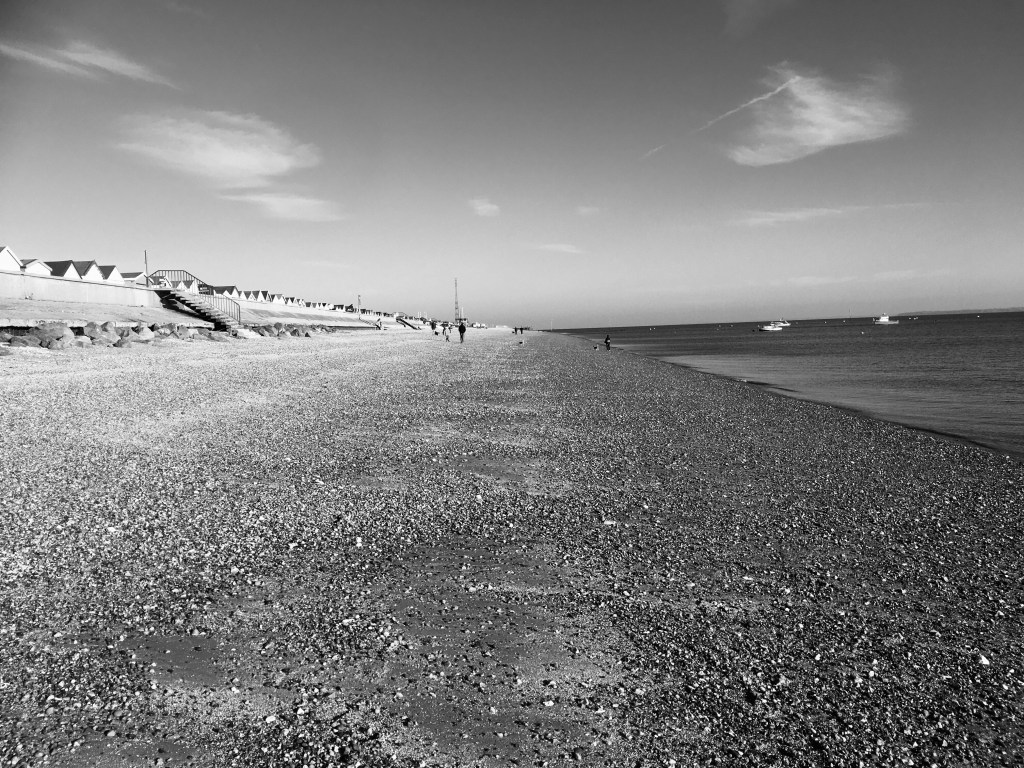
And although technically we slightly bypassed Purfleet as such, Shoeburyness beach was full of oyster shells with an expansive view across the Thames estuary way down to the Thames Barrier – we think.
26th March 2020 Covidyssey Day 2:
Poem written in 1938 to mark a meeting between Hitler and Mussolini by Montale, one of the Italian anti-fascist Ermeticist poets.
The poem was born from the encounter, in Florence in the spring of 1938, between Mussolini and Hitler. The allegiance between the two men was irreparably strengthened and this, for Montale, is a clear indication of the catastrophe to come. After the encounter, fascism took a more aggressive turn towards anti-Semitism, and racial laws were put into effect in the following September. Being Jewish, Irma Brandeis (the woman Montale loved) would migrate to the USA
The dense white cloud of moths whirls crazy around
the whitish lights and over the parapets,
spreading a blanket on the ground that crackles
like sprinkled sugar underfoot. Now coming summer frees
the nightfrosts held in lockdown of the dead
season’s secret cellars and in the gardens
that climb down from Maiano to these sandpits.
A hellsent herald just flew over the avenue
to a war-whoop of goons. A gaping orchestral pit, firelit
and decked with swastikas, seized and gulped him down.
Windows are shuttered up, shabby and harmless
though even they are fitted with guns and war toys;
the butcher who laid berries on the snouts
of slaughtered baby goats has closed. The feast day
of killers meek and mild, still ignorant of blood, has turned
to a sick contra dance of shattered wings,
of shadow larvae on the sandbars, and
the water goes on eating at the shore
and nobody is blameless anymore.
So, all for nothing? And the Roman candles
at San Giovanni slowly whitening
the skyline, and the vows and long farewells
as binding as a baptism in dismal
wait for the horde (but a gem scored the air,
strewing your ice, the edges of your coasts,
with the angels of Tobias, the seven,
seed of the future) and the heliotropes
born of your hands — all of it burned away,
sucked dry by a pollen that shrieks like fire
and stings like hail on wind
Oh the wounded spring
is still a festival if it can freeze
this death back into death. Look up again
Clizia: it is fate, it is the fate
of changed you keeping up your changeless love,
until the sightless sun you bear within you
is dazzled in the Other and consumed
in Him, for all. Perhaps the sirens, the bells
tolling to hail the monsters on this eve
of all hell breaking loose already blend
with the sound loosed from the heavens that descends
and conquers—with breath of a dawn that may break
for all, tomorrow, white but without wings
of horror, on scorched rockbeds of the south.
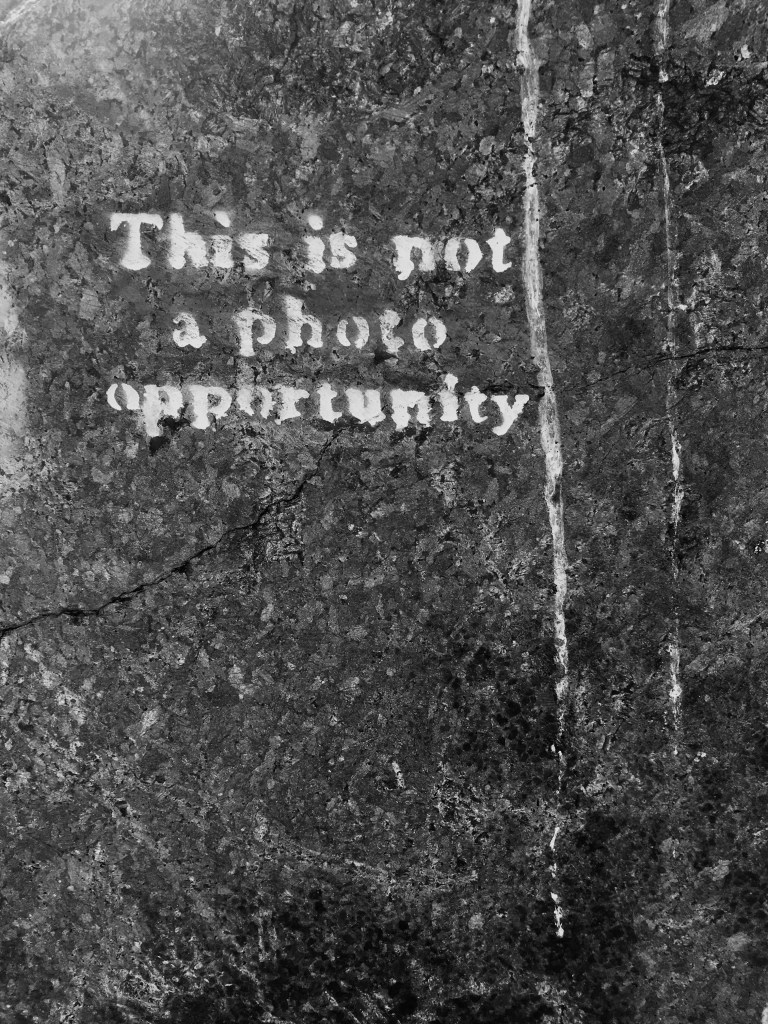
On a house front in Clayton-On-Sea
A big question is whether the evils of capitalism can be reversed without falling into authoritarian Stalinist State-Capitalism. It is crazy that, in the UK, Corbyn and his manifesto could be forbidden so effectively, crushed by those in power. Trump and Johnson are the Hitler and Mussolini of our times. Populist, lying propagandists, irrational, thriving on nationalist myths, calling for sacrifice for the greater good in the name of neoliberal pragmaticist capitalism.
27th March Covidyssey day 3
Clacton-on-Sea
Enemy of Death by Salvatore Quasimodo
You should not have ripped out your image taken from us, from the world, a portion of beauty. What can we do we enemies of death, bent to your feet of rose, your breast of violet? Not a word, not a scrap of your last day, a No to earth’s things, a No to our dull human record. The sad moon in summer, the dragging anchor, took your dreams, hills, trees, light, waters, darkness, not dim thoughts but truths, severed from the mind that suddenly decided, time and all future evil. Now you are shut behind heavy doors enemy of death.
Who cries? You have blown out beauty with a breath, torn her, dealt her the death-wound, without a tear for her insensate shadow’s spreading over us. Destroyed solitude, and beauty, failed. You have signalled into the dark, inscribed your name in air, your No to everything that crowds here and beyond the wind. I know what you were looking for in your new dress. I understand the unanswered question. Neither for you nor us, a reply. Oh, flowers and moss, Oh, enemy of death.
Will we be able to really see through the lies of ‘earth’s things’ and ‘dull human record’ that ‘decided all future evil’ as they have been spoken for many years by the right wing neoliberal capitalist pragmatists such as Thatcher, Blair, Reagan and Trump. The lies of the ‘invisible hand’, of trickle-down wealth? Is this current corona virus crisis going to prove to be the ‘enemy of death’? A door to a better society? Will those in power fear the masses and take a totalitarian turn for the worse first?
28th March 2020, day 4 Covydyssey
Lowestoft
The BBC world service at 7.06pm has informed us of ways lockdown ‘rules’ are being enforced in different countries; inter-alia: Indian police are beating people with sticks and telling them to do squats and sit ups if they break the rules and leave their houses when they shouldn’t; in Israel the secret service, the Shin Bet are tracking people via their mobile phones, elsewhere drones are being used. And so the stories go on. In the UK police have been deluged with calls from people ‘dobbing’ their neighbors for leaving their homes without good reason. So much for neighbourliness.
We’re in a free car park with a sea view in Pakefield, no overnight camping allowed. At about 8pm a police car drove in; and then drove out again. Our covidyssey northwards continues painfully slowly. Mentally duller every day. Maybe this is an early effect of oppression induced paranoia (and I check my privilege here because this apparent oppression cannot be compared to oppressions elsewhere). A laziness, languor, a stifling of any creativity. But it has been a long and strange two months, and maybe am just fatigued.
This poetry was written under fascist oppression by those who maintained a creative spark.
Here’s a poem written by the Italian hermeticist poet Eugenio Montale, written during the Second World War as part of anti-fascist resistance.
The Tempest
Princes have no eyes to see these great marvels
Their hands now serve only to persecute us
–Agrippa D’Aubigne, à Dieu
The storm that drums on the hard
leaves of the magnolia its long March
thunder and hail,
(the sounds of crystal in your nocturnal
nest surprise you, of the gold
squandered on the mahogany, on the gilt edge
of the bound books, a sugar grain
still burns in the shell
of your eyelids)
the flash that candies
trees and walls and surprises them in this
eternity of an instant–marble manna
and destruction–that you carry
carved in you by decree and that binds you
more than love to me, strange sister,–
and then the rough crash, the sistri, the shudder
of the tambourines above the ditch of thieves,
the tramp of the fandango, and above
some gesture that gropes. —
just like when
you turned around and with your hand, cleared
your brow of its cloud of hair,
waved at me–and went into the darkness
Reflection
Whilst in Hebron we used some contemporary Palestinian art and music of resistance as part of our morning reflection together: rappers and film makers from Gaza, Lebanon and Egypt (see here and here and here). Accounts of cultural resistance ( see ‘cultures of resistance in Palestine and beyond’) suggest that before the fall of the PLO with the Oslo Accords art and poetry often focused on the Palestinian national identity. But, since Oslo, cultural resistance amongst the young has focused more on social issues, inequality, poverty, and less on nationalism. At the same time contemporary art-as-resistance is easily commodified and repackaged in ways that sustain capitalism and its necessary politics of competition (envy, greed and xenophobia). It is of course always the case that oppression, whether by occupation, ethnic cleansing or capitalism, will always weaken resistance efforts as individuals have to focus on personal survival.
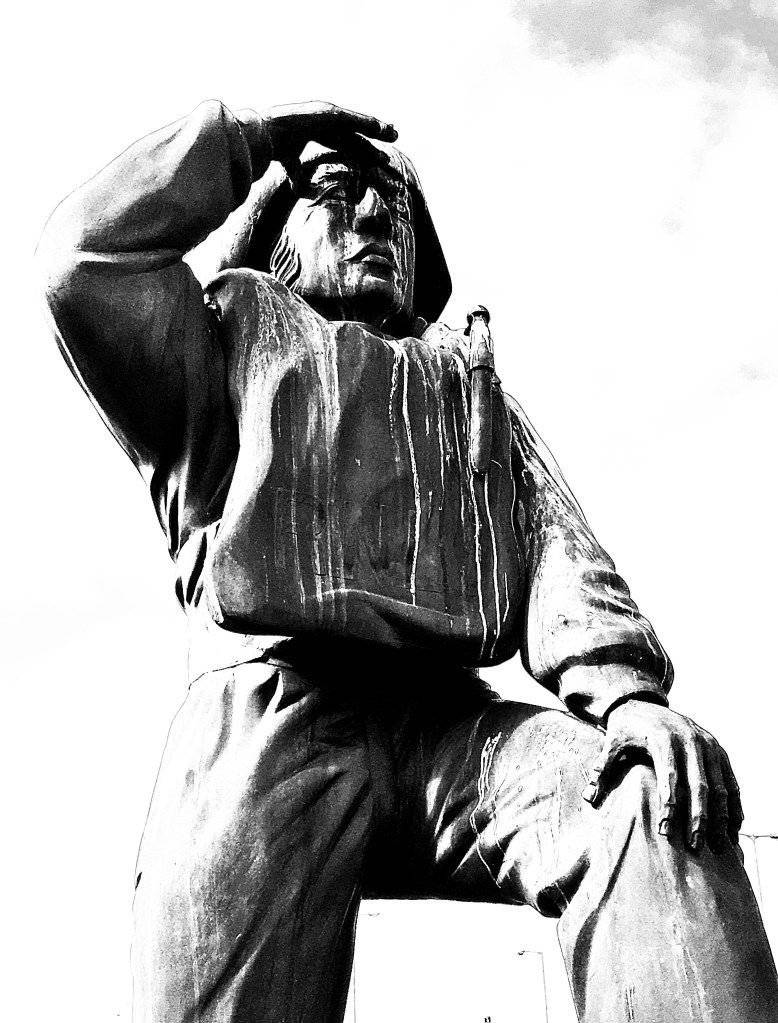
Lifeboat Man Lowestoft
Covidyssey has just become Covidiocy:
We’re in Old Hunstanton somewhere near Norfolk. In hindsight a silly place to be because a) we stand out like a sore thumb and b) it’s a petty bourgeoisie neighborhood full of golfing captains and retired police chiefs. So, put two and two together and we’re dobbed, and just been through a police interrogation, sarcasm : “Do you know there’s a pandemic?”, sarcasm from the police is, as usual, in my experience. Too much media-induced fear and panic out here so doesn’t feel safe – we are retreating pdq to Moray to either camp in van in our drive or, more likely decamp to our cabin – lucky us!!
Helpful leaflet given to us by local Norfolk constabulary in Old Hunstanton – it’s a very good question, if a bit deep.
Police urge Brits to spill the beans on neighbours suspected of breaching coronavirus lockdown: Telephone ‘hotline’ and online ‘snoopers’ forum are set up as scores of people still break rules after five days in isolation
In my view this is bad news: I don’t mean the advice on travel etc. – which I think is well-founded, but I mean the encouragement of vigilante paranoia because this is based on the assumption that the public are not capable of self-management but must be controlled by the security forces with the aid of collaborators. This atomizes society (breaks it up into atoms of singletons desperate for security) – which is exactly what the Nazis did in Germany in the 1930s.
This ideology is that: it is a good thing to a) suspect everybody of breaking the rules and then b) to report to the security services anybody you suspect of breaking a rule even if c) it leads to further destruction of social bonds of love, respect and kindness, bonds already severely strained by neoliberal pragmatist capitalism.
The net result is that kindness, neighbourly compassion, is no longer valued by society.
It is perhaps ironic that we started out heading for the so-called crappy towns, not my term and surely a misnomer only to get dobbed in what turned out to be a precious spot of beauty (the policeman’s term). There are probably kind people there, not making us unwelcome primarily, ‘just scared’ …. mmm.
Local People
29th March Day 5 Covidyssey/Covidiocy
We subjugated ourselves to our objectivism and objectivised ourselves in the constitution of our subjectivity as obedient social-isolationists and set off for Scotland.
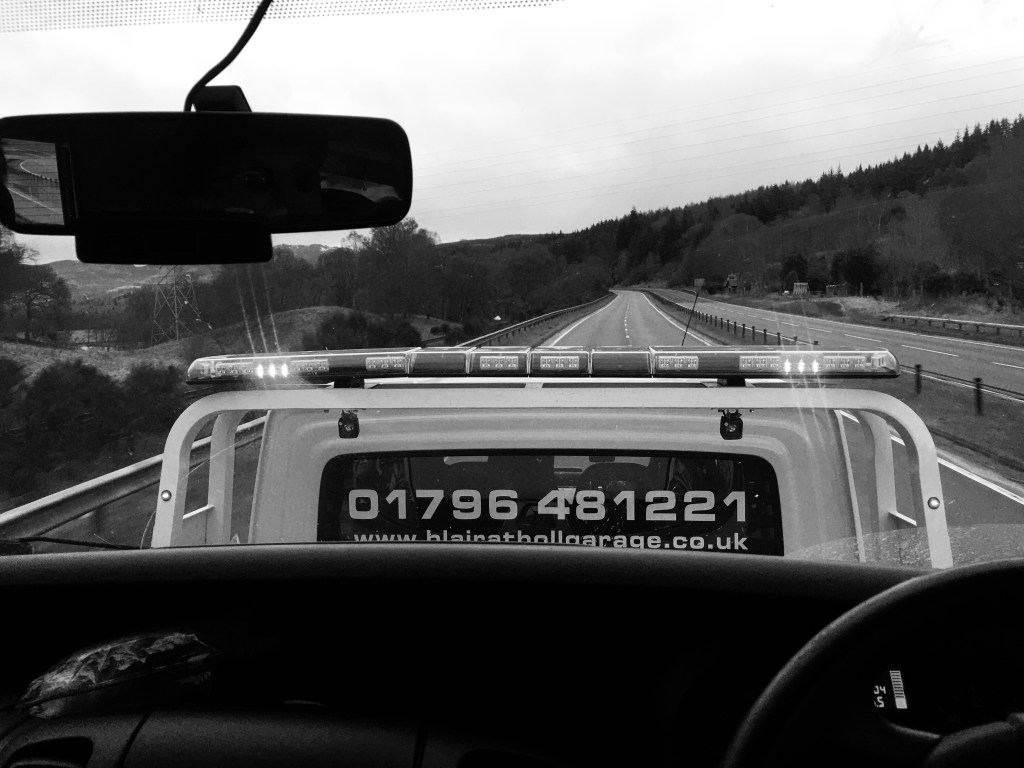
We didn’t quite make it back in one go as it were; a radiator leak ++ stopped us in our tracks 120 odd miles from home. Organized chaos, but luckily we had a weak phone signal and could get get through to RAC breakdown. In double quick time we have a tow truck, and appropriately socially isolated, an elevated view from the van on top of the truck. A very cold 2.5hrs on twisty roads and we’re back at Coltfield and – extremely luckily for us – a warm welcome from Cor and Nicole our Dutch house sitters – who keep a safe distance, and then we set up home for the foreseeable future in our log cabin. I know ….
A9 19 miles north of Perth – 114 miles from home on the back of breakdown truck Lay-by 25 A9 Northbound Water from radiator flowing down the road Oops – it’s a breakdown 10.30pm back at Coltfield Moray, in the log cabin, log stove fired up and dinner on the go. Feeling a bit rough – wonder if it’s flu?
And one final poem from Salvatore Quasimodo:
Nostalgia and Regret
(Ora che sale il giorno) Now the day breaks night is done and the moon slowly dissolved in serene air sets in the canals. September is so alive in this country of plains, the meadows are green as in the southern valleys in spring. I have left my companions, I have hidden my heart behind ancient walls, to be alone, to remember. Since you are further off than the moon, now the day breaks and the horses’ hooves beat on the stones
There are now articles, e.g. see here even by political leftists crying out for authoritarianism, at its most stark representing a shift towards Stalinism – a perfect fascist storm; the stories being written start by describing the harms of politicians scapegoating the other (currently – the ‘ordinary person in the street’) apparently to deflect criticism, as the virus spreads, from the government’s failings due to, or so the stories claim, the lack of diktat, rules and authoritative ‘action’ to enforce social distancing and lockdown.
To be clear as I explain at the end of this piece I am in favour of government interventions to ensure landlords cannot evict, that the vulnerable have financial support including the self employed, and the lockdown of non-essential business – that said, the responsibilisation of individuals to socially distance is achieving a mythical status reminiscent of moral panic. Sensible social distancing is exactly that, sensible / it is not a panacea and should not be implemented over-zealously by little hitlers.
On a forum for a self-described spiritual community in the North a resident posted angrily because he saw people he ‘didn’t recognize’ in the Park (implied as ‘spreading the virus’) – what could he do to evict them, he cried, “who do I call?” – the reply from the list moderator was “Shout at them”. Is this a self-identified spiritual person vying to be first in line for the most zealous and xenophobic fascist prize? Is this ideology at work, an incitement to elevate social distancing to its most extreme level as a sign of moral dutifulness that actually reveals a fearful subservient identification with authority itself.
The zealots are already at work ‘shaming’ what they call Covidiots, and the mainstream media is lapping it up, see here. Will shame really ‘shine as a tool that can be used for social good’? Or is it a tool to embed fascist and xenophobic ideology and thinking as if not only normal but moral.
Instead of actively shaming others we could instead rely upon a naturally developing sense of what is good through simple guilt, because we care and by adopting sensible norms.
Prof Sznycer argues that “guilt – an emotion when you realise you’ve harmed people you love” – tends to lead to “more stable, benign and reliable” behaviour change.
“It may be that a government prompt about caring about the welfare of others could be more effective than shame,” he says, although “for guilt to work, you need to value the welfare of others to begin with.”
We should note that no matter what action the government takes it won’t be sufficient to prevent Covid-19 deaths; and it will suit government to blame the feckless others which will become surplus humanity: the unemployed, migrants, homeless etc.
A few breaches of social distancing will soon become socially unacceptable through ideological normative effects of peer pressure, without the need for heavy-handed law enforcement.
It seems some are desperate to believe that social distancing applied zealously is our salvation – spurred on by the media ghoulishly showing videos of clearly distressed exhausted and tearful medics after 13 hour shifts begging people to ‘stay at home’. Their fantasy is that zealous social distancing is not only the ‘good’ political thing, but the cure if only if can be done ‘enough’, regardless of collateral effects of fear and social isolation. And of course ‘enough’ is always out of reach spurring us on to ever greater efforts approaching the bizarre.
The thought-police and neighborhood vigilantes will soon be out with their Kafkaesque vitriol enforcing an over-investment in fear and social distancing.
A perfect recipe for fascist ascendancy: I would think that simply stating the infectious nature of this virus, and illustrating ways to avoid, eg with videos of social distancing in shops etc. should be enough. S Korea and China apparently have it under control; but even here we should be cautious and sceptical about claims for the effects of enforcing their apparent actions on quarantine and testing. The false-negative rate of tests and existing lack of social cohesion, (exacerbated of course by years of individualist arch-neoliberal pragmatism), to cope with enforced distancing make these dubious approaches here. Governments will love to blame the ordinary person for the spread and as an excuse to move towards increasing fascist mythology, hatred of the rational and science, and xenophobia. The people will come to believe that the sacrifice of the elderly and vulnerable to save the economy is ‘a good thing’ as if arch neoliberal pragmatism is the savior of us all! This is fascist ideology.
This combination of manufactured social fragility and neoliberal governance will sooner or later produce a political rupture. The election of Donald Trump was the first act of one. An extended economic crisis can produce social solidarity or a deeply ugly political response. The Democrats’ choice to stick with their neoliberal program means that they are indifferent between electing Joe Biden and a second term for Donald Trump. Add the widespread unemployment that is already baked into their reflexive austerity and a more perfect formula for fascist ascendance is difficult to imagine.
And that’s before we get on to the economic fallout: the lack of support for tenants … the continual refusal to enforce rather than request businesses to not lay people off, the lack of enforcement in place around supermarkets and hoarding, and the apparent total lack of economic planning measures to deal with what is to come.
Let me be clear: people have to obey the lockdown. And we as a citizenry should be vigilant about that. But if politicians do not start governing across every area of economic and social life to provide people in lockdown with what they need to live securely under these extraordinary circumstances, then at some point people will become desperate and lockdown breaches will become inevitable. There’s nothing about what the government has done so far which suggests to me that they are up to that task, so we have to push them to get there. The politicians have to govern and the citizens have to hold them to account. That’s how this has to work.
Sotiris discusses the possibility that community reactions to the coronavirus pandemic may occur through non-coercive democratic decision making and not necessarily through apparently successful totalitarian decisions that are creating Agamben’s states of exception necessitating increasingly coercive surveillance and securitisation.
I just note here that Netanyahu in Israel has just announced that cyber-tracking of people’s movement will be used to ensure inefficiency to quarantine restrictions and that the loss of personal freedom to privacy is a ‘worthwhile sacrifice’.
that there can be a non-coercive biopolitics so that it is possible “ … to have collective practices that actually help the health of populations, including large-scale behaviour modifications, without a parallel expansion of forms of coercion and surveillance?”
He suggests that this may take place through ‘democratic collective decision making’, and cites the success of grass roots movements like ACT-UP that led to many improvements in health care for people with, or at risk from, HIV.
No doubt grass roots movements are important and democratizing in their potential but their relevance to the coronavirus pandemic isn’t clear to me at the moment.
I want to consider first the idea of coercion within the context of subjectivity formation; and then, second, the potential impacts on the psyche of a) normative demands for social distancing and b) the inhibitions on the potential to consume and exchange commodities that is accompanying the coronavirus pandemic.
Love and capitalism both take a hit with this coronavirus. My guess is that capitalism will in its death throes become even more right wing and fascist.
Can collective decision making ever be non-coercive, when even identify or subjectivity adoption is always coercive – subjectivisation works through coercion. Caring for the other could be a non-oppressive ideology, albeit subjectivism always takes place through ideological coercion. I provide a short description of subjectivity formation here, but note especially that this means that individuals never have autonomy or free unlimited choice, but are only free to choose between masters, between ideological systems that determine what we have to value and what we can’t value as good things or good ways to be.
Here I draw from a Lacanian perspective on subjectivity – how humans assume their sense of themselves or their identity. This perspective is based on a standpoint that humans can never be fully self -aware and are always lacking – lacking a complete sense if self. This lack from birth, causes an inaugural fear or anxiety of the lack of identity, which in turn leads to desire, for security through the fantasy that there is a Big Other who can provide security, leading to (in order to secure identity) a felt unconditional demand of the imagined Big Other to obey his Law.
But what about if, as with these public health ideas for containing coronavirus. caring involves essentially negative actions: social distancing, not panic buying, not traveling, not gathering in groups of more than 10 (Israel). Is this a form of negative freedom (Lockes version of negative liberty for the vulnerable, albeit a positive liberty for most people constrained to be socially distant) – the freedom not to be infected or to infect, based on a normative norm?
Caring is, according to Freud, a fully sexually-driven, libidinal, activity albeit aim-inhibited. Doing care or giving love without harming, or assuming knowledge of the needs of the other. Is it possible to care with love, using what is a sexually-driven energy, by not-acting?
In any case not-acting, a philosophy or ethics of silence or absence (social distancing) runs directly counter to capitalist-radical-empiricism’s command to a) ignore science and its rationality and b) always act – as if for action’s sake – to solve ‘the’ problem you face regardless of collateral harms. This may go some way to explaining the reluctant of far right politicians like Trump and Johnson to reduce activity, in favor of, in Johnson’s case, encouraging viral spread to develop herd immunity, accepting the collateral damage of increased deaths – in the short term, it is implied.
I speculate that caring through inaction does not involve love as such; as love for an other individual, but is narcissistic – perhaps sometimes as reluctance to take responsibility for harming the other as opposed to wishing to care for the other with love. Especially likely if the other isn’t actually complaining of anything at this moment in time; that is, if the inaction means that usual forms if showing love – like being with people are forbidden.
To what extent does, say, social distancing represent a form of inaction and unconditional collective protection that prevents inter-personal caring with love; and at the same time represents an inaction abhorred by capitalism (and the far right pragmatists) as the chain of commodity exchange breaks up.
The far right capitalist and the left wing socialist face a dilemma. To not act – to be socially distant, not travel etc. is both to obey capitalism’s incitement to break social bonds; and at the same time to disobey radical empiricism’s injunction always to act – to encourage spread, to vaccinate, to invest in more technology etc. This may mean, at a population level, that many become very stressed because of what amounts to a double-bind, leading to anger (taken out on who? to your neighbor or the state?), emotional exhaustion, and paralyzing burnout with depression
People are positively ‘acting’ by wearing mask, by blaming the foreigner, or the Chinese, or, bizarrely, by buying lots of toilet paper, perhaps, if after Freud we interpret the stool as a gift for the other, then being able to wipe away faecal matter is an unconscious way of ensuring we can be free of the responsibility to actually care for individual others. Maybe. And people in towns are negatively acting through social-distancing sometimes through no real choice with gyms restaurants etc. closing.
But whether or not subjectivisation is coercive negative public health measures face two ideological obstructions – they prevent a natural (sexual but aim-inhibited, drive to care with love for the interpersonal other), and at the same time even seems to be causing ruptures in the commodity-exchange chain demanded by capitalism. I fear a collective response to this will be an even more intensified ramping up of capitalism and a ramping up of its consequent socio-economic inequalities and spin offs such as nationalist xenophobia.








 "My OwnPrivateMedicine" by Owen Dempsey