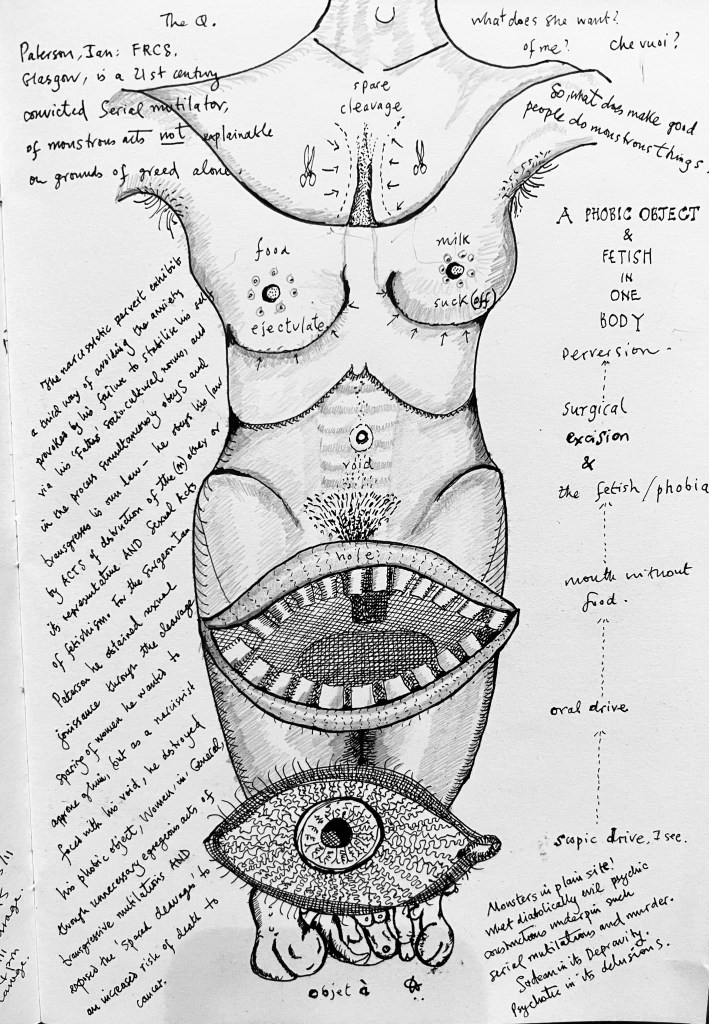
As an aside to the debate over Shared Decision Making (SDM) vs so-called Quality Improvement (QI). which is focused on methods of decision making at a patient and population level respectively, another (and perhaps less intellectually accessible) problem may well be the question of the decision itself.
INTRODUCTION
One specialism within Evidence Based Medicine is Shared Decision Making. There is much debate and research on the ‘best’ ways to share decision about healthcare with patients. This work usually assumes that a patient can be empowered to make a rational and free choice so long as she or he is provided with all the relevant information in an unbiased way.
My problem with this, the psychology and praxis of SDM, is that people and soon-to-be-patients, and health professionals are always caught up in the moral imperatives imposed by cultural norms so that even the presentation of the option of a health care intervention becomes performative. And that is to say it persuades. The health scientists are driven by a utopian vision of ‘the cure’, the ‘final solution’ of medicine; and patients made fearful and driven to desire more, that is, more of everything (possessions, wealth. Life, security, meaning). These concerns have led me to argue that for anticipatory diagnostic health care aimed at the currently asymptomatic that presenting ‘screening’ enforces a decision and that this undermines autonomy and risks harm in ways that patients and most health professionals are unable to evaluate objectively. There comes a point therefore when, just because a technology is available, it becomes reasonable to withhold the offer of such interventions. In this wildy neoliberal and pragmatic world the very idea of not offering screening interventions must sound ultra-idealistic and utopian. Nonetheless as an idea it has power and such ideas once germinated can grow.
It is clear that approaches to SDM are worth pursuing as decisions often cannot be avoided.
However, crucially, for important sectors of care, decisions could be avoided. And this may be especially true for a major arena of care – population-based anticipatory diagnostic screening programmes. These programmes arguably cause more harm than good, and impose an emotional debt on a public made to feel fearful and duty bound to comply.
I believe too little attention has been given to how, in these modes of care, values and meaning are produced through the power relations between the medical-industrial complex, medical scientist-practitioners, and the public, by:
a) cultivating totalising fantasies of perfect solutions, cures and preventions;
b) inciting excessive implementation of interventions by demands for
c) increasing consumption by an anxious public made fearful.
These relationships, of power, lead to two problems:
First, as with the science-industrial complex in general the fantasy or assumption of a final solution, or cure, incites a perverse fanaticism in the professions that demands always more, more science, more cure, more screening uptake, more fire-power, regardless of the consequences.
This fanaticism takes the form of a self-instrumentalisation in the service of (medical) science – a radical disavowal of the harmful consequences – and what I have called a juridicistic perversion. The psyche of the medical scientist in pursuit of Cure – can only lives with the harms by rejection of socially acceptable conscious norms and becomes an embodiment of the lethal Law that demands more intervention, more innovation and more decisions.
See:
‘Now I am become death, destroyer of worlds’: science, perversion, psychoanalysis, Journal for Cultural Research, 24:4, 315-333, DOI: 10.1080/14797585.2020.1861811
Below is a copy of Nedoh’s paper, in the context of the science-industrial complex and the invention of the atomic bomb. This illustrates the deformation of the scientific psyche by the totalising ideology of a Totalitarian Law that demands more knowledge regardless of the consequences inciting a kind of bureaucratic or juridical perversion in which the Science for more intervention in the name of absoluteness is fetishized and becomes the fetish object.
Second, the effect of this demand for (always) more has been to unleash hyperbolic levels of anticipatory or curative technologies, and their harmful consequences.
APPENDIX – Nedoh’s paper of the science-industrial complex and self-instrumentalisation.
‘Now I am become death, destroyer of worlds’: science, perversion, psychoanalysis, Journal for Cultural Research, 24:4, 315-333, DOI: 10.1080/14797585.2020.1861811
ABSTRACT
This article offers a critical examination of the contemporary imperative to ‘trust science’ from the point of view of Lacanian psychoanalysis. It begins by putting contemporary scientific research in the twentieth-century historical context of the ‘military- industrial complex’ (D. Eisenhower) in which science and technol- ogy become symbiotically connected to the military. It then exam- ines the psychic structure driving the military-industrial complex in which science (perversely) instrumentalises itself for military pur- poses. This structure is crystalized in two statements of J. Robert Oppenheimer, the principal investigator of the Manhattan Project. In these two statements, Oppenheimer describes this singular invention in terms of being ‘good’ and having ‘intrinsic value to humanity’, which is then bound to an identification with ‘death’ and total destruction in his famous citation of the Bhagavad-Gita. The article then proposes that the psychic structure underpinning this claim corresponds to the Kantian notion of diabolic evil, and then goes on to further conceptualise structure under the concept of ‘bureaucratic science’. The article concludes by showing how such a self-instrumentalization of science does not correspond to the psychoanalytic concept of the death drive, as is usually implied, but rather to the superego defined by Lacan as the ‘imperative to enjoy’.
“Now I am become death, destroyer of worlds.” (Bhagavad-Gita, cited by J. Robert Oppenheimer, 1945, in Marzec, 2015)
“I don’t want you to listen to me. I want you to listen to the scientists. I want you to unite behind science and I want you to take a real action.” (Greta Thunberg, 2019, in Volcovici, 2019)
Introduction
On 18 September 2019, climate activist Greta Thunberg addressed US Congress in a now historic speech, begging US lawmakers to ‘listen to the scientists’ and to ‘unite behind science’ in order to counteract climate change and the global environmental crisis. Following the growing concern about the catastrophic impact of climate change amongst progressive political groups in Western countries, as well as the persistent climate scepti- cism on the conservative side of the political spectrum, it is no coincidence that the imperative to ‘trust science’ has already become the unquestionable imperative of today’s mainstream Western progressive orientations.
Yet, despite its noble appearance, such an imperative raises multiple concerns for the critical gaze. At first glance, the imperative is already symptomatic insofar as it is actually the supplement for the missing political programme of the Left, which (follow- ing Žižek’s repetition of Benjamin’s insight that, historically, fascism is a sign of a failed revolution) has created the space for the rise of reactionary populism over the last decade. In other words, after a decades-long series of defeats in the ideological battle against the – then neoliberal and today authoritarian – political paradigms, the political Left is now having recourse to science as an a-political mode of mobilisation in order to simultaneously cover over and supplement its impotency to mobilise the masses with its own political programme. In this respect, it is reductive to restrict such an imperative exclusively to the issue of climate change. The imperative to ‘trust science’ is often taken by progressivists in an almost Kantian sense of the term: as a universal, that is, all- encompassing imperative that operates as a leading principle in all areas of the decision-making process. What is disavowed, here, is that such an imperative is clearly a form of depoliticisation, and as such does not solve the problem, but rather to reinforce it.1
Now, on a much more fundamental level, such an imperative to ‘trust science’ none- theless raises even more important questions, that go well beyond the bare symptomatic revelation of the absence of a political programme. To introduce the subject of this article, I want to argue that the apparently unconditional imperative to ‘trust science’ raises the following question: To what kind of ‘science’ does such an imperative refer? Put differ- ently, what is the science that, in its logic and structure, suits such an imperative to ‘trust science’? Without asking such tough, yet necessary questions, the imperative to ‘trust science’ or to ‘unite behind science’ may end up being much more ambiguous, even dangerous, than first appears. Not only might such an imperative remain very abstract and empty, but, in so doing, it would neglect the concrete historical context and social structure in which science operates.
This structure is, as many scholars have documented, far from being neutral. As Marzec (2015) is only the latest critic to show, contemporary mainstream science and technology, including climate science, are not abstract and detached from society and politics, but are actually very concrete structures that belong to a longstanding historical context, stretch- ing back to the first half of the twentieth century, that President Dwight Eisenhower famously called the ‘military-industrial complex’.2 Such a ‘militarised science’ was, for instance, capable of inventing not only creative and emancipatory solutions for humanity and the world, but also very destructive innovations, such as, for instance, the atomic bomb – a weapon that has the potential to terminate all life on Earth. Moreover, the invention of this weapon of mass destruction was done in the name of protecting the world, which ultimately led not only to the conflation of security and insecurity, as Marzec notes, or of biopolitics and thanatopolitics, but also of scientific creation and destruction. As Robert Oppenheimer’s alleged reference to an ancient Hindu verse on 16 July 1945, upon witnessing the first successful detonation of nuclear weapon in the desert of New Mexico, proposed: ‘Now I am become death, the destroyer of the worlds.’ Today still, climate change is one of the primary concerns of US military institutions, from the Department of Defence to the US Army.
This article offers a critical examination of the contemporary imperative to ‘trust science’ from the point of view of Lacanian psychoanalysis. It begins by putting con- temporary scientific research in the twentieth-century historical context of the ‘military- industrial complex’ (D. Eisenhower) in which science and technology become symbioti- cally connected to the military. It then examines the psychic structure driving the military- industrial complex in which science (perversely) instrumentalises itself for military pur- poses. This structure is crystalized in two statements of J. Robert Oppenheimer, the principal investigator of the Manhattan Project which led to the invention of the atomic bomb. In these two statements, Oppenheimer describes this singular invention in terms of being ‘good’ and having ‘intrinsic value to humanity’, which is then bound to an identi- fication with ‘death’ and total destruction in his famous citation of the Bhagavad-Gita. The article then proposes that the psychic structure underpinning this claim corresponds to the Kantian notion of diabolic evil, and then goes on to further conceptualise structure under the concept of ‘bureaucratic science’. In the last section, drawing on Lacan’s sharp distinction between the death drive and the superego, the article concludes by showing how such a self-instrumentalization of science, which completes itself only in the real possibility of the total destruction of the world, does not correspond to the concept of the death drive, as is usually implied, but rather to the teleological dynamics of desire, the ‘jouissance of transgression’, and to the corresponding concept of superego as defined by Lacan as the ‘imperative of jouissance’ (Lacan, 1998a, p. 3).
So, my contention will be that the scientific and technological inventions with the widest destructive potential which emerged out of the convergence between science and technology in the military-industrial complex – a convergence that still persists today – would not be possible without the surplus ‘systemic enjoyment’ (Tomšič, 2019; Zupančič, 2020) imposed by the superego – a surplus enjoyment which emerges from the very renunciation of direct subjective enjoyment. Such a systemic enjoyment should not be misunderstood as necessarily related to any kind of individual excessive behaviour, but as operating in the seemingly smooth functioning of the system itself. In short, systemic enjoyment is the effect of the ontological structure, and as such exists even in circum- stances where nobody seemingly enjoys subjectively. Contemporary science and tech- nology are, therefore, the modes of participating in the contradictions that are generated by this ontological surplus, albeit without solving them.
Science between the teleology of desire and the jouissance of transgression: the case of J. Robert Oppenheimer
In any discussion of J. Robert Oppenheimer, the project leader of the atomic bomb programme, his reaction to the first successful detonation of a nuclear weapon is invari- ably recalled. As he famously put it on 16 July 1945: ‘Now I have become death, destroyer of worlds.’ However, far less known and discussed is another of his statements, also from 1945, in which he describes the reasons that led him and his team to take and eventually to complete the job of inventing the atomic bomb:
The reason we did this job is because it is an organic necessity. If you are a scientist you cannot stop such a thing. If you are a scientist you believe that it is good to find out how the world works; that it is good to find out what the realities are . . . It is not possible to be a scientist unless you believe that the knowledge of the world, and the power which this gives, is a thing which is of intrinsic value to humanity, and that you are using it to help in the spread of knowledge, and are willing to take the consequences. (Oppenheimer, cited in Marzec, 2015, p. 33)
This statement alone brings up several different issues. First, as Marzec rightly pointed out, it is a paradigmatic example of a ‘unidirectional’, ‘teleological’ mode of thinking, which is one of the main characteristics of the twentieth century ‘militarizing scientific and technological research from the ground up’. (Marzec, 2015, p. 32.) On the one hand, the teleology at stake obviously consists in the binding together of the essence of science with the ‘organic necessity’ of inventing the atomic bomb. In other words, when it came to the need to invent the nuclear weapon, Oppenheimer claims, scientists as such could not do otherwise than fully identifying this specific task with the whole idea of science itself. This reduction of science to the ‘organic necessity’ to fulfil the task of inventing the atomic bomb corresponds to a peculiar reversal of the temporality of existence, which is taken here as entirely autonomous of any scientific subjective involvement in the con- stitution of this very same reality itself. By disavowing any role for the subject in the discovery of objective reality, Oppenheimer actually turns the relation between subject and object upside down: the scientist thus become not just an instrument, but an automatic instrument, a tool in the process of discovering a seemingly pre-existing reality (the atomic bomb/weapon of mass destruction). In Marzec’s own words: ‘the scientist true to his or her own profession will assume the mandate of unveiling the secret nature of reality (preforming hard science by confronting hard reality without prejudice) – as if the reality of releasing a force of mass destruction preexisted its own constitution in and through the intellectual activity of a wartime-motivated inquirer.’ (Marzec, 2015, p. 33.) However, there is more at stake here, since Oppenheimer characterises such an ‘organic necessity’ of inventing the nuclear weapon as unequivocally ‘good’. Even more, he claims that such an invention has ‘intrinsic value to humanity’, which implies its universal ethical validity. Finally, if we take this claim together with Oppenheimer’s more famous citation of the old Hindu text, we get the following logical formulation: the supreme universal good (or invention of atomic bomb), which has an ‘intrinsic value to humanity’, is looped back into its own opposite, that is, the ‘death’ and total ‘destruction of the world’.
This kind of teleological thinking and self-instrumentalization of science for military purposes (the invention of weapon of mass destruction), which is moreover ‘good’ and has ‘intrinsic value to humanity’, immediately evokes Kant’s well-known idea of evil and the inversion of the moral law, even though the latter was usually applied to the US’s chief enemy during WW II: Nazi Germany, and especially the bureaucratic logic of power during the Holocaust. To recall very briefly, Kant’s revolution in ethics in his Critique of Practical Reason (Kant, 2015), consist in inverting the ancient hierarchy between ‘good’ and ‘the law’ upside down. If, for the Ancients, the supreme good was a cornerstone of ethics, and the law was subordinated to it in the form of its external expression/ emanation, Kant inverted this relationship so that the ‘highest good’ is now directly the law as the empty form, devoid of any positive content, and judged only following the criterion of its universal validity. In other words, the Kantian ‘moral law is THE LAW, the form of the law and as such cannot be grounded in a higher principle’. (Deleuze, 1991, p. 83)
Therefore, the moral law as an empty form is a self-standing, unconditional entity, which is grounded in the pure will alone, and not in any external (natural) causality or subjective pleasure. The unconditional of the moral law is also the reason why Kant considered so- conceived ethical acts as acts of freedom (see Zupančič, 2000). Following this, Kant’s categorical imperative is a formal determination of an act, which is not only in accordance with the moral law as an empty form, but is also motivated entirely and exclusively by the latter – an act of duty from respect of the law. It requires no positive prescription, but only the universal validity of the maxim of the action. As Kant famously puts it: ‘There is, therefore, only a single categorical imperative and it is this: act only in accordance with that maxim through which you can at the same time will that it become a universal law.’ (Kant, 1998, p. 31) On the opposite end of this schema stands what Kant considers the ‘pathological’, or ‘evil’, which is defined negatively with regard to the moral law, that is, as non-self-grounded – an action that derives from and is motivated by the self-interest of the subject (by sensible impulses and subjective pleasure), which is by definition not universal, but particular.
In the very last session of his Seminar VII, famously entitled by Jacques-Alain Miller as ‘Paradoxes of ethics, or, have you acted in conformity with your desire?’ (Lacan, 1997, pp. 311–325), Lacan returns to Kant’s moral law once again in order to show how this corner- stone of Kant’s ethics opens up a psychoanalytic insight into the dynamics and topology of desire. In contrast to the classical Aristotelian ethic ‘of the possible’, Kant’s moral law as an empty form introduces the ‘void’ at the core of moral experience, which is ‘blind’ to the possible and impossible, so to speak. As we already mentioned, the only demand of the moral law is to act from the duty of the moral law itself – this is the essence of Kantian ‘Thou shalt’. However, as Lacan does not fail to stress, for Kant, it is impossible for human mortals to fully achieve this so-conceived ethical experience in this world (‘nothing on earth satisfies the demands of moral action’, p. 316), rather, they can only infinitely approach the moral law – this is why Kant postulates the ‘immortality of the soul’. Against this background, Lacan then shows how the moral law qua void, and the subject infinitely approaching the moral experience without ever completely reaching it in its totality, correspond precisely to the relation between subject and desire (as desire of the Other). What triggers the meto- nymic sliding of desire from one empirical object to another is not any positive content in the Other, but the object-cause-of-desire, that is, the constitutively lacking object which embodies the void. In line with Kant’s moral law, and in contrast with the ancient ‘ethics of the possible’, Lacan thus posits desire as the ‘incommensurable measure, an infinite measure’ (p. 316), which cannot ever be fully satisfied – desire is always ‘the desire for something else’ (Lacan, 2006d, p. 431). So conceived, desire is not repetitive, but slides from one object to another, which makes it essentially ‘perverse’ and ‘teleological’ – it is ‘tele- ology-without-repetition’, as opposed to the death drive, which is ‘repetition-without- teleology’ (Johnston, 2017, p. 186). Desire is fixed on and oriented towards the point of the ‘beyond’ (object-cause-of-desire) that cannot ever be reached – if one reaches it, one at the same time traverses the limits of desire and enters the domain of Das Ding, which, at the level of Seminar VII, is foreign to the ‘service of the goods’ and ‘responds only to enjoyment, the death drive and to waste’ (De Kesel, 2009, p. 266). This is also the reason why the Law actually imposes the repression of desire (‘law and repressed desire are one and the same thing’, Lacan, 2006a, p. 660), while, with this same gesture, also sets up its own obscene ‘other side’, which consists of the imperative of transgression.
This imperative to transgress the law fits the double-sided instance of the superego, which Lacan associates with, on the one hand, the (sadistic) sense of guilt (Seminar VII), and, on the other, the imperative of jouissance (Seminar XX). The more the subject attempts to act in conformity with her desire and transgresses the law and enjoys, the more she feels guilty, since the law (symbolic authority) imposes precisely the repression of desire. This is why, later on, alongside the shifts in the ‘paradigms of jouissance’ (Miller, 2000) from the inaccessible jouissance of Das Ding to surplus enjoyment (enjoyment gained from the very renunciation of enjoyment), whereby modern scientific-capitalist knowledge becomes the apparatus of jouissance (see Lacan, 2006c), Lacan also opens up guilt itself as the source of (surplus) enjoyment (see McGowan, 2020).
Such a self-instrumentalization for the purposes of transgressing the law by ‘obeying orders’ famously attracted the interest of Hannah Arendt when she attended Adolf Eichmann’s trail in 1963 in Israel, and eventually led her to develop her classic thesis on the ‘banality of evil’ (Arendt, 2006 [1964]). For Arendt, there was nothing demoniac in Eichmann, nothing hidden under the surface: Eichmann was not at all a ‘sadistic pervert’. On the contrary, Eichmann was a ‘superficial’, ‘thoughtless’ professional bureaucrat, who only executed the orders of his superiors. He was, in short, a completely ordinary profes- sional employee in a supposedly bureaucratic machine, one that can also be found in the ‘normal’ functioning of power in capitalist democracies. However, although Arendt rightly rejects the idea of any demonic ‘depth’ in Eichmann, and developing instead the concept of the ‘banality of the evil’ (that is, absurdity or superficiality), this thesis requires another shift in perspective. As Žižek has pointed out in his commentary on Arendt’s analysis of Eichmann and the transgression of the law by obeying orders of Nazi bureaucratic power, her analysis does not include one specific and yet a key element of this transgression, which is exactly the element of the obscene systemic enjoyment, related to the super- ego’s injunction to transgress and to enjoy, driving Nazi atrocities (Žižek, 1997, pp. 231–232).3 By rejecting any direct, immediate pleasure in torturing and killing, limiting themselves to only ‘executing orders’ as cold automata, the agents of the Nazi bureau- cratic machine gained an excessive, surplus enjoyment, which Lacan defined precisely as the paradoxical enjoyment that derives from the rejection of immediate enjoyment itself. According to Todd McGowan, the most extreme and clear example of the logic of gaining (surplus) enjoyment from the very renunciation of (direct) enjoyment, is, perhaps, the famous Heinrich Himmler speech to a group of SS officers on 4 October 1943, at the dawn of the ‘Final Solution’. There, Himmler made clear the imperative of duty to sacrifice the material enjoyment for the enjoyment of the ‘cause’: ‘We have the moral right, we had the duty to our people to do it, to kill this people who wanted to kill us. But we do not have the right to enrich ourselves with even one fur, with one Mark, with one cigarette, with one watch, with anything.’ (Himmler, as cited in McGowan, 2020, p. 148). In further commenting upon this passage, McGowan rightly points out how this logic of surplus enjoyment corresponds precisely to the superego’s injunction to transgress (the law) and to enjoy:
Himmler exposes perfectly how the superego functions in politics. It directs subjects to do what they know violates the law in the name of a higher morality.
Because the superego enjoins them to transgress the law for a higher cause, it creates enjoyment for them through the burden of guilt that it offers. The strength that Himmler praises is the strength to live with the guilt of the superego and to benefit from the license that it gives the subject to transgress the law. [. . .] Through the superegoic imperative, one can promise followers unrestrained enjoyment while assuring them that one is restoring law and order. The logic of the superego makes this paradoxical politics realizable. (McGowan, 2020, p. 148)
Ultimately, this omission of the superego’s injunction to transgress and to enjoy is, perhaps, the reason which led Arendt to (wrongly) conclude that Eichmann was not any kind of ‘sadistic pervert’. As Žižek notes, in doing so, she refers to the ‘pre-theoretical’ popular image of perversion, which can be found even in Adorno’s and Horkheimer’s Dialectic of Enlightenment (Adorno and Horkheimer, 2002), according to which there is a demonic dimension in sadism. Eichmann was indeed a pervert, yet not according to the popular image of perversion, which depicts the pervert as a subject obsessed with total domination, but precisely according to the Freudian-Lacanian concept of perversion which refers to nothing but the perverse ‘systemic’ (objective) enjoyment generated by the supposedly pure, cold, instrumental ‘execution of orders’ or the professional workings of power. In other words, the pervert is the one who ‘determines himself as object’ (Lacan, 1998b, p. 185; see also Lacan, 2006a), and self-instrumentalises himself for the purposes of the Other’s ‘total’ enjoyment (enjoyment of God). However, regarding the Nazi atrocities, we are still on the level of what Kant considered radical evil, which is by definition not universal, but particular. In fact, the transgression of law and the ‘sacrifice’ for the ‘cause’ related to it must, in any case, remain publicly hidden, which only multiplies the phantas- matic ‘burden’ on the executioners (see, again, McGowan, 2020, p. 148). As Himmler phrases it in the same speech: ‘Most of you will know what it means when 100 bodies lie together, when there are 500, or when there are 1000. And to have seen this through, and – with the exception of human weaknesses – to have remained decent, has made us hard and is a page of glory never mentioned and never to be mentioned.’ (Himmler, as cited in McGowan, 2020, p. 148).
Contrary to this disposition, in which the obscene transgression of the law should remain hidden from the public gaze, Lacan points out that Sade’s politics and philosophy take a step further by elevating the (hidden) transgression of the law (and the superego’s injunction to enjoy and to transgress) at the level of the moral law itself, that is, by universalising transgression so that it becomes indistinguishable from the categorical imperative itself – even at the price of the subject’s own death: ‘I showed you one can easily substitute for Kant’s “Thou shalt” the Sadean phantasm of jouissance elevated to the level of imperative – it is, of course, a pure and almost derisory fantasm, but it doesn’t exclude the possibility of its being elevated to a universal law.’ (Lacan, 1997, p. 316) This is why, as Lacan puts it elsewhere, ‘Sade is the truth of Kant’ (Lacan, 2006a). The elevation of the obscene superego’s injunction to transgress and to enjoy at the level of the catego- rical imperative itself, for which the pervert is even ready to sacrifice himself, however, implies the shift from radical evil (banality of evil) to diabolic evil, which Kant develops in his ‘Religion within the boundaries of mere reason’ (Kant, 2005). In fact, ‘diabolical evil’, as Zupančič puts it,
would occur if we were to elevate opposition to the moral law to the level of the maxim. In this case the maxim would be opposed to the moral law not just ‘negatively’ (as it is in the case of radical evil), but directly. This would imply, for instance, that we would be ready to act contrary to the moral law even if this meant acting contrary to our self-interest and our well- being. We would make it a principle to act against the moral law, and we would stick to this principle no matter what (that is, even if it meant our own death). (Zupančič, 2000, p. 90.)
In this respect, Sade’s politics is indeed the purest example of diabolical evil precisely in the sense that it elevates transgression and the jouissance related to it to the level of principle. Not surprisingly, Lacan articulated this Sadean jouissance of transgression also in terms of a ‘jouissance of destruction’ (Lacan, 1997, p. 197) insofar as jouissance is by definition harmful to the subject. Jelica Šumič-Riha was thus right to point out that Sadean politics is actually a ‘tyranny of jouissance’ (Šimič-Riha, 2018) – it universalises the injunction to transgress (and to destroy) by elevating it to the level of a moral principle.
Bureaucratic science as diabolical evil? Jouissance of destruction as moral law
In the last pages of Seminar VII, Lacan makes it clear that the contemporary social practice that embodies this so-conceived superegoic injunction to transgress and the teleology of desire, is science (twentieth century physics), particularly that which, because of the financial support it receives from political and economic power, implies a ‘payback’, in the form of the technological invention of ‘machines, gadgets, and contraptions’ (Lacan, 1997, p. 325) in the service of that same power. As he puts it: ‘The universal order has to deal with the problem of science in which something is going on whose nature escapes it. Science, which occupies the place of desire, can only be a science of desire in the form of an enormous question mark; and this is doubtless not without a structural cause.’ (p. 325) On the one hand, the ‘question mark’ driving science qua desire, here, corresponds to precisely to the Kantian ‘void’ we discussed above, which makes desire ‘infinite’ or an ‘immeasurable measure’. In other words, science is, here, driven by the desire qua desire of the Other, the void in the Other qua ‘structural cause’, which scientists try to satisfy with the invention of ‘machines, gadgets, and contraptions’ – the atomic bomb which deto- nated in the desert of New Mexico was indeed called a ‘gadget’. In short, science tries to discover/invent precisely object a – the object-cause-of-desire, a constitutively lacking object, which is also the materialisation of the void in the Other (structural cause) (see also Zwart, 2017). As De Kesel points out with regard to the ‘science of desire’, this is the historical place of psychoanalysis, whereby the task of analytic interpretation of desire aims precisely at creating a new knowledge that symbolises excessive unconscious desire (De Kesel, 2009, p. 268).
Yet, on the other hand, science (physics) tries precisely to repress and avoid at all cost desire as such, thereby neglecting the void in the Other, that is, the structural cause driving its inventions. This is why Lacan stresses in ‘Science and Truth’ ‘that science, if one looks at it closely, has no memory’ (Lacan, 2006b, p. 738), which refers precisely to the foreclosing of this constitutive point of truth (as structural cause). Differently put, science wants know nothing about the truth as the ‘objective dimension of discourse’ (Zupančič, 2011), which implies that the discourse (of science) has also the consequences in the real in the sense of producing its own object (after modern science, nature is no longer considered to be a matter qua substance, but the effect of discourse; see on this also
Milner, 2020; and, Chiesa, 2016). However, science is ‘blind’ not only for its subjective involvement in co-creating the reality that supposedly pre-exists its discovery/invention, but, most importantly, for structural/discursive causes driving its own ‘desire to know’. As De Kesel pointed out: ‘Any science – and culture in general – that denies desire runs the risk of becoming victim of that “immeasurable measure”.’ (De Kesel, 2009, p. 267) For Lacan, one of the primary victims – with all the consequential burden of ‘guilt’ – of science driven by desire as an ‘immeasurable measure’, about which it wants know nothing, is precisely Robert Oppenheimer (Lacan, 1997, p. 325). To recall Oppenheimer’s longer statement, which we already cited above, it is clear that he understood his own mission in a way that perfectly fits the teleological dynamics of desire, namely, as attached to the object-cause-of-desire (the bomb) as a materialisation of the ‘void’ which is located beyond the existing symbolic framework (‘If you are a scientist you cannot stop such thing. If you are a scientist you believe that it is good to find out how the world works; that it is good to find out what the realities are . . . ’). However, he remained ‘blind’, so to speak, to the fact that the desire ‘to know’ driving the invention of the bomb was actually the desire of the Other (US political power, and, more precisely, the military-industrial com- plex), which he and his team tried to satisfy with the invention of the ‘gadget’, as if the invention of the bomb were a reality pre-existing any subjective involvement (through desire) in the creation/preservation of this reality itself. For Lacan, in fact, desire’s ten- dency to transgress the law in the direction of jouissance and destruction is operative only within the law itself – one cannot transgress the law outside it. Importantly, we here encounter the role of unconscious fantasy (the relation of simultaneous alienation and conjunction – represented by the lozenge sign – between the split subject of the signifier and the object-cause-of-desire – $<>a) as a support for the teleological sliding of unconscious desire. If Zwart (2017) points out that Oppenheimer’s structural position should be grasped – within Lacan’s university discourse (see Lacan, 2006c) – as knowledge in the position of agent, oriented towards object a (bomb) in the position of the other (S2 →a), we should thus add to this consideration that this relation involves also the ‘desire to know’ in the place of knowledge itself. In other words, the relation is driven by the teleological dynamics (not statics) of desire, oriented towards object a as a materialisation of the void. For Lacan, Oppenheimer’s sense of guilt refers precisely to the acknowledgement of the excessive character of desire (and the pleasure related to it), which led him to invent something whose consequences go well beyond his own intention – a weapon that could terminate the entire life on Earth.
Lacan’s estimation of Oppenheimer’s guilt, here, allegedly refers only to Oppenheimer’s citation of Bhagavad-Gita at the moment of detonation (‘Now I am become death, destroyer of worlds’). However, if we also take into account the latter’s longer statement cited above, the one in which he thinks the invention of the atomic bomb is an ‘organic necessity’ for science, which is, moreover, ‘good’ and has an ‘intrinsic value to humanity’, and we read this claim together with his Bhagavad-Gita quote, we get a more complex picture of science, which shows its closer proximity not simply to Kant’s radical evil, embodied in Nazi bureaucratic machine, but rather to diabolical evil, embo- died in Sade’s elevation of transgression to the level of a categorical imperative. To be sure, Oppenheimer’s statements indeed suggest that the self-instrumentalizing structure driving the invention of the atomic bomb was very similar to the one operating in the Nazi bureaucratic-military machine: the transgression of all symbolic coordinates (existing knowledge) is motivated by a ‘higher cause’ (the invention of the nuclear weapon), which is one and the same with the essence of science, an ‘organic necessity’.
However, the parallel with Oppenheimer’s case does not stop here, since there are two additional elements which escape the complete convergence between his logic and the logic of the Nazi bureaucratic-military machine. On the one hand, Oppenheimer believes that the invention of the bomb is not only scientifically ‘good’, but has also ‘intrinsic value to humanity’. With this gesture, he does nothing but elevate the invention of the bomb to the level of a universal categorical imperative. On the other hand, however, in a purely Sadean manner, he also acknowledges the very real possibility that this universalisation can be one and the same with the complete annihilation of this very same humanity. This is suggested by his citation of the Bhagavad-Gita at the moment of detonation of the ‘gadget’: ‘I am become death, the destroyer of worlds.’ This claim actually binds together the idea of the invention of the atomic bomb (an ‘organic necessity’ for science), considered to be universally ‘good’ and of an ‘intrinsic value to humanity’, with its own opposite, that is, the ‘death’ and destruction of the worlds. Put differently, the invention of the atomic weapon is ‘good’ for science and has ‘intrinsic value to humanity’, even or especially if this means the total destruction of the planet Earth, including the scientific inventors of the weapon. The highest good of science (the bomb) is looped back into the total annihilation of all and everything. In this respect, again, the total destruction and annihilation is elevated to the level of a maxim – it is not negatively, but directly, opposed to the moral law as an empty form, that is, it has the form of the maxim and hence of the categorical imperative, so that the highest good (the moral law) and absolute (diabolical) evil actually becomes indistinguishable. In this respect, it seems justified to call such a blend of bureaucratic logic and scientific research, induced by the military-industrial complex, a bureaucratic science: a science that elevates the invention of atomic bomb, which can terminate the entire life on Earth, to the level of universal value (‘intrinsic value to humanity’) and becomes indistinguishable from the formal requests of the categorical imperative. Most importantly, and slightly differently with respect to Lacan’s reading of this episode proposed at the end of Seminar VII, Oppenheimer’s quote from the Bhagavad-Gita at the moment of detonation might suggest the reversal (by progression) of ‘guilt’ into the purely perverse identification with the object of jouissance (the bomb) and its consequences (‘you are willing to take the consequences’), which can only bring death to the world. In order to achieve the highest good, the subject now establishes himself as the object, which may fulfil the void in the Other by satisfying its desire, even if this means to ‘become death, the destroyer of words’. It is here that the shift from the ordinary perverse metonymic sliding of desire, supported by the unconscious fantasy ($<>a), to perversion proper is achieved, whereby the latter consists mainly in reversing the position of subject and object in ordinary, neurotic fantasy: ‘Next time, I shall come back to what I have called the structure of perversion. Strictly speaking, it is an inverted effect of the phantasy. It is the subject who determines himself as object, in his encounter with the division of subjectivity.’ (Lacan, 1998b, p. 185; see on this also, Lacan, 2006a).
In this respect, it is critical to mention Zwart’s observation that the Manhattan Project was a technological project in the first place (Zwart, 2017, p. 89), which, however, was led by a theoretical physicist (Oppenheimer). In other words, the Manhattan project brought together modern scientific knowledge, which Lacan calls savoir, and empirical/technolo- gical know-how, which he calls savoir-faire and associates with the pre-modern practical knowledge of Aristotelian slave. Not surprisingly, in Seminar XX, Lacan associates this difference between knowledge and technological/empirical savoir-faire precisely with the structure of perversion. In fact, he makes clear that perversion is nothing other than this subversion of knowledge itself: ‘People then [after they have observed the not-yet-true perversion in neurotics, related to the perverse, teleological sliding of desire] began to meet perverts – they’re the ones Aristotle didn’t want to see at all costs. There is in them a subversion of behaviour based on savoir-faire, which is linked to knowledge (savoir), knowledge of the nature of things [i.e., empirical, practical knowledge] – there is a direct connection between sexual behaviour and its truth, namely, amorality [referring to Sade as the truth of Kant].’ (Lacan, 1998a, p. 87) In this passage, Lacan makes it clear that the pervert’s fantasy about the knowledge of enjoyment (and consequently the self- instrumentalization of the pervert as the instrument of Other’s enjoyment), and the scientific truth of the knowledge are one and the same thing.
So, again, in order to grasp the essence of so-conceived bureaucratic science, the idea of radical evil does not suffice – one needs to shift from radical to diabolical evil as an embodiment of Sadean perversion, in which the jouissance of transgression qua (total) destruction is elevated to the level of the moral law itself. Not surprisingly, Arendt herself noted in an overwhelmingly cited passage from Eichmann in Jerusalem that the invention of the nuclear weapon, coupled with the excessive population induced by the growing automaton of production (both of which are direct outcomes of scientific and technolo- gical inventions), the gas chamber would ultimately appear a primitive child’s toy by comparison: ‘The frightening coincidence of the modern population explosion with the discovery of technical devices that, through automation, will make large sections of the population “superfluous” even in terms of labour, and that, through nuclear energy, make it possible to deal with this twofold threat by the use of instruments beside which Hitler’s gassing installations look like an evil child’s fumbling toys, should be enough to make us tremble.’ (Arendt, 2006, p. 273)
However, as Arthur Bradley has recently shown in his highly original reading of Lacan’s Seminar II alongside the history of automation, the machine and the invention of the atomic bomb, the self-destructive teleology set up by the invention of the atomic bomb stretches back-and-forth across the historical continuum: it originates in the idea of the machine and automation, which goes back to Aristotle’s figure of the slave (a living tool), passes through modern philosophy and the political theory of the machine (Descartes, Hobbes, La Mettrie), and finally ends up in the twentieth-century war machine complex (Bradley, 2019b; 2018). Such a self-destructive teleology reaches its apex in the twentieth century during the Cold War with the invention of a Secure Second Strike Retaliatory System (SSRS) that ‘has the capacity to meet a first or “surprise” strike that destroys its command and control structures with a retaliatory second strike of its own,’ (Bradley, 2019b, p. 106) and thus ensuring the ‘mutually assured destruction of the human race’ (p. 107). In this sense, it seems that the SSRS achieves the ideal of self-destructive diabolical evil by folding its own destruction together with the total destruction of the world, insofar as the system, even when it is already destroyed, nevertheless has the capacity to keep destroying beyond its own death in a kind of Lacanian ‘un-deadly’ manner.
Ethics (of science) beyond the superego: from science of desire to science as death drive
In this context, it is also crucial to not conflate this structure of perversion, which relies on identification with the object and the superego’s injunction to enjoy, with the structure of the death drive, which substantially differs from any teleology and self- instrumentalization of the subject for purposes of Other’s jouissance. Lacan himself puts a huge question-mark around Jacques-Alain Miller’s claim in his canonical essay ‘On Perversion’ that we should acknowledge that ‘the drive is by its very nature perverse, and that perversion is the norm of the drive’ (Miller, 1996, p. 313) by arguing that ‘the drive is not perversion. What constitutes the enigmatic character of Freud’s presentation derives precisely from the fact that he wishes to give us a radical structure – in which the subject is not yet placed. On the contrary, what defines perversion is precisely the way in which the subject is placed in it.’ (Lacan, 1998b, pp. 181–182). Far from suggesting we grasp the drive in terms of an a-subjective free-floating energy, in other words, Lacan here relies on Freud’s own theory of the drive from his ‘Drives and Their Vicissitudes’ (Freud, 2001a). Here, Freud indeed develops the concept of the drive as an impersonal constant pressure or force (konstante Kraft), which is, however, structured by passive and active grammatical oppositions (watch/being watched; hear/being heard etc.) and related to the activities of the so-called anatomical erogenous zones on the surface of the body (mouth, eyes, anus and ears). This seems to imply that the drive is indeed structured as an a-subjective, impersonal pressure, yet it is not ‘raw’ material, but rather a very well- composed mechanism – Lacan will call it in the Seminar XI a ‘montage’ (Lacan, 1998b, p. 169). The key for understanding how the drive achieves the shape of a vector repeti- tively circulating around grammatical oppositions is Freud’s original articulation of repres- sion and the point of negativity (castration) at work in it. In fact, as Alenka Zupančič boldly emphasises in her last book What Is Sex? (Zupančič, 2017), there is a persistence of an underlying ontological structure, necessary for the emergence of something like jouis- sance (as different from pleasure), regardless of its changing paradigms. At the core of this structure is what she proposes to call ‘ontological negativity’, which consists of what Freud articulated as the hypothesis of primal repression (Urverdrängung), which fixes the drive:
We have reason to assume that there is a primal repression, a first phase of repression, which consists in the psychical (ideational) representative of the drive [die psychische (Vorstellungs-) Repräsentanz des Tribes] being denied entrance into the conscious. With this a fixation is established; the representative in question persists unaltered from then onwards and the drive remains attached to it. (Freud, 2001b, p. 148)
In my view, the greatest attention needs to be paid to this crucial formulation in Freud’s psychoanalysis. Unlike the standard understanding, Freud here clearly says that what is repressed is not the drive itself, but rather its ‘(ideational) representative [(Vorstellungs-) Repräsentanz]’ or the ‘subject’s marker of this representation’ (Zupančič, 2007, p. 39). Importantly, this point of primal repression – that is, the repression of the primal signifier, which was never conscious, because, to the contrary, the very conscious/unconscious distinction emerges on the basis of primal repression – is one and the same as what Lacan formulates in Seminar XI as the ‘necessary fall of one signifier’ (Lacan, 1998b, p. 218) for the emergence of the symbolic order of language, which starts running according to the ‘logic of signifier’ (that is, the (unary) signifier starts representing the subject for other signifiers) only when one signifier is ‘gone missing’ or with ‘one-signifier-less’ (Zupančič, 2017, p. 47). In short, ontological negativity (primal repression) shapes both the drive (circulation around the hole of primal repression) and language (the logic of signifier begins with ‘one-signifier-less’).
In this respect, Lacan’s death drive amounts not simply to every single partial drive, but to partial drives and the mechanism of repression which shapes drives as partial (Zupančič, 2017, pp. 94–106). This reading has indeed far-reaching consequences, insofar as it reverses Freud’s first articulation of the death drive from his 1921 essay ‘Beyond the Pleasure Principle’. There, Freud famously defined the death drive as the tendency towards the lowering of tension in the human organism to the point of homoeostasis, which finds its final expression in the idea of the return of the subject into inorganic state (see Freud, 2001c, Ch. II). Contrary to this definition, but at the same time following the aforementioned Freudian theory of repression, Lacan’s point is that the death drive has no object outside its circulation, the goal of the drive is precisely the repetitive circulation itself. So, the death drive cannot be grasped in terms of teleology; rather, as Johnston points out, the death drive is a ‘repetition-without-teleology’ – as opposed to desire as ‘teleology-without-repetition’ (Johnston, 2017, p. 186). In this way, the death drive is rather a repetitive excess set up by the structure which involves ontological negativity, an excess which persists beyond life and death, because it is actually indifferent to them.
So, to sum up what we have just shown, primal repression fixes the drives, and, at the same time, also triggers the whole mechanism of (secondary) repressions of all represen- tations that are by association connected with primal repression. Secondary repressions are ordinary, everyday repressions, and as such are essentially ‘after- pressions’. Most importantly, in Seminar XX, Lacan highlights the exact temporal moment in which repression (based on primal repression) occurs: ‘From the moment he [a baby] begins to speak, from that exact moment onward and not before, I can understand that there is [such a thing] as repression.’ (Lacan, 1998a, p. 56) In short, when the baby becomes a speaking being in a strict sense by speaking its first words, the whole mechanism of repression (including the point of primal repression) is there – not earlier, not later, but simultaneously with the beginning of the speech. This structural primacy of (primal) repression also reaffirms Lacan’s early statement from Seminar XI, according to which ‘with regard to the agency of sexuality, all subjects are equal, from the child to the adult’ (Lacan, 1998b, pp. 176–7). So, the drive is shaped by the mechanism of repression, and revolves around the point of negativity or primal repression, while the mechanism of repression starts running at the moment when the child subject starts speaking its first words. The drive is therefore essentially pre-Oedipal (although not pre-linguistic or preceding castration, as Miller rightly stresses), insofar as the Oedipus complex, which is grounded on the acknowledged difference between the sexes (via the gaze on mother’s genitals lacking penis), emerges later on in the development of the psychic-libidinal life of the child.
Conversely, the superego (in all its variations) is essentially post-Oedipal, insofar as it is set up as a ‘decline’ from the Oedipus complex with the emergence of the symbolic law (the symbolic father), conceived as an instance of symbolic prohibition/repression of desire of the mother. More precisely, following Freud’s most complex articulation of the superego in the third chapter ‘The Ego and the Super-ego (Ego Ideal)’ of his essay ‘The Ego and the Id’ (1923) (Freud, 2001d, Ch. III, pp. 28–39), the Oedipus complex can be solved in two different ways: ‘either an identification with his mother or an intensification of his identification with his father.’ (Freud, 2001d, p. 32) However, the ‘means’ for solving the Oedipus complex is the constitution of a fully developed superego, which derives from early unconscious libidinal investments and consists not only in the symbolic law/ideal as the agency of identification (the image of the father), but also in the prohibition (of the mother as the object of child’s satisfaction, that is, his object-cathexis). As Freud puts it:
The super-ego is, however, not simply a residue of the earliest object-choice of the id; it also represents an energetic reaction-formation against those choices. Its relation to the ego is not exhausted by the precept: ‘You ought to be like this (like your father).’ It also comprises the prohibition: ‘You may not be like this (like your father) – that is, you may not do all that he does; some things are his prerogative.’ This double aspect of the ego ideal derives from the fact that the ego ideal had the task of repressing the Oedipus complex; indeed, it is to that revolutionary event that it owes its existence. (Freud, 2001d, p. 34)
The main point is therefore that the superego emerges out of the Oedipus complex and constitutes itself as the agency that represses this very same complex. And it does this by binding the libidinal investments of the drives, which are already shaped by negativity (primal repression), with the symbolic agency of the father (symbolic law). However, this binding is itself contradictory and sadistic towards the subject insofar as it imposes upon it two contradictory injunctions: be like him, and do not be like him. The prohibition at stake indeed refers to the prohibition of the mother as the object of satisfaction, which is, in turn, also the exclusive object of the father’s libidinal satisfaction. This means that the symbolic law itself is perverted, yet, to borrow Andreja Zevnik’s formulation, this ‘perver- sion of law is complete only in the face of the superego’ (Zevnik, 2016, p. 222; see also, 2013). The essential trait of the superego (as the obscene other side of symbolic law) thus lies, as Joan Copjec remarks, in prohibiting something (and in imposing the transgression of this prohibition), but also in never saying what this prohibited object is (the mother’s desire as desire of the Other is essentially enigmatic, just as the Kantian ‘void’ we discussed above): ‘The prohibition proper to the superego renders something unsayable and undoable, to be sure, but it does not say what we should not say or do; it merely imposes a limit that makes everything we do and say seem as nought compared to what we cannot.’ (Copjec, 2015, p. 236) So, the superego does not say what lies beyond the prohibition because the prohibited constitutively defies symbolisation and exists only by being permanently (phantasmatically) displaced into infinity. As Lacan does not fail to add in this regard: ‘That is why the superego, which I qualified earlier as based on the (imperative) “Enjoy!”, is a correlative of castration, the latter being the sign with which an avowal dresses itself up (se pare), the avowal that jouissance of the Other, of the body of the Other, is promoted only on the basis of infinity (de l’infinitude).’ (Lacan, 1998a, pp. 7–8) If castration (ontological negativity qua primal repression) fixes the drive and frames it as partial in relation to the fulfilment of sexuality, one should note that the drive, by circulating around the constitutively missing signifier, is actually indifferent to this very same fulfilment – the goal of the drive is not satisfaction, but repetition/circulation itself (Zupančič, 2017, p. 104). Satisfaction/enjoyment is only an (essential) by-product of circulation. The phenomenon that is attached to this missing object of full satisfaction is therefore not the drive, but desire – the object of the drive is, for Lacan, also the object-cause-of-desire, since the lack of total satisfaction triggers the metonymic (teleological) sliding of desire from one empirical object to another. Being a ‘correlative of castration’, the superego binds up the constitutively missing object with the symbolic prohibition, and – most importantly – replaces the ontological impossibility of full satisfaction with the subject’s impotency of reaching the indefinite object that the superego prohibits – which indeed generates in the subject its sense of guilt, while at the same time imposes the injunction to transgress.
To sum up, the death drive as an ethical category does not impose the commandment to enjoy over the subject. On the contrary, the death drive in its silent repetitive circula- tion is rather indifferent towards enjoyment – it can kill the subject, even if the subject enjoys this self-annihilation. This is also the reason why Lacan in Seminar XX clearly rejects the reduction of the drive to the level of any kind of knowledge-oriented force. More specifically, the Freudian idea of the ‘drive to know’ is directly contradicted by the self- referential structure of the drive, which, according to Lacan, is never the drive towards something. Lacan makes this clear in Seminar XX by rejecting the Freudian idea of ‘drive [trieb] for knowledge’, claiming that ‘“there’s no such thing as a desire to know,” that famous Wissentrieb Freud points to somewhere.’ (Lacan, 1998a, p. 105) In any case, the ‘killing of the subject’ at stake in the death drive aims at the subject’s symbolic identity, not its physical annihilation, while the superego and teleology of desire would rather turn this picture upside down: the superego’s injunction to transgress and to enjoy may even physically kill the subject in order to preserve his or her symbolic identity, which is always given by the Other. Thus, the difference between the superego and the death drive corresponds to the difference between the demand (of the drive), which emerges on the very place of structural impossibility of total enjoyment as a surplus/excess, and the imperative (of the superego), whereby the latter actually replaces the structural impossi- bility of total enjoyment with subject’s impotency to achieve this phantasmatic totality of jouissance.
Conclusion
In drawing this article to a close, I would like to refer the difference between the death drive and the superego, as well as the perverse self-instrumentalization of the subject corresponding to the latter, to Lacan’s inversion of the question ‘Is psychoanalysis a science?’ (that is, is there a homology between psychoanalytic discourse and the discourse of science) into the more accurate and far-reaching question ‘What would a science be that included psychoanalysis?’ (Lacan, 2001, p. 187; on this see Johnston, 2013, pp. 39sq; and, Johnston, 2019a, Ch. 13–15), which suggests a non-homology between psychoanalytic discourse and the discourse of science in the first place. So, rather than implying a scientific status for the psychoanalytic clinic, the question ‘what would a science be that included psychoanalysis?’ points in the direction of the psycho- analytic clinic of science itself. As we have seen, at the level of Seminar VII, Lacan’s answer to this question is a ‘science of desire’, that is, a science that takes as its object of analysis its own unconscious desire, about which it otherwise wants know nothing. This implies a ‘de-teleologization’ of desire and its detachment from the superego’s injunction to transgress by creating a new knowledge (via analytic interpretation) that would bring desire into the picture (De Kesel). However, following Lacan, the latter can occur only through the hysterization of the subject of science so to speak, which would move the science from university discourse, in which the science qua technology is in ‘the service of goods’, to something like ‘hysterical scientific discourse’ as a precondition for the sub- jective destitution of the subject of science. At the end of his teaching, following the changes in ‘paradigms of jouissance’ (Miller) and the shift in psychoanalytic ethics from desire to the death drive, this attempt to detach science from the superego appears in the form of Lacan’s equation of science with the death drive, which, as Johnston notes (Johnston, 2019b, p. 167), occurs in Lacan’s (final) Seminar XXV Le moment du conclure (Lacan, 1977–1978, session of 20 December 1977) in the context of his criticism of the mathematisation of psychoanalytic knowledge that he advocated during previous period of his teaching. Just as in Seminar VII desire is something unconscious, which needs to be interpreted and symbolised, but modern science wants to know nothing about, so are the death drive and jouissance in Lacan’s final seminars (see, again, Johnston, 2019b) some- thing that need to be psychoanalytically ‘deduced’ through interpretation (Miller), but modern science wants to know nothing about. In both cases, we are dealing with the attempt to articulate the ‘truth as cause’ (Lacan, 2006b, p. 738), whereby the latter means the material/structural cause as different from formal cause that science usually deals with, and is coextensive with the separation between jouissance and superego as one of the primary goals of psychoanalytic clinic. This separation is precisely the place of the death drive as pre-Oedipal, yet not pre-linguistic (since it is shaped by castration, that is, by the ‘hole’ in the Other).
In this respect, it could be said that if modern science represses its own desire and remains ‘blind’ for the fact that the ‘truth’ is the consequence of the discourse and does not pre-exists the latter, the majority of contemporary science under the rule of the military-industrial complex does not simply repress its own desire and disavows the consequences of the scientific discourse. As Oppenheimer says, ‘you are willing to take consequences’, even if this consequence means total destruction of the world. This statement alone, however, should not be understood in terms of subjective destitution, but rather as a properly perverse self-instrumentalization for the purposes of the Other’s jouissance. If Freud famously defined the goal of psychoanalytic practice with the formula Wo Es war, soll Ich werden (‘where the Id was, there the Ego shall be’), Oppenheimer actually turns this formula upside down: now the ego instrumen- talises itself by way of embodying the object of jouissance of destruction and, simultaneously, starts speaking on behalf of the truth, whereby the latter, for Lacan, can only speak half-way in the first person (‘I, truth, am speaking’; see Zupančič, 2011). In other words, contemporary science forecloses the truth not simply by repressing it, but precisely by (perversely) speaking directly on its behalf – it disavows the con- sequences of the discourse of science in the real by way of talking about the real all the time. So, the question is not should we trust scientists or not, but, rather, does science trust truth as the effect of discourse or not.
Notes
- I owe this insight to Arthur Bradley. Moreover, as Bradley himself suggested recently in his brilliant Unbearable Life, Robespierre and the Jacobins’ conception of politics was exactly the opposite of contemporary depoliticisation, namely, they conceived politics as a kind of
groundless decision, taken in a void, that is, in a space devoid of any external principles or
‘guarantees’ (Bradley, 2019a, pp. 136–139).
- To be sure, although there is indeed a tectonic change in scientific research represented by
the emergence of the ‘scientific-military complex’, some germs of this ‘militarization of science’ can be found already in the late nineteenth century paradigmatic shift in physics, where modern physics (relativity, radiation, the subatomic realm etc.) replaced a classical (Newtonian) paradigm that had been in force until that point. I owe this point to Adrian Johnston. - To the best of my knowledge, Cory Han-yu Huang’s contribution (Han-yu Huang, 2009) is one of the rare attempts to systematically conceptualise Arendt’s insights on the banality of evil not by directly referring to Kant’s concept of radical evil, but instead along psychoanalytic conceptualisation of the structure of perversion, including the concept of superego, as conceptualised by Lacan and then Žižek – that is, as an imperative of jouissance.
Acknowledgments
I am deeply grateful to Arthur Bradley and Adrian Johnston for their invaluable comments and suggestions on early versions of this article, as well as for many discussions on this theme. I am also grateful to JCR editors Mick Dillon and Scott Wilson for considering this article. I am particularly indebted to Scott Wilson and two anonymous reviewers for their pointed comments and sugges- tions on an earlier draft of this paper. A special thanks goes also to Giovanni Bettini, Peter Klepec, Alenka Zupančič, and my wife Jerneja Brumen for many discussions on topics closely related to this article.
Disclosure statement
No potential conflict of interest was reported by the author.
Funding
This article is a result of the research programme P6-0014 ‘Conditions and Problems of Contemporary Philosophy’, the research project J6-9392 ‘The Problem of Objectivity and Fiction in Contemporary Philosophy’, the research project J5-1794 ‘The Break in Tradition: Hannah Arendt and Conceptual Change’, and the research project J6-2589 ‘Structure and Genealogy of Perversion in Contemporary Philosophy, Politics, and Art’, which are funded by the Slovenian Research Agency.
Notes on contributors
Boštjan Nedoh is a Research Fellow at the Research Centre of the Slovenian Academy of Sciences and Arts, Institute of Philosophy. He works at the intersection between contemporary continental philosophy, psychoanalysis, biopolitical theory, and political theology. He is a co-editor (with Andreja Zevnik) of the volume Lacan and Deleuze: A Disjunctive Synthesis (Edinburgh University Press, 2017) and author of the book Ontology and Perversion: Deleuze, Agamben, Lacan (Rowman and Littlefield International, 2019).
References
Adorno, T., & Horkheimer, M. (1947/2002). Dialectic of enlightenment. Philosophical fragments (E. Jephcott Trans.). Stanford University Press.
Arendt, H. 2006 [1964]. Eichmann in Jerusalem: Report on the banality of evil.
Bradley, A. (2018). In the sovereign machine: Sovereignty, governmentality, automaticity. Journal for Cultural Research, 22(3), 209–223. https://doi.org/10.1080/14797585.2018.1461359
Bradley, A. (2019a). Unbearable life: A genealogy of political erasure. Columbia University Press. Bradley, A. (2019b). Lacan’s war games: cybernetics, sovereignty, and war in seminar II. Filozofski
Vestnik, 40(1), 89–107. https://ojs.zrc-sazu.si/filozofski-vestnik/article/view/8097/7494
Chiesa, L. (2016). The not-two: Logic and God in Lacan. MIT Press.
Copjec, J. 2015 [1994]. Read my desire: Lacan against the historicists (2nd ed.). Verso.
De Kesel, M. (2001/2009). Eros and ethics: Reading Lacan’s seminar VII (S. Jöttkandt Trans.). State
University of New York Press.
Deleuze, G. (1991). Coldness and cruelty (J. McNeil, Trans.). In G. Deleuze, L. von Sacher-masoch, &
J. McNeilEds., Masochism: Coldness and cruelty and venus in furs (pp. 9–138). Zone Books.
Freud, S. (2001a). Instincts and their vicissitudes. In J. Strachey (Ed.), The standard edition of the
complete psychological works of Sigmund Freud (Vol. XIV, pp. 109–140). Vintage.
Freud, S. (2001b). Repression. In J. Strachey (Ed.), The standard edition of the complete psychological
works of Sigmund Freud (Vol. XIV, pp. 141–158). Vintage.
Freud, S. (2001c). Beyond the pleasure principle. In J. Strachey (Ed.), The standard edition of the
complete psychological works of Sigmund Freud (Vol. XVIII, pp. 7–64). Vintage.
Freud, S. (2001d). The ego and the Id.”. In J. Strachey (Ed.), The standard edition of the complete
psychological works of Sigmund Freud (Vol. XIX, pp. 1–66). Vintage.
Han-yu Huang, C. (2009). The banality of radical evil in the name of enjoyment: Hannah arendt
revisited through ethics of psychoanalysis. NTU Studies in Language and Literature, 21, 57–80.
https://doi.org/10.6153/2009.21.03
Johnston, A. (2013). Prolegomena to any future materialism, volume one: The outcome of contempor-
ary French philosophy. Northwestern University Press.
Johnston, A. (2017). Repetition and difference: Žižek, Deleuze and Lacanian drives. In B. Nedoh &
A. Zevnik (Eds.), Lacan and Deleuze: A disjunctive synthesis (pp. 180–202). Edinburgh University
Press.
Johnston, A. (2019a). Prolegomena to any future materialism, volume two: Weak nature alone.
Northwestern University Press.
Johnston, A. (2019b). Lacan’s endgame: Philosophy, science, and religion in the final seminars. Crisis
and Critique, 6(1), 156–187. http://crisiscritique.org/april2019/johnston.pdf
Kant, I. (1785/1998). Groundwork of the metaphysics of morals (M. Gregor Trans.). Cambridge
University Press.
Kant, I. (2005). Religion within the boundaries of mere reason. In A. W. Wood & G. Giovanni (Eds.),
Religion and rational theology (pp. 39–215). Cambridge University Press.
Kant, I. (1788/2015). Critique of practical reason (M. Gregor Trans.). Cambridge University Press. Lacan, J. (1977–1978). unpublished typescript. Le Séminaire de Jacques Lacan, Livre XXV: Le moment
de conclure, 1977–1978.
Lacan, J. (1986/1997). The seminar of Jacques Lacan, book VII: The ethics of psychoanalysis (D. Porter
Trans.). W. W. Norton and Company.
Lacan, J. (1975/1998a). The seminar of Jacques Lacan, book XX: Encore, on feminine sexuality, the limits
of love and knowledge (B. Fink Trans.). W. W. Norton and Company.
Lacan, J. (1973/1998b). The seminar of Jacques Lacan, book XI: The four fundamental concepts of
psychoanalysis (A. Sheridan Trans.). W. W. Norton and Company.
Lacan, J. (2001). Les quatre concepts fondamentaux de la psychanalyse: Compte rendu du Séminaire
- In J.-A. Miller (Ed.), Autres écrits (pp. 187–189). Éditions du Seuil.
Lacan, J. (2006a). Kant with Sade. In B. Fink (Ed.), Écrits: The first complete edition in English (pp.
645–668). W. W. Norton and Company.
Lacan, J. (2006b). Science and truth. In B. Fink (Ed.), Écrits: the first complete edition in English (pp.
726–745). W. W. Norton and Company.
Lacan, J. (1991/2006c). The seminar of Jacques Lacan, book XVII: The other side of psychoanalysis
(R. Grigg Trans.). W. W. Norton and Company.
Lacan, J. (2006d). The instance of the letter in the unconscious, or, reason since Freud. In B. Fink (Ed.),
Écrits: The first complete edition in English (pp. 412–441). W. W. Norton and Company.
Marzec, R. P. (2015). Militarizing the environment: Climate change and security state. University of Minnesota Press.
McGowan, T. (2020). Superego and the law. In Y. Stavrakakis (Ed.), Routledge handbook of psycho- analytic political theory (pp. 139–150). Routledge.
Miller, J.-A. (1996). On perversion. In R. Feldstein, B. Fink, & M. Jannus (Eds.), Reading seminars I and II: Lacan’s return to Freud (pp. 306–320). State University of New York Press.
Miller, J.-A. (2000). Paradigms of Jouissance (J. Jauregi Trans.). Lacanian Ink, 17, 8–47.
Milner, J.-C. (1995/2020). A search for clarity: Science and philosophy in Lacan’s oeuvre (E. Pluth Trans.).
Northwestern University Press.
Šumič-Riha, J. (2018). Sadean politics or a Tyranny of Jouissance. Filozofski Vestnik, 39(3), 71–120.
https://ojs.zrc-sazu.si/filozofski-vestnik/article/view/7225/6743
Tomšič, S. (2019). The labour of enjoyment: Towards a critique of libidinal economy. August Verlag. Volcovici, V. (2019). UPADTE 1-Greta Thunberg to Congress: ‘Don’t listen to me. Listen to scientists’.
Reuters, September 18, 2019. Retrieved December 5, 2020, from: https://www.reuters.com/arti
cle/climate-change-thunberg-congress-idUSL2N2690MK
Zevnik, A. (2013). Life at the limit: Body, eroticism, and the excess. Theory & Event, 16(4). Retrieved
June 9, 2020, from https://muse.jhu.edu/article/530501.
Zevnik, A. (2016). Kant avec Sade: Ethics entrapped in perversions of law and politics. In S. Tomšič &
A. Zevnik (Eds.), Jacques Lacan between psychoanalysis and politics (pp. 217–232). Routledge. Žižek, S. (1997). The plague of fantasies. Verso.
Zupančič, A. (2000). Ethics of the real: Kant and Lacan. Verso.
Zupančič, A. (2007). On repetition. Sats – Nordic Journal of Philosophy, 8(1), 27–44. https://doi.org/10.
1515/SATS.2007.27
Zupančič, A. (2011). Realism in psychoanalysis. European Journal of Psychoanalysis, 32, 29–48.
Retreived June 9, 2020, from https://www.journal-psychoanalysis.eu/realism-in-psychoanalysis/ Zupančič, A. (2017). What is sex? MIT Press.
Zupančič, A. (2020). A-seksualno nasilje in sistemski užitek [A-sexual violence and systemic enjoy-
ment]. Problemi, 58(1–2), 5–29.
Zwart, H. (2017). Tales of research misconduct: A Lacanian diagnostics of integrity challenges in science
novels.