Category: Uncategorized

  • A novel: All the names by José Saramago

    A beautifully crafted and written tale about what it is to be human having thoughts, desires, making decisions. Through the mind of a lowly clerk – the novel takes us on a journey, or even an adventure, of the mind. Senhor José’s strange hobby: collecting media reports about celebrities, becomes a perverse fetish: the hunt for an unknown woman.

    Is he the universal ‘human’, who is perverse, and ‘enjoying’ his symptom? Who seeks, but fails to find, freedom from his incompleteness and subjugation by following his desire – apparently ridiculous, irrational, inexplicable – relentlessly, never satisfied, desire followed through continually new, endless, demands and objects: to satisfy his need for knowledge of the other (described in the novel as being identical to ‘love’ of the other), to try but always fail to, I think, complete his sense of himself.

    So this novel is about perversion, the unconscious, desire, lack, failing but failing better. And it appears to end on an optimistic, perhaps overly optimistic note, as his erstwhile dictatorial boss becomes his admirer and accomplice, setting him free to continue looking for love through the fantasy of the anonymous and immortal other.

    However, there is a much less optimistic, darker undercurrent; he objectivises the unknown woman, even as a sex object; and her suicide, it is obliquely implied, may be a direct result of his enquiries. She ‘doesn’t want to be found’ but he pursues her relentlessly. He wants to own her it seems.

    This may be a pessimistic perspective on man’s incapacity to ever truly love, with love that isn’t, at least partially, at the expense of the other.

  • Slow violence and anticipatory medicine

    The ‘slow violence’ of Human Eco-Biological destruction by anticipatory medicine and a strategy of selective non-violent resistance.

    Adapting Nixon’s (Robert Nixon: 2011 Slow violence and the environmentalism of the poor. Cambridge. Harvard University Press) concept of slow violence through environmental damage: we need new terminology to capture the idea of a human biological environment – a human ecobiological environment – the idea or concept of a person’s biological ecosystem: not as something perfectly capable of sustaining function, but something vulnerable to harm through medical intervention – an ecobiology crucial to individual and collective potential, vicariously, to function as well as possible.

    Overtreatment; medicalisation and overdiagnosis:these are the humanly suffered forms of invisible slow violence equivalent to environmental damage : these form of slow violence are slowly dissipating through time, space and human bodies and slowly having effects on collective health through, for example, increasing overdiagnosis due to anticipatory technologies: unsolicited yet still applied or apparently just ‘offered’ to the asymptomatic population – this is causing a slow and insidious expansion of the screening diagnostic tools for screening and names, like pre-diabetes, applied to the de-individualised body/mind: just as technologies, such as de-forestation, intensive farming methods and fracking are applied to the earth’s crust. Yes, gas can be produced by cracking open the crust, but at what collateral environmental cost? Yes, screening can prevent cancer, but at what human eco-biological cost? Overdiagnosis, Overtreatment and medicalisation are invisible, because nobody ever knows they’ve been overdiagnosed because the treatments eradicate the future you might have had. And so the ‘problem’ of overdiagnosis does not capture the public imagination. Invisible because people do not want to know they may have been overdiagnosis because, then, all the anxiety, pain, ill health, and relationship problems caused by the intervention, shall have been as if for nothing.

    A lot of health scientist and medical concern about overdiagnosis is by those who seem either to want to improve the science, or to improve the methods of communication about risk – both of which in fact only, and perversely, serve to reinforce the ideologies that: a) ‘innovative science is good’: thereby expanding technology using empirical science and b) ‘transparency and eliciting values leads to democratic decision-making’, thereby de-individualising the individual in the name of humanising the patient and ‘eliciting her values’ – as if the market and its offer to apply better objective science to diagnose ‘your’ cancer early, has no impact on personal values. And yet our values are constituted through and amongst a) our existential struggles for identity, b) with fear/desire/guilt and with c) the apparent moral imperative to consume.

    Healthcare may have something useful to learn from the politics of non-violence (see Gene Sharpe 1973, The politics of non-violent action, referenced in Glaser 2019. Jeffers’s axe: the instability of non-violence. Psychoanalysis, Culture and Society. Vol. 24. 1. 1-14). Whilst a comprehensive ethical stance that aims to never do harm (violence) is impossible for care providers since most treatment of illness or suffering carry a risk of harm. Yet, a strategic policy of selective non-violence may be effective (as it has been politically in other arenas such as combating colonialist oppression in India) with a particular goal in mind, such as reducing overdiagnosis.

    One could have a policy of selective non-violence by targeting a particular form of healthcare oppression. I am thinking here of a form of oppression that is a) anti-democratic because it uses rhetorical slights of hand that demand consumption and relies on both the incitement of people’s irrational fears of ill-health as well as desire for commodities that promise to, but often fail to, provide the security of surplus life; b) causes harm: overdiagnosis, that is never valued adequate to the harm it causes and is invisible because no one ever knows they’ve been overdiagnosed, or, therefore, experiences it as such, and c) reduces both the opportunity and human potential for delivering care-with-love, or kindness, to individuals who are suffering. This form of oppression is due to a particular cause of slow violence through collective and personal human eco-biological destruction: namely, unsolicited population-based anticipatory diagnostic medical nominal expansion and screening.

    A strategy for selective non-violence to resist and reduce overdiagnosis of the asymptomatic would be for care-providers. to refuse to offer this care to, or even counsel against this form of care for, the public. And, for care-consumers and labourers to campaign against, sanction, this form of care

    Afterthought:

    The end of capitalism is tricky / it feeds off its own disasters : because mystical intuitive pragmatism shrieks and finds another commodity to fix it.

  • Anticipation and Medicine: a fetishised commodity and vulnerable human subjectivity

    News

    GPs order three times as many diagnostic tests as 15 years ago, study finds

    BMJ 2018; 363 doi: https://doi.org/10.1136/bmj.k5093 (Published 29 November 2018)Cite this as: BMJ 2018;363:k5093


    Why has there been such an increase in diagnostic testing?


    I think we should take seriously the interaction between a) diagnostic tests that evoke a sense of anticipation of more secure future personal health and b) the human individual whose sense of himself or herself is intimately bound up with cultural expectation and norms.


    This interaction is between:


    1. Tests that seem to possess a mystical power to secure life itself, in other word tests that are fetishised as commodities that are intensively and freely marketed and available for exchange; and


    1. The human being whose very identity and values, beliefs and behaviour, as a well person, is unsettled by the availability of tests, and whose identity as a moral citizen (doctor, parent, citizen etc.) relies upon following cultural norms.


    And there is no doubt that screening by testing the asymptomatic has now become a cultural norm: regarded as a ‘good thing’.


    The power of a fetishised test to unsettle and capture the identity of us all is leading to increasing harms to healthcare services as well as to the health of the asymptomatic, (or say minimally symptomatic) especially.


    EBM ‘shared decision making’ (SDM) practice sustains this harm because it assumes that a person’s identity, values and preferences can exist and be identified, as if they are independent:  a) of the way commodities are over valued; and b) of the way tests incite fear and lead to a compulsion to agree to testing, even when presented with ‘balanced pros and cons’ as if the process is ‘fair’.


    Perhaps, as a start, screening tests should come with a very clear health warning, as with cigarette smoking: that “Having a diagnostic screening test when you are well can seriously damage your health.”


    I have explored these issues in detail in my recently published book:


    Book Cover

    New Book by Owen Dempsey:

    Anticipation and Medicine: A Critical Analysis of the Science, Praxis and Perversion of Evidence Based Healthcare


    Blog:

    https://myownprivatemedicine.com/

  • A new book: Anticipation and Medicine

    Routledge has just published this new book.

    I have been researching and writing this over the past ten years or so. By way of knowledge and so called ‘expertise’, I have experience as a UK GP,  of  teaching,  and of some health services research, and an MSc in Health Sciences and Clinical Evaluation.

    The book addresses the anticipatory care paradox: the way in which, in the Western World at least, the continuing expansion of anticipatory care – such as population based cancer screening programmes that are promoted in the name of doing good – is in fact causing increasing harms to the capacity to care with love, individual health, and to overall healthcare service accessibility and effectiveness.

    Book Cover

    For a link to the publishers site and a list of the contents go to:

    https://www.routledge.com/Anticipation-and-Medicine-A-Critical-Analysis-of-the-Science-Praxis-and/Dempsey/p/book/9781138552180

    The book is written in a clear accessible style and avoids arcane jargon as far as possible.  It is aimed at undergraduate and postgraduate students of healthcare, and healthcare practitioners, as well as educators of evidence based critical appraisal research, methods and implementation – including those addressing the problems of industry bias, eminence based medicine, overdiagnosis and shared decision-making.

    This book is highly recommended as a tool for evidence based heathcare education.  It introduces, and explains clearly, with case histories, radically new, but crucial concepts for the way anticipatory healthcare interacts with a) science, b) politics and c) our values, in the real world.  This is a book for real EBM.  It goes beyond empirical science: the how and the what of EBM, and the harms of medicalisation, to address why the human condition is vulnerable to oppressive ideologies and sustains the anticipatory care paradox. The book, then, is able to point us towards still partial, but, at least, more emancipatory solutions.

    The book challenges the apparently self-evident good sense of the idea that early diagnosis by population based screening saves lives and is a good thing. As an alternative the emphasis is, instead, shifted towards a healthcare model that aims to protect the individual from apparently knowing interventions, and, at the same time, to liberate the individual’s unknown capacity to self-actualise his or her own optimal potential for health.

    The book asks: a) how and why are powerful medical elites wedded to a pragmatist version of science that decide what effects of care should determine anticipatory healthcare public policy and guidelines and b) why do practitioners and the public alike find such guidelines acceptable, and even desirable?

    To address these questions the book moves beyond the science of EBM, to use three additional sites of knowledge production and meaning making.  These are sites of:  a) political-economic sensibility: that sees capitalist structures and relations as inherently mesmeric and potentially exploitative; b) epistemic (knowledge/truth forming) sensibility: that sees how expert elites use the combination of empirical science andlanguage to shape social beliefs by transforming the meanings of the effects of anticipatory care to: (i) promote the meaning of intended effects to market interventions, and (ii) demote the meaning of collateral harms as harms, that might restrict marketability; and c) psychoanalytic sensibility: that sees the human condition as always embedded within socially produced belief systems, and thereby always vulnerable to exploitation because of its search for, and the necessity to construct, its own values and identity.

    The book identifies a series of collateral harms, that, taken together, cast huge doubt on the healthcare value, and acceptability of the vast majority, at least, of population based anticipatory diagnostic interventions and care.

    In brief, the book identifies six major forms of collateral harms, these are: a) the exploitation of individual desire for commodities of this kind by using  persuasive rhetoric that incites fear, de-values harms, and promises much, and which, in the end, becomes coercive,  b) the impossibility that the fact of over-diagnosis can ever individually be adequately valued as the harm it actually is.  This is because overdiagnosis is never personally experienced, or imaginable as a harm by any one individual – this means that recourse to providing information of the scale of overdiagnosis as a means of suggesting that the shared decision making process is fair is actually simply cover for an insidiously anti-democratic process, c) the continued diversion of limited financial resources to new forms of anticipatory care that is slowly crippling the capacity of carers to respond with interpersonal love to present day suffering, d) individual financial toxicity in places where there is very limited publicly funded healthcare as in, for example, the USA, e) the depersonalisation of inter-personal caring in a system that incites ever more zealous, even perverse, commitment to meeting screening uptake targets as if for the target’s sake, and f) the unknown, but very likely, and unpredictable harms of medical interventions on the delicate ecosystems of the  total-individual, mind and body, to respond to life’s tribulations, and to auto-correct, re-set, self actualise and maximise his or her own  health on an ongoing basis.

    If there is a call for action here, it is simply: a) to educate future and present health carers about these sensibilities and harms, b) to ask individuals, carers and the public at large, to consider re-evaluating their trust, faith and belief in the elite expert authority and institutions that warrant this form of care and these harms, and c) ultimately, to question whether the vast majority of population based anticipatory care is really a good thing.

  • Chemotherapy Guided by a 21-Gene Expression Assay in Breast Cancer

    See here for article and comment

    https://www.nejm.org/doi/full/10.1056/NEJMoa1804710?query=RP

    This paper suggests that this test, a new high tech ‘personalised’ (but actually still a population risk score) genetic signature, enables women to judge whether it is worth risking chemotherapy (in addition to the mastectomy they have already had etc) to prevent a recurrence. In effect it promotes use of the test. But there is more to this than meets the eye.

    This is my comment

    The wrong Question?

    This research promotes the use of this test.

    The list price of this test is £2500 a time, in the UK.

    It will be offered as ‘good practice’ to thousands of women.

    It will cause financial hardship to those who pay privately – many in countries such as the USA without adequate public health services financing.

    A few key points:

    • The test has not been compared with the currently available free test to assess recurrence risk.

    • As such it may be adding zero clinical benefits and only adding cost.

    • When budgets are limited for healthcare ( as they are for publicly funded health services as in the UK NHS) such ‘new’ tests must be paid for out of existing monies: so, a) that money is not available for other services and b) replaces other more cost effective care so that overall health gain is actually reduced.

    • Many patients being over treated with chemotherapy to prevent recurrence have already been overtreated with mastectomy as a result of overdiagnosis by screening.

    The ‘science’ and discourse of this research promotes a neoliberal pragmatism wedded to innovation and a flow of new products for the market.

    It should be put in a diagnostic and socio-economic context otherwise it is harmful and misleading.

    The test is OncotypeDX

  • “Everybody knows the 2 state solution is dead and gone”

    It is commonly said, and I quote from a recent letter from my conservative MP Douglas Ross dated 14th May 2018 (even as IDF snipers are cold bloodily killing peaceful protesters in Gaza) that: “A two state solution brought about through agreement is the most effective way for Palestinian aspirations of statehood to be met”.

    In fact, a two state solution has always been an impossibility ever since the UN General Assembly agreed to partition Palestine in 1947, because this partition gave the zionists and its militia the go ahead to expel the Palestinians with impunity, and to colonise Palestine and to continue colonising Palestine to create Greater Israel: a ‘nation’ sans frontiers. 

    Facts on the ground:

    One of the ways the racist Israel state expands is by creating facts on the ground: settlements, which it can do with impunity largely due to continuing USA support, military aid, UN vetoes and propaganda.

    The following graphic illustrates the way the illegally occupied territories, here the West Bank, have been increasingly, illegally according to international Law, colonised by Jewish settlers.

    Two things should be clear:

    a) with the West Bank so heavily colonised and broken up a Palestinian state could not function.

    b) the persistence rhetoric of an eventual 2 state solution is deceitful and fulfils a function as propaganda for the current apartheid Israeli state that makes continuing colonisation publicly acceptable.

    The following maps show how Palestinian land has been stolen and is disappearing.

    This video provides a little more background. The important points being the massacre and expulsion of up to 1 million Palestinians from their homes and land that provided them with the mean to survive, and the ongoing settler colonisation of the Occupied Palestinian Territories such as the West Bank.

    Therefore:

    a) anybody who is still talking of a two state solution is complicit in Israeli state plans to continue colonising the occupied territories, and is complicit in effect in an ongoing genocide of the Palestinians in Palestine that began in 1948.

    This includes not only Douglas Ross, my conservative MP, but also, for example, UK’s so-called Labour Friends of Israel.

    b) the only just solution is a single binational democratic state from Jordan to the sea, where Jews, and all other denominations and citizens have equal rights and nationality.

    This has been described by Jeff Halper:  The ‘One Democratic State Campaign’ program for a multicultural democratic state in Palestine/Israel.

    As Jeff begins:

    As the Leonard Cohen song goes, “everybody knows” the two-state solution is dead and gone. Zionism’s 120-year quest to Judaize Palestine – to transform Palestine into the Land of Israel – has been completed. Every Israeli government since 1967 has refused to seriously entertain the notion of a genuinely independent and viable Palestinian state alongside the state of Israel. Any possibility of a viable Palestinian state in the OPT has long been buried under the massive “facts on the grounds.” Israel’s Matrix of Control has rendered its control over the entire country permanent.

  • Partition

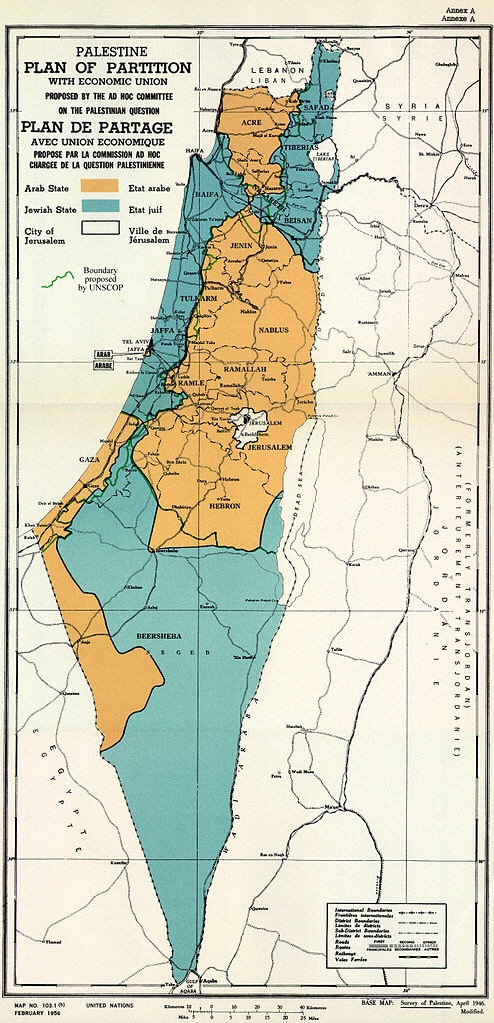
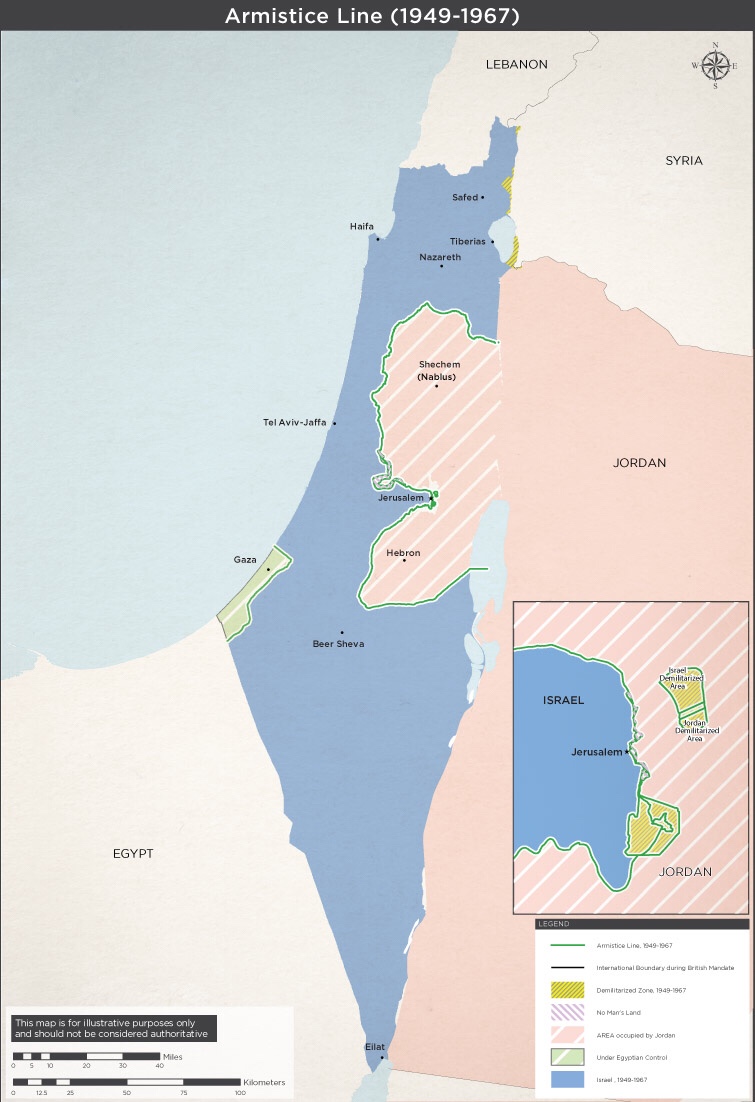
    This is a very brief background to the confusing border between Israel and the occupied West Bank. It differentiates between the planned but never to be ‘Partition’ and the Green Line, and emphasises the impact of the 1967 war and the subsequent Israel’s militarisation of the Green Line after the first intifada, 1987-1991.

    Up to 1948 Palestine was a relatively thriving area between Syria, Lebanon, Egypt and Jordan, cultivated, well educated, cultured, with good transport links between for example, Jaffa, Haifa and Lebanon. It was not as some zionists like to suggest ‘a land with no people’.

    Since the First World War it was under the governance of Britain which had been mandated to be the governing body by the European International Powers.

    Even well before the Second World War European zionists planned to colonise Palestine and turn it into a Jewish state called Israel. In the 1940s, even during the Second World War, Zionist terrorist groups were destroying Palestine’s infrastructure, terrorising the civilian population and attempting to drive the British, and then the Arabs, out, all achieved with, especially, USA Zionist support. (Suarez’ “State of Terror” provides a detailed account)

    The Partition was a plan to divide Palestine according to Resolution 181 in November 1947 of the UN General Assembly. It was suggested by USA/Europe a) as a way for Britain to wash its hands of Palestine and its Palestinian inhabitants, to turn its back, and b) for Israel to achieve statehood – a status that transformed its army from being regarded as terrorists into a national ‘state’ army and enabled rapid expansion of settler colonisation with impunity. It provided Israel with a beachhead – a military front from which the rest of Palestine could be conquered.

    Of course the partition was never going to be enough for the zionists. And in fact it never even materialised as a border of any kind.

    This plan never materialised because, before and during the Nakba (catastrophe) of 1948, the Jewish Terror units (Irgun, Lehi, Palmach and Hagana of the Jewish Agency) over-ran, massacred and displaced 750 000 Palestinians from their lands and homes and intensified settler colonising.

    Instead the zionists took 50% of the area allotted to Arabs under the Partition plan and a so called Green Line was marked out on the map in 1949 separating the State of Israel from the occupied territories.

    This could be crossed freely even after it was over-run after the 1967 six day war that drove Jordanian control out of the West Bank and East Jerusalem.

    From an article by Prof Newman in 2014 (dean of the Faculty of Humanities and Social Sciences at Ben-Gurion University) :

    Although the line was overrun by Israel during the Six Day War of 1967, it has never ceased to be the administrative line separating sovereign Israel from that area which is controlled/administered/ occupied (delete whichever terms is least suitable to your personal political preferences). Israel has never formally annexed the West Bank and, as such, has left the Green Line in existence by default. The one exception has been Israel’s policy regarding east Jerusalem.

    However, since the first intifada, (a Palestinian uprising against Israeli occupation 1987-1991), the Green Line became the line of curfews and check points.

    Those remaining inside Israel became Israeli citizens, while those in the West Bank were transformed into stateless citizens, initially under Jordanian administration and, since 1967, under Israeli control.

    Of course the wall is situated to take as much Palestinian land as possible and often strays well over the so called Green Line of 1949 into the occupied West Bank.

  • Arms Embargo on Israel???

    The United Nations Office for the Conduct of Humanitarian Affairs (UN OCHA) has issued a report:

    Humanitarian snapshot: mass casualties in the context of demonstrations in the Gaza Strip

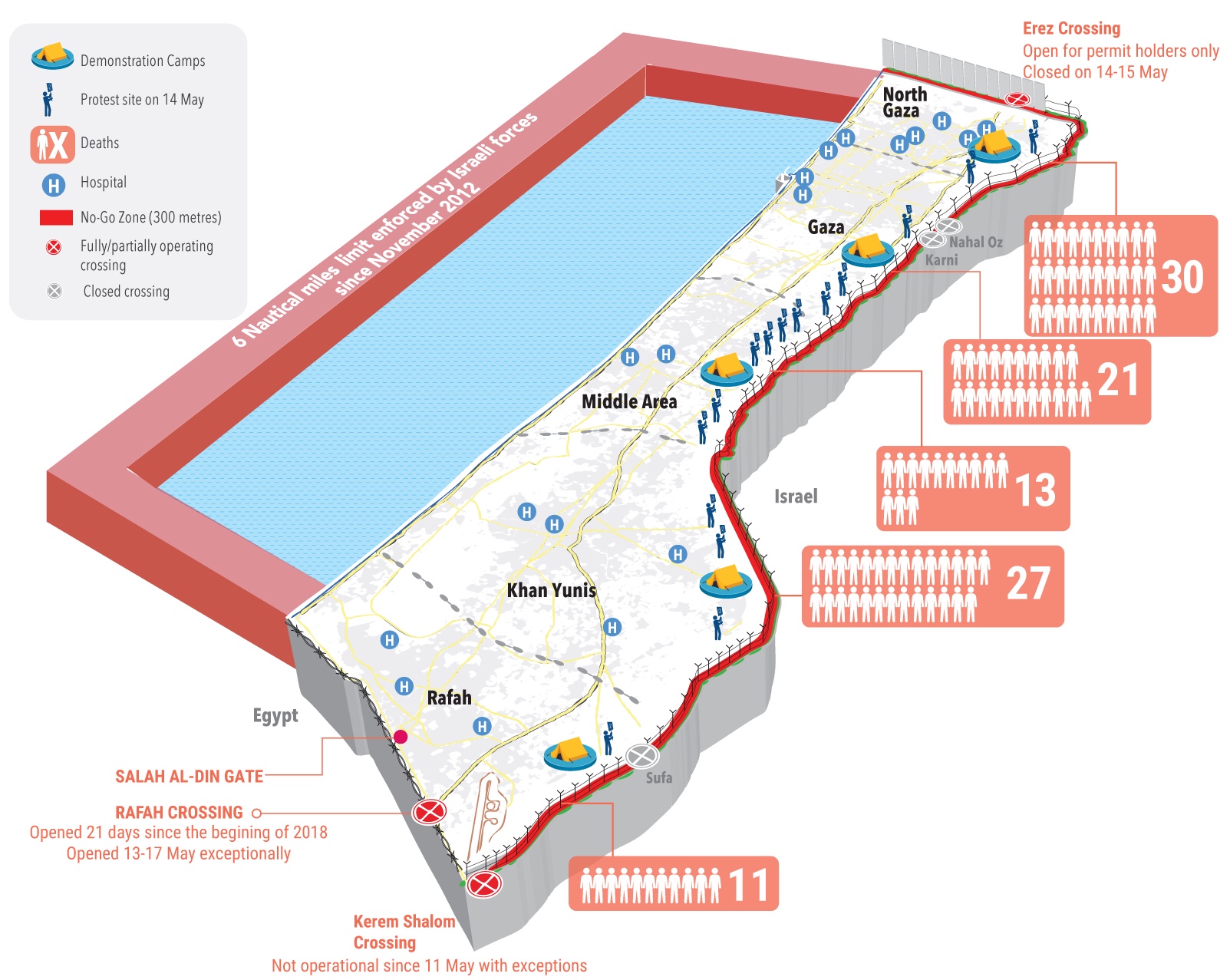
    Since 30 March 2018, the Gaza Strip has witnessed an enormous increase in Palestinian casualties in the context of mass demonstrations taking place along Israel’s perimeter fence with Gaza. The demonstrations have occurred as part of the ‘Great March of Return’, a series of mass protests, expected to continue up to 5 June. The large number of casualties among unarmed Palestinian demonstrators, including a high percentage of demonstrators hit by live ammunition, has raised concerns about excessive use of force by Israeli troops. Gaza’s health sector is struggling to cope with the mass influx of casualties, due to years of blockade, internal divide and a chronic energy crisis, which have left essential services in Gaza barely able to function.

    2018: May – massacre in Gaza

    This is a serious violation of international humanitarian law, acts of pure terrorism – of intentional lethal military action against peaceful protesting civilians to provoke fear.

    This is not at all about Israel ‘defending itself’.

    The demonstrations by the Gazans have been peaceful – peaceful in the sense that they posed zero threat to Israeli life – peaceful therefore even whilst throwing some stones and flying some flaming kites over the fence.

    Since international humanitarian law is being violated the UK government should revoke licenses for the sale of arms to Israel.

    Amnesty International has called for an arms embargo.

    I quote from a letter sent by my MP Douglas Ross dated 14/5/2018:

    A license would not be issued if there was a clear risk that any exports might be used in the commission of a serious violation of International Humanitarian Law

    So, even in a conservative MP’s own words, the arms licenses for sales of arms to Israel should be revoked immediately.

    as MediaLens put it:

    1. Israelis Deliberately Killing Palestinians, Including Children

    A recent media alert highlighted the mass killing and wounding of Palestinians in Gaza, including children, by Israeli armed forces in what the media often describe as ‘clashes’. Before the latest major massacre on May 14 (see below), Israeli forces had already killed over 50 Palestinian protesters and injured over 5000, including 1700 by live fire, during Great March of Return protests that began on March 30. UN Special Rapporteur Michael Lynk condemned Israel’s actions as violations of international law.

  • 2018 – Apartheid Israel and Gaza

    An open letter to our local MP, conservative Douglas Ross.

    The United Nations Office for the co-ordination of Humanitarian Affairs (UN OCHA) has summarised the ongoing tragedy:

    Since 30 March, 41 Palestinians, including five children, have been killed by Israeli forces during the course of the demonstrations. In addition, 12 Palestinians were killed during the same period in other circumstances, including five shot at the fence or after crossing into Israel, whose bodies are reportedly withheld by the Israeli authorities. The cumulative number of injuries has exceeded 9,800, of whom nearly 5,000 have been hospitalized. As of 4 May, at least 169 health personnel had been injured and 18 ambulances damaged, according to the MoH in Gaza.

    The UN Secretary General has called for an independent investigation. The Israeli government is responsible for the deaths of Gazans ‘armed’ only with symbolic slingshot. It’s excuse – the need to protect Israel from invasion. Really?

    As Amnesty International says, there must be an immediate boycott on selling military equipment to Israel.

    The Israeli government is fuelling global instability – it is no ally of the people of the UK or anywhere else.

    The Israeli government demonises the secular and Shia neighbouring states, and illegally occupies the Golan Heights (with its oil reserves and links to the Murdoch and Rothschild empires through Genie Energy). It is inciting war in order to pursue its racist, expansionist and profiteering aims.

    I think that there is increasing local UK and global awareness of the increasingly destructive nature of the Apartheid government in Israel. And, that politicians who wish to be re-elected would be wise to increasingly acknowledge this and to begin to publicly withdraw support from Israel. For example: Make public your criticism of and resignation from Conservative ‘Friends of Israel’, make a plea for military sanctions, and support BDS.

    Future conservative political power may well depend upon a willingness to acknowledge and call for an end to Israel’s apartheid policies and unacceptable actions.

    Specifically, will you support a) Amnesty International’s call for a military boycott and b) the UN General secretary’s call for an independent investigation into the murders in Gaza?

  • The reification of Palestine and Israel

    Interesting post from Eyal; provokes thoughts about when language reveals ‘white privilege’, racism, and the impossibility of ever being in the ‘other’s ‘ shoes (perhaps the impossibility of the sexual relationship too, obliquely anyway).


    Eyal's avatarTruth from Eretz Yisrael

    I love Tamer Nafar. What an excellent performer! I love his music and his politics. Never spearing his audience the burden of politics, and the multilayered difficulty of being a Palestinian, combining criticism of the West and Israel, with that of Palestinian society, and of those observing it. I thoroughly enjoyed his show last week, which was part of his UK tour, where he tried new electronic material, this time in English. It was a huge hit, if you ask me. Very different to his previous works, and really taking his art to the next level, upping the game and giving the audience an extraordinary time.(*)

    But what was particularly evident for me in comparison to previous DAM songs, is that it really expressed more forcefully how tired he is of it all, and how he just wants to live his life and be happy. Aren’t we all!? The best…

    View original post 434 more words