Category: Uncategorized

  • de-radicalisation or proselytism in the name of `Western Terror’?

    Tonight, 13/02/2017, on radio 4 news BBC, I heard that “a de-radicalisation expert” is going to be commissioned to intensively counsel  a 17 year old “neo nazi”  arrested for making a pipe bomb in Bradford.  So, …. how can a person’s belief system be overturned by a de-radicalisation programme? In the past forced conversions have taken place but have just been a sham with no change in sincerely held beliefs taking place, one example of this may even be the family of the philosopher Spinoza forced to convert to Christianity in Portugal but which then fled to the more liberal Dutch city of Amsterdam in the 1600s.

    What is an expert on de-radicalisation and what do they do and how do they do it? What assumptions are they making about the nature of radicalisation? Is a radical a modern form of heretic? And is the expert a proselytiser?

    In September 2016 six men were charged with trying to join ISS.

    Next week, an expert will take the stand in a federal courtroom in Minneapolis and take us inside the minds of six Minnesotans who have admitted to trying to travel to Syria to join the Islamic State.

    Daniel Koehler, director of the German Institute on Radicalization and De-radicalization Studies, is playing a pivotal role in the fate of the would-be jihadis at the center of the high-profile terrorism conspiracy case in Minnesota. On Tuesday and Wednesday, he will testify regarding the de-radicalization assessments he conducted on six defendants.

    “My only goal, my task, my position in this, is to understand why these persons came to the point that they were willing to go and become a member of ISIL,” Koehler said, using another term for the terror group ISIS.

    Koehler specializes in reversing radical ideologies. He leads a nonprofit institute in Germany, and in the past, has worked with neo-Nazis. Now, he’s increasingly focused on pulling ISIS supporters out of the terror group’s orbit and was brought in to work on the Minnesota terrorism case by Judge Michael Davis.

    The ‘expert’ says some of the prisoners might not be safe to release after a prison term, perhaps this attributes him with the power to make people safe again.

    And he said he believes at least one defendant still poses a threat to the public.

    “Let me say, there are individuals in that interview sample who I regard as still being at medium-to-high risk,” Koehler said.

    Koehler’s ultimate goal is to eliminate that risk because he said he believes lengthy prison sentences alone will not end the extremist threat.

    Forced conversion has a terrible history going back centuries across the globe, and radical islamists have been held responsible for recent examples

    With the de-radicalisation experts are we witnessing another example of proselytism?

    What if ‘we are the bad guy’? What if it is the neocon and its deep state that is radicalised : scapegoating Islam and other ‘non-white’ peoples.

    Both pro- and anti-Trump factions of the Deep State are in denial of the fact that this escalating crisis is due, fundamentally, to the global net energy decline of the world’s fossil fuel resource base.

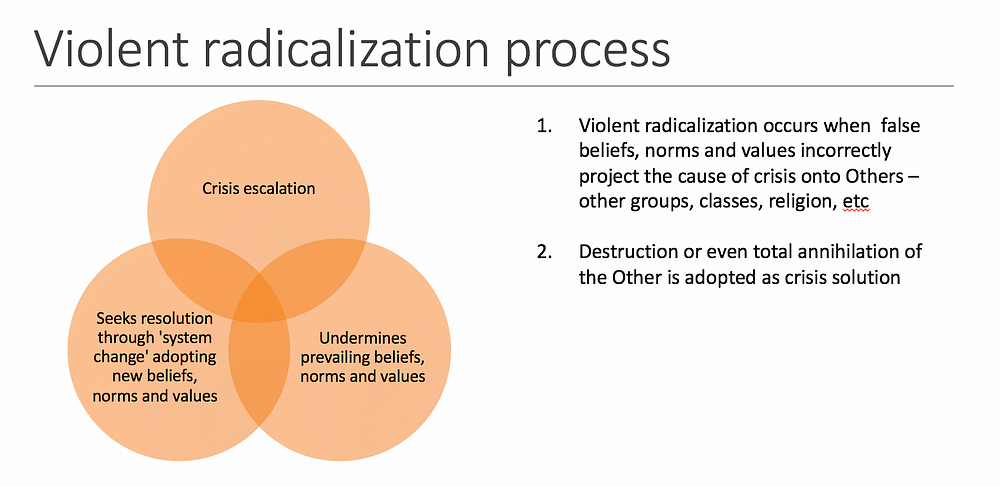
    In a time of fundamental systemic crisis, the existing bedrock of norms and values a group normally holds onto maybe shaken to the core. This can lead a group to attempt to reconstruct a new set of norms and values — but if the group doesn’t understand the systemic crisis, the new construct, if it diagnoses the crisis incorrectly, can end up blaming the wrong issues, leading to Otherization.

    https://cdn-images-1.medium.com/max/1000/1*Uyj6poeFIvQT09MrW4en3w.png

    The ‘radical’ is a rhetorical device that functions as a Master Signifier that lends power and authority to the idea that the radical is 100% wrong and importantly, therefore, we are 100% right.  This ‘de-radicalisation programe’ acts rhetorically to convince the public of the innate evil in the other and represses  awareness that anti-West feelings are aggravated by the West’s political support for racism and oppression home and abroad?

    Is it hard to believe that a radical will be converted, and made safe, by ‘counselling’ and family therapy?

  • The Northampton Peasant Poet

    John Clare : Died 1864 after over twenty years in a lunatic asylum.

    Wrote this whilst there:

    I am

    I am: yet what I am none cares or knows,

    My friends forsake me like a memory lost;

    I am the self-consumer of my woes,

    They rise and vanish in oblivious host,

    Like shades in love and death’s oblivion lost;

    And yet I am! and live with shadows tost
    Into the nothingness of scorn and noise,

    Into the living sea of waking dreams,

    Where there is neither sense of life nor joys,

    But the vast shipwreck of my life’s esteems;

    And e’en the dearest–that I loved the best–

    Are strange–nay, rather stranger than the rest.
    I long for scenes where man has never trod;

    A place where woman never smil’d or wept;

    There to abide with my creator, God,

    And sleep as I in childhood sweetly slept:

    Untroubling and untroubled where I lie;

    The grass below–above the vaulted sky.

    The latest In Our Time with Melvyn Bragg suggests, in and amongst, a tale worthy of some psychoanalytic  interest. Did he become mentally disrupted  because of the Enclosure Acts:  a series of United Kingdom Acts of Parliament which enclosed open fields and common land in the country, creating legal property rights to land that was previously considered common. These were consolidated in 1845: and allowed for the appointment of Inclosure Commissioners who could enclose land without submitting a request to Parliament.

    The story goes that John’s poetry illustrated an exceptional connection with the nature in his locality and countryside. Big trees and streams had names and were part of the community. But suddenly with the latest Inclosure Act his access was restricted – and for example well known  big trees were cut down just for profit by the landowners.

    Is it possible his ‘mental decline’ and delusions – in which he adopted the identity of poets like John Byron ‘with the confidence to be attractive to women’ – wa the result of a reverse crisis of investiture – the destruction of a material symbolic network of natural signifiers that in a way spoke to him and stabilised his sense of identity for him. Was his writing a symptom of this extraordinary relationship with nature.

    Perhaps psychosis can be triggered by a crisis of investiture for a form of subjectivity  already on the edge, as suggested by Santner in My Own Private Germany about the German judge Schreber. He  became psychotic – and whose copious and elaborate writings of his delusions were famously analysed by Freud (who attributed his breakdown to a suppressed homosexuality).

    Joyce’s writings it is often suggested may have been a symptom to deal with his own relationship with the symbolic, maybe Clare also wrote to stabilise.

    Clare’s wife never visited him once in the 24 odd years he was looked after in the asylum. He once walked the 80 miles back to his village.

    It’s kind of sobering to think about the harms caused by industrialisation and the expansion  of private property so well described by Marx.

  • Shared Decision Making and Overdiagnosis as Illusory Developmental Psychologisation

    ” …Additionally, the suggestions from some women that overdiagnosis would be relevant to their decisions only if they were actually diagnosed with a screen detected cancer reveal a concerning misconception that a screening mammogram is a separable event from the cascade of investigation and intervention that may be triggered by an abnormal result. This highlights the need to explain clearly to women that once cancer is detected, evidence based treatment is virtually always indicated because potentially threatening cases cannot be differentiated from those representing over diagnosis.” Women’s views on overdiagnosis in breast cancer screening: a qualitative study  Hersch J e al BMJ 2013;346:f158

    This quote is from a paper looking at women’s reactions to being told about the possibility of over-diagnosis from breast cancer screening, and how it might influence their decision about whether to be screened. Notice how, not always, but often, that knowing about over diagnosis did not dissuade from a decision to be tested, but that the women then thought that they could use that information to make a decision about whether to have treatment if tested positive. The comment about ‘ … making it clear that once diagnosed treatment is virtually always indicated’, suggests this attitude of the women doesn’t meet with the approval of the researchers who, despite the possibility of over-diagnosis, would seem to ‘insist’ on compliance with treatment.

    How does this narrative fit with a Lacanian structure for discourse and subjectivity? Is there a suggestion here that some signifiers are being rendered meaningless and repressed into the unconscious?

    “The temporal relation between past and present is something that is constructed and reconstructed by the subject in ways that will defeat any developmental account that tries to define how particular events in the past will have psychological sequelae. “Psychology After Lacan by I Parker 2015 p 21

    “What is realised in my history is not the past definite of what was, since it is no more, or even the present perfect of what has been in what I am, but the future anterior of what I shall have been for what I am in the process of becoming.” (Lacan cited in Parker, 1956/1977b:86 – The Seminar of Jacques Lacan: The Four Fundamental Concepts of Psychoanalysis)

    EBM’s and NICE’s shared decision making discourse can be conceptualised as a kind of developmental psychologisation of the ‘client’ and clinician. The normative idea is that information can be presented as ‘full’ – leading to a subsequent fully informed decision. There is discourse of a process by which the client ‘develops’ as a fully self aware subject, into a more knowledgeable client, able to, as is well known, ‘make the right choice for them’, implicitly responsibilisng the client, and justifying the testing process.

    If I ‘shall have been over-diagnosed’, but the test promises surplus life then  how can I make sense of contemplating the test?

    But for Lacan – each moment of action recreates subjectivity anew not dependent in a linear way on what has gone before because of the necessity for sense making and the role of the unconscious – for example: to be told about overdiagnosis and then told to decide about a test means that the client has to imagine how he shall have been overdiagnosed (a future anterior tense) – thrust into a relationship of equivalent use value of outcome with the use value of the test, with the full glare of its accuracy and inaccuracy laid bare, but in capitalist healthcare such a certainty about equivalence is a certainty about mortality and is in effect forbidden in order to to sustain the sense of the offer of the test underpinned by state/scientific/medical authority, and the test as a commodity in a capitalist economy that promises surplus semantic and economic value. So even though fully informed in the past, the action is to have the test anyway and if positive to presume it is a true positive because the future anterior possibility of dying is repressed into the unconscious in the process of becoming (a compliant patient)

    Mapping onto Lacan’s structure of discourse

    In this diagram we can map this narrative onto the University discourse structure. Here S2 is the ‘all knowing’ NICE diktat, result of the so called ‘independent review’ that concluded screening is ‘good’. S1 is the screening test itself as authentic and as always providing a true result,  it is the ‘truth’ that drives S2. ‘a’ is a subversive-impact factor imposed on the discomfort the client feels when told about over-diagnosis, or at least suspects the test’s threat to life. There is a necessary repression of the idea of over-diagnosis into the unconscious, and this takes place in the ‘work’ or ‘clinical labor’ to coin Wallaby’s phrase, to create a subject $, that believes in the fantasy of the perfect test and therefore complies. The researchers insistence on treatment if the test is positive sustains the fantasy of the test result as always perfect and requires the clinician’s repression of over diagnosis post hoc as well.

    image

  • A curious copulation

    Science and capitalism “a curious copulation” (Lacan)

    With acknowledgements to Ian Parker’s “Psychology after Lacan” which is a great source of fundamental Lacanian thought. 

    EBM and capitalism must be analysed together – and the analysis should address the issue of Too Much Medicine. 

    The approach here starts with the question of human subjectivity, and the thesis is that the human’s consciousness in capitalism is shaped by social relations which includes the means of production and subsistence through exchange for profit. 

    The argument relies on a philosophy of consciousness as lacking, and of language as the public/social symbolic structure in which the subject thinks and makes sense of communication but can never master. 

    This in turn relies on the idea of this symbolic language as a social public domain of ungraspable meaning as our unconscious which sits alongside and affects consciousness but which is unable to communicate to us directly through language but only indirectly through slips and patterns of speech and behaviours. 

    In this philosophy the human subject is never where he thinks and is always partly public and always partly historically constituted. 

    Our unconscious holds that which had become non-sense because it conflicts with what we must believe to make sense of the communications we live by and through. Our relation to knowledge as a truth is always a relation in the line of the imaginary and a misrecognition. But this doesn’t means anything holds …. the social relational and productive structures of a given time limit what can be held to be true. 

    For example innovation is good versus innovation is bad is  a false road to take -and to claim one or the other is to neglect the manufactured consent to the unequal distribution of vulnerabilities and discounts hospitality for the stranger, it would be an a priori kind of truth regime. There is no truth here about knowledge production being good or bad – it’s what is done with it and the nature of the ‘truth’ basis for the fantasy in the line of the imaginary and the social-political effects that has on oppression that matters first. 

    Intellectual insight is not all of knowledge – belief is important here. 

  • Lacanian Discourse Analysis – notes

    SEMINAR FEB 2017:There’s the unconscious and then there’s what becomes ungraspable as meaning i.e. becomes non-sense. What does become ungraspable depends on the structure – the alienation from our real existing conditions – social relations is an extra level of alienation and Lacano-Marxism might say this is something unique about our – capitalist block.

    (more…)

  • Compassion also can be prey to the ideological

    Iona Heath has just published a very well crafted piece in the BMJ …..

    http://www.bmj.com/content/355/bmj.i5705

    critiquing preventive EBM’s ‘ludicrous’ claims for efficacy, and calling for more patient awareness of life’s intrinsic uncertainties, and calling for more ‘humanity’ – attention to those parts of medical practice not captured by the biomedical science map. I fully endorse these ideas and as a GP myself for over 25 years have witnessed and accompanied folk on those non EBM-calculable lives. 

    What is interesting is that she alludes to the value of non-biased EBM, as if this is a possibility.   But isn’t this to ignore the original bias in Descartes’ Cogito, the faith in a benign God, that presumes the primacy of the ‘mind’ over the Body?  This original ideological bias is what fulfils EBMs primacy over medical practice. The fundamentalism of EBM and capitalism’s desire for surplus have combined to create the destructive juggernaut we witness today. 

    Science is not an innocent, and language and words do not just open emotional avenues for compassion. And compassion, whilst essential, is always prey to the ideological. 

    In addition we need to raise medical professional awareness of capitalism’s (ideological) corrosive powers, that function through EBM, and a deeper sceptical and political perspective.  If I were to suggest anything extra,  it would be that medical students should be introduced to alternative philosophies, and to a primer on media literacy.

    (more…)

  • Now, can we think of a world without numbers?

    Eyal asks this question, “Can we think of a world without numbers?”

    In response to Eyal’s blog Homo numeralous: Decimal literacy and modern everyday digit normalcy .

    I argue that in the capitalist block, whilst we can have agency and resist the dominant narratives that use numbers to entice us to continuously labour for wages, to be exploited and to consume, we can only do this within the limits of our historical block ( to use Kordela’s expression in ‘Being, Time and Bios, 2014), which are set by a Cartesian ‘certainty’ at one pole and ‘radical uncertainty’ at the other. Not ‘knowing’, is not an option, even with the best ‘will to truth’ in the world, surplus knowledge is desired, and there is no meta-desire state.

    Eyal suggests that,  thinking :

    ….   about numbers through technological determinism, as a technology, a device, that has come to shape more than science or math, that organises knowledge/sense in the broadest sense. That we don’t only use numbers to think, but that we think numbers, or think numerally, period. That to think is to number/enumerate and the other way around.

    and suggests:

    ….  the hypothesis that this ‘numbercy’ is not meaningless, but that numbers literacy in particular brought an epochal global order, or a shared language ….

    I agree that the ‘numbercy’ is not ‘meaningless’, and that numbers literacy helped to bring about a global epochal order.

    But I think numbercy as technological determinism requires other additional forms of consciousness and social structures.  I think that Descartes’ cogito, ensured a sense of a human subject that has an independent mind (or consciousness), free to choose his own destiny, and that this kind of ‘thinking freedom’ ruled the market place where the labourer is free to sell his labour to his legally equal partner in this exchange, the buying capitalist.  Both money as the universal equivalent, and the exploitation of waged labour, have led to the desire for surplus value, and it is this desire and the search for satisfaction that  provides jouissance and ‘meaning’ for our lives, and this is dependent upon ‘numbercy’.

    The capitalist epoch produces and depends upon surplus value through exchange, and this is only possible through numerical calculability (and forms of money), all other thought and representations become increasingly exploited as commodities and in the process are enumerated. And this includes things like affect, happiness, mental health, risk of future disease, and so on.

    As Lacan suggested, once jouissance becomes calculable ‘this is where the accumulation of capital begins’.

    The digital ‘byte’ infinitesimally divides and multiplies, and can (through computerised algorithmic machines),  transform the body itself through degradation and re-constitution, into a numerical signifier of, say future risk of biological disease, it is abstract, and as digital, infinitely malleable, as a kind of zero-institutitional-form that enables the inauguration of the digitalised symbolic exchange of ‘risk’ for technology consumption.

    I am interested in how ‘risk’ is digitalised as a malleable industrial commodity, ‘shape-changing’ to ensure sufficient desire is induced by those ‘paying’, or ‘paying-on-behalf-of’ others.

    I am interested in how ‘evidence’ on cost-effectiveness uses QALY data, where the QALY is the necessary but impossible zero-institutional-form for symbolic (semantic and economic) exchange in the market and science fora.

    I am interested in how neoliberal governmentality ‘speaks’ discourse that pushes any limits on expenditure ‘out of language’, so that there shall be no threshold to the sacrifice of cost and effectiveness, to ensure continued production of surplus (value, semantic and economic).

    The numbers we voraciously consume speak to a chain of sliding signifiers, where each signifier, in turn, provides an ‘enjoyable’ sense of anticipation in its implicit promise of satisfaction through (numerical) knowledge, but doomed to fail of course so that, without pause, we move onto the next signifier.

    In capitalism we cannot think outside numbers, the calculable, all value is calculable. The number exchange is the vehicle for the search for what we desire.

  • Middle East – an outsider’s view from the UK

    Middle East

    I must confess, I’m a white male older middle aged academic type, of British and Irish citizenship, inclined to distrust the British government, politicians and the media. I believe that politics is firmly in the grip of international business, and by this I don’t mean Jews. Just capitalists. 

    The Middle East conflicts seem to be escalating and heralding  a major clash between the US and Russia, which could annhilate us all.  Israel will no doubt see fit soon to re visit Gaza as well.  

    This whole Middle East scenario is massively confusing, and we are fed all sorts of propaganda, so that in the end it is tempting to just throw up our hands and give in to uneasy confusion. But the least we can do is to expect that lies and hypocrisy from our own parliament will be challenged. 

    The targeting of the Assad government, i.e. particular ‘this’ Assad government, only makes sense if it is seen as part of a western backed corporate attempt to secure future business by ‘piggy-backing’ onto a Shia Sunni war, and wahabist expansionism.  It only make sense in this interpretation because there seems to be no sense otherwise that can explain why, for example, the western powers did not call for a no fly zone over Gaza during the last ‘mowing of the grass’ in which many children were killed in war crimes. Or, for example, that could explain why there has been no call for a no fly zone over Yemen, in the midst of a criminal acts of murderous proportions. If Assad is a tyrant responsible for a popular Arab uprising, by his cruelty to minorities, then that is of concern, but could, as with other nations, be addressed through non-violent means, which could include pressure to stop the flow of arms to ISIS elements in Syria. It is difficult to know whether the military opposition to Assad in Syria is led by ISIS, or so called moderate (and by implication therefore, justifiable) rebel resistance. If ISIS is involved – and if ISIS has the destructive and expansionist ideology claimed for it then it would be reasonable to attempt to starve it of military power. 

    One thing though, in and amongst the swamp of lies that is dragging us down to global destruction, the swamp is particularly nauseating here, at home, where the government, ‘in our name’ speaks in the already discredited voice of warmongers like Boris Johnson, pontificating in parliament as if he were some kind of latter day Churchill. His, and parliament’s pathetic debate on Syria, its deceptive manipulation of the narratives sold to the public, is what makes me really angry. According to ‘our’ parliament – Assad is the only villain, and Russia the ‘pariah’, talk of diplomacy is ridiculed, talk of Israel/Saudi US/NATO war crimes treated as treasonable. Only a corporate global kind of banking war (perhaps mainly over energy raw materials), piggy backing onto a Shia/Sunni and wahabist uprising, can explain this degree of hypocrisy.